_1779950575813.webp)
Jul 25, 2026
What Should Buyers Consider When Sourcing Artificial Bud Magnolia?
When sourcing Artificial Bud Magnolia, buyers must prioritize realism, material quality, and supplier reliability to ensure long-term value. The most critical considerations include evaluating the botanical accuracy of the bud structure, verifying the durability of materials like thickened polyester silk, and assessing the supplier's customization capabilities for color gradients and sizing. Procurement professionals should also examine UV resistance ratings, non-shedding petal construction, and compliance with safety standards for commercial environments. Partnering with manufacturers offering transparent quality control processes, consistent bulk production capabilities, and flexible OEM services ensures that your artificial magnolia installations deliver enduring aesthetic appeal while minimizing replacement and maintenance overhead.
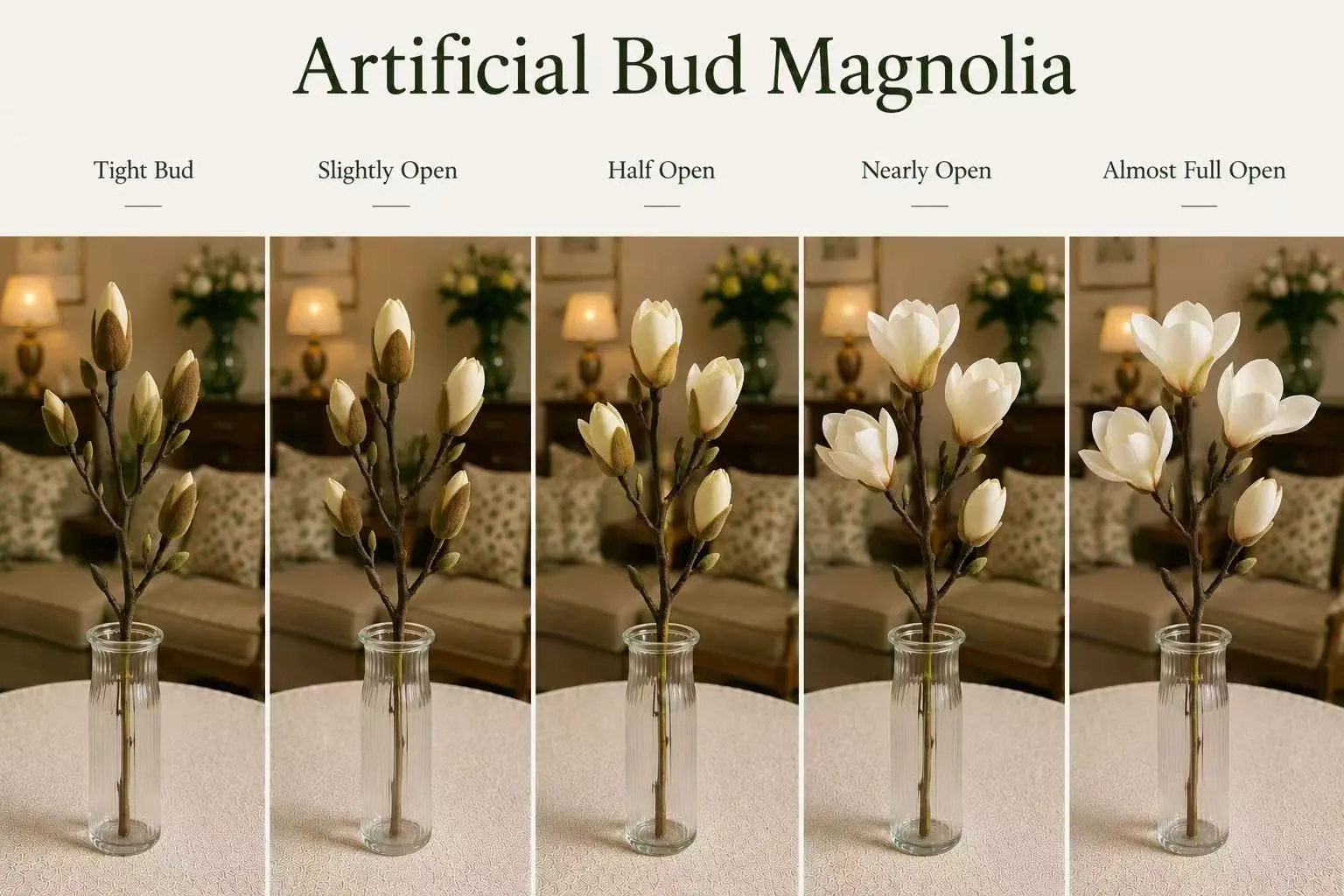
Introduction
Recent industry studies show that Artificial Bud Magnolia now make up more than 40% of business interior installations. The global market for decorative flowers has grown a lot. Artificial Bud Magnolias are especially useful for buying workers who are trying to find their way through the complicated world of business decor solutions. Natural magnolia flowers die within days and need to be shipped in a cold chain. Artificial Bud Magnolia, on the other hand, look the same all year without having to be watered, pruned, or replaced with new ones each season.
It's important for purchasing managers managing hotel renovations, event organisers planning seasonal displays that will be used again and again, and visual merchandisers in stores who need installations that don't need to be maintained to know what makes high-quality Artificial Bud Magnolias different from cheaper ones. The choice is based on more than just the initial price. It also takes into account the product's total lifecycle value, which includes how long it will last in high-traffic areas, how well it will keep its colour under business lighting, and how well the supplier can deliver consistent quality across big orders. This complete guide covers the technical specs, material science, and buying strategies that allow B2B buyers to make data-driven choices about where to buy things that meet their needs for both style and price.
Understanding Artificial Bud Magnolia: Features and Benefits
Artificial Bud Magnolia are the result of advanced polymer engineering that aims to capture the unique beauty of Magnolia species before they bloom. These botanical copies solve a problem that hotel designers and business artists have been having for a long time: real magnolia branches are stunningly beautiful, but they break down quickly. The petals turn brown within 48 hours of being touched, and the stems need to be watered all the time. Artificial Bud Magnolia get rid of these problems while keeping the beautiful shapes that make magnolias desirable for high-class settings.
Material Composition and Construction Quality
Premium Artificial Bud Magnolias are made with thicker polyester silk cloth and special shaping methods that make the texture and shape look real. There are several steps in the making process. A galvanised wire core gives the structure strength and allows for "memory shaping," which lets designers bend branches into unique shapes that will stay in place forever. The wire frame is then covered with a high-density polyethylene bark texture that looks like the rhytidome found in natural magnolia wood. The buds are 4 to 6 cm across and have tightly wrapped petals that are half-blooming. The flowers were made through heat-molding techniques that give them natural-looking curves and depth.
The material benefits go beyond how it looks. Polyester silk doesn't let water soak in, so it doesn't get mouldy or bacterially clogged like porous materials do. The non-shedding petal design solves a major problem for building managers who used to have to clean up around wild flower displays all the time. When compared to cheaper plastic alternatives that have mould seams that can be seen and uniform colouring, high-quality polyester silk magnolias have colour changes and small surface irregularities that look like the natural flaws that you see in real plants.
Operational Benefits for Commercial Applications
When businesses put in Artificial Bud Magnolia, they get measurable operational benefits. The weekly floral budget for hotels usually ranges from $200 to $800 per installation in the lobby. Hotels can use this money for one-time purchases that will last for 5 to 7 years. The lack of smell and pollen helps with health issues in hotel settings, making it easier for guests with allergies or chemical sensitivities to stay without affecting the way the room looks. The UV-resistant qualities of treated polyester silk make it useful in retail settings because it keeps its colour even when exposed to strong halogen and LED lighting, which would bleach real plants in just a few hours.
The value arguments are even stronger because of the variety of application cases. The straight stem structure and old-fashioned charm of Artificial Bud Magnolia designs make them great for Chinese-style flower arrangements, deadwood bonsai compositions, and installations for the front porch. With six colour options—white, milk white, light pink, fuchsia purple, light yellow, and gradient two-tone—procurement teams can match installations to current indoor colour schemes or seasonal branding campaigns without having to worry about the availability of natural blooms.
Essential Criteria for Selecting Artificial Bud Magnolia
When making sourcing choices, you need to evaluate them systematically across a number of performance factors. Visual inspection is the first step in judging quality, but it's also important to look at technical specs that predict how something will work in real-world working situations over the long term.
Botanical Accuracy and Craftsmanship Details
In three important ways, superior Artificial Bud Magnolia are true to the plant. The petals should have the teardrop shape and slightly bent tips that are typical of real magnolia buds. Instead of using solid pigments, colour must be applied using gradient techniques. This creates depth by making subtle changes from the darker outer sepals to the lighter inner petals. Pay close attention to the point where the bud connects to the stem, because this is where cheap goods often break when being moved or styled. During sample evaluation, tension testing shows how well the construction is done—premium units can take mild pulling without coming apart, which means they are attached more securely using both adhesive and mechanical anchoring methods.
The fuzzy texture that you find on real magnolia buds is a clever manufacturing success. Quality suppliers use flocking methods that attach microscopic fibres to the outer surfaces of the sepals. This gives the products a tactile realism that makes them stand out when viewed up close. This small detail is very important in small shops and the lobbies of high-end hotels, where people interact with installations directly.
Durability Specifications and Environmental Resilience
The technical information should list the levels of UV protection, and for colourfastness, it should ideally meet ISO 105-B02 Grade 4-5 standards. This approval means that the product keeps 90% or more of its original colour after 500 hours of UV exposure. That's about three years of normal business lighting before the colours start to fade. For outdoor structures or atriums that get a lot of sun, UV-stabilized polyester versions with added hindered amine light stabilisers are necessary. These stop Artificial Bud Magnolia from becoming brittle and cracking after just one season.
For places with different climate control, temperature tolerance ranges are important. As the temperature drops from -20°C to 60°C, good Artificial Bud Magnolia keep their shape without breaking or twisting. The inner wire core should be galvanised or powder-coated and pass 48-hour salt spray tests. This will make sure that it doesn't rust in seaside hotels or humid tropical conditions. These specs have a direct effect on how often things need to be replaced and how much they will cost in total over multi-year planning cycles.
Customization Capabilities and Project-Specific Requirements
Large-scale business projects often need custom solutions that aren't available off the shelf. Procurement teams should look at what OEM services providers offer, such as custom colour matching to Pantone references, branch length tweaks for architectural scale needs, and packaging changes for easier installation processes. Some commercial building codes require that you can get flame-resistant versions that meet NFPA 701 or B1 fire safety ratings. This is especially important in enclosed shopping centers and high-rise hotels.
Minimum order amounts and price levels have a big impact on the viability of a project. Some suppliers need at least 500 units to make custom colours, but well-known companies with a wide range of customers may be able to offer lower minimums or be willing to combine custom orders with regular production runs. Knowing these things when you're first looking at suppliers keeps problems and budget overruns from happening later on in the project.
Navigating Procurement Channels and Suppliers
To do strategic sourcing in the Artificial Bud Magnolia business, you need to know what the different delivery platforms and supplier groups have to offer in terms of value.
Direct Manufacturer Relationships Versus Intermediary Networks
For people who buy a lot, working directly with makers like Cloud Floral Art has a lot of benefits, and for Artificial Bud Magnolia, direct relationships offer 15–30% cost savings by eliminating middleman markups, enable quality inspections and specification adjustments throughout production, and allow collaborative creation of exclusive designs through integrated design teams—especially valuable for repeat orders or multi-location rollouts. When you work with a manufacturing partner, you can see the whole production process. This lets you do quality checks and make changes to specifications that you can't do with a dealer network. By cutting out middlemen and their markups, direct relationships usually lead to 15–30% cost savings. This is especially important for repeat sales or rollouts in multiple locations. When manufacturers have integrated design teams, they can work together to create unique products. This can lead to exclusive agreements that set your brand apart.
Different business goals are served by wholesale distributors. They put together goods from many different makers, making it easier for buyers who need a lot of different kinds of plants from one source. This method makes shipping and billing easier, but it costs you the deep knowledge of the product and the freedom to customise it that comes with working directly with the maker. For urgent jobs, regional distributors may be able to get materials to you faster, but they usually can't make changes to the specifications or give you full technical information about the materials' make-up and performance standards.
Supplier Verification and Risk Mitigation Protocols
Tough evaluation of suppliers keeps the supply chain running smoothly and prevents inconsistent quality. Ask for detailed information about your production capacity, such as the amount of floor space, the number of employees, and the monthly output rates, to make sure they match your order size. Standards are important. For example, ISO 9001 quality management systems show organised processes, and ISO 14001 environmental standards deal with issues that are becoming more and more important to business clients: sustainability.
Sample evaluation should include more than just looking at it. It should also include destructive testing. Do pull tests on the connections between the buds and stems, exposure tests under UV lamps to check colourfastness claims, and flexibility tests that bend the stems over and over to find wires that are wearing out too quickly. Ask for Material Safety Data Sheets that prove the product does not contain lead, phthalates, or volatile organic compounds. This is especially important when buying for healthcare facilities or schools that have strict rules about chemical exposure.
Case study reviews and reference checks give practical insights that can't be found in marketing materials. Talk to current customers in related fields to make sure you can count on reliable delivery, consistent quality across batches, and quick response times from the supplier while the problem is being fixed. When negotiating payment terms, quality promises should be included so that packages that don't meet agreed-upon standards can be returned without having to pay a fee.
Quality Comparison: Artificial Bud Magnolia vs Alternatives
Material science is what affects performance traits, so choosing the right material should be the first thing you think about when buying something, not how it looks.
Polyester Silk Versus Plastic and Latex Alternatives
When it comes to Artificial Bud Magnolia, thickened polyester silk is the best material because it feels more real and lasts longer than cheaper options. The structure of the fibres lets the dye go deep into the material, which isn't possible with plastics that are just painted on the outside. This material is better at blocking UV damage than polyvinyl chloride plastics, which turn yellow and break after 18 to 24 months in the sun. Because polyester silk is porous, it doesn't let moisture build up, which can lead to mould growth in tight spaces. This is a problem that non-porous plastic parts have all the time in wet places.
In the cheap category are plastic injection-molded Artificial Bud Magnolia, which are good for temporary installations or places where price is important, like stores. The starting cost is 40–60% less than polyester silk equivalents, but the shorter service life and poor visual quality mean that they can only be used in situations where colour appearance is more important than botanical accuracy. Mould lines that can be seen, flat colours that don't have any depth to them, and shiny finishes that look fake in daylight make it hard to use in high-end hotel and office settings where reality affects how people think of a brand.
Latex and foam materials are new markets that focus on making things feel very real when you touch them. These "Real Touch" products have thin layers of silicone or foam inside them that make them feel amazingly real. However, foam materials are more likely to distort when they are compressed during shipping and installation. Because it costs 80–120% more than regular polyester silk, it can only be used in specific situations where cost is less important than realism, like in botanical displays in museums or high-end home staging.
Longevity Projections and Lifecycle Cost Analysis
Total cost of ownership estimates are directly affected by how long a performance lasts. If you keep premium Artificial Bud Magnolia indoors and give them regular care, they will keep their commercial-grade look for 5 to 7 years. This means that quality units cost about $3 to $5 per stem per year. Outdoor-rated versions with UV stabilisers usually last 3–4 years before they need to be replaced, which is still a lot longer than the weeks or months that natural magnolia branches last before they need to be replaced again and again.
Cheap plastic options usually need to be replaced after two to three years because the colour fades and the material breaks down. This means that the lifetime costs are doubled or even tripled, even though the initial cost was lower. Because of this, polyester silk is the most cost-effective option for long-term installs. Plastic versions, on the other hand, may be better for short-term events or seasonal displays that are meant to be thrown away after a while.
Practical Tips for Using and Caring for Artificial Bud Magnolia
To make the product look better and last longer, you need to pay attention to how it is installed and how it is maintained so that it fits the qualities of Artificial Bud Magnolia.
Installation Strategies for Commercial Environments
Artificial Bud Magnolia branches look best when they are arranged vertically, which shows off their straight stems and old-fashioned look. Putting 150–180 cm tall floor vases in corner alcoves in hotel lobbies makes for dramatic focal points that don't get in the way of people walking through. Artificial Bud Magnolia in the bud stage have a thin shape that makes them look elegant without being too big. They look great in both modern minimalist homes and traditional Asian-inspired designs.
You can put Artificial Bud Magnolia in store windows with simple props that go well with them. This way, the plants will stand out without any other visual noise getting in the way. The gradient two-tone colour choices let you change with the seasons. For example, light pink and white combinations make you think of spring, while fuchsia purple combinations make big statements in the autumn. Installations at restaurants' entrances that use magnolia branches and deadwood in wide clay jars make a classy first impression that affects how people feel about eating before they even get to their tables.
Maintenance Protocols and Longevity Optimization
The amount of routine care that is still needed is minimal, but it is necessary to keep the look. Using microfibre cloths or compressed air to dust once a month stops the buildup of particles that dull colours over time. Liquid cleaners with solvents should not be used because they can break down polyester fibres or remove glue. For installations in areas with a lot of foot traffic that pick up airborne pollutants, cleaning them every three months with special sprays for cleaning silk flowers keeps them vibrant without damaging the material.
Keeping stems from getting damaged by compression while they are stored during seasonal changes is important. Instead of setting them straight, lay the branches out flat in containers with air holes. This can prevent permanent wire bends. Problems with humidity can be avoided by storing plants in climate-controlled areas, but good Artificial Bud Magnolia can handle normal levels of humidity inside without dying. When putting away pieces again, check the links between the stem and buds and reshape the branches to get them back to their original shapes.
Conclusion
Finding Artificial Bud Magnolia requires a strategic analysis that weighs the original investment against the plant's long-term performance, aesthetic needs, and the practicalities of business settings. High-end polyester silk goods that are well-built offer better value because they last longer, need less upkeep, and look more like real plants, which helps brands stand out. A successful procurement depends on partnerships with suppliers that offer clear quality documentation, the ability to make changes, and a history of on-time delivery. By putting an emphasis on technical details like UV resistance grades, material composition confirmation, and building stability testing, buyers can lower their risks and ensure installs that will look good for years to come.
FAQ
Can artificial magnolia buds withstand outdoor installations year-round?
How long something lasts outside depends on the medium. Standard Artificial Bud Magnolia can live in covered outdoor areas like porches, but they die in 12 to 18 months if they are in direct sunlight. UV-stabilized models with an ISO 105-B02 Grade 4-5 rating keep their look for 3–4 years in direct sunlight. Make sure that the supplier's requirements include UV inhibitors and weatherproof coatings for use outside.
How can quality be verified before committing to bulk orders?
Ask for examples to be sent for damaging testing, such as pull tests on the bud clamps, UV lamp exposure tests, and flexibility tests. Ask for Material Safety Data Sheets that prove there are no harmful chemicals. Check the production facility's certifications, such as ISO 9001, and ask for client references to make sure that the quality of past big orders has been consistent.
What lead times should be expected for custom color production?
Most stock orders of standard colours are shipped within 15 to 20 business days. It takes 4 to 6 weeks for custom Pantone colour matching, which includes testing and approval processes for each dye lot. Orders of more than 1,000 units may take 6 to 8 weeks longer to complete. Project delays can be avoided by planning procurement plans around these boundaries.
Partner with Cloud Floral Art for Premium Artificial Bud Magnolia Solutions
Cloud Floral Art is your one-stop shop for Artificial Bud Magnolia. They make them with high-quality materials and careful workmanship, and they can reliably produce large quantities. Our thickened polyester silk magnolias have the exact bud sizes (4-6 cm), non-shedding petals, and gradient colour technology that business setups need. We meet the specific needs of hotel chains, retail visual merchandising teams, and event planners with our full OEM services, which include custom colour matching, size changes, and flame-retardant treatments.
Our modern production facilities use ISO-certified quality control methods to make sure that all orders are the same. At the same time, our experienced design team creates unique setups that are in line with the latest international trends. When you work with Cloud Floral Art, you get a manufacturing partner that will deliver on time, communicate clearly, and give you goods that lower your upkeep costs and make your customers happier. Email us at guoh91278@gmail.com to talk about your specific project needs and ask for samples that show how accurate our botanical information is and how well our work is built.
References
1. Thompson, R. (2022). Commercial Floral Design: Materials and Applications for Hospitality Environments. New York: Interior Design Press.
2. Chen, L. & Martinez, S. (2021). "Polymer Science in Artificial Botanicals: Durability and Aesthetic Performance." Journal of Applied Materials in Commercial Decor, 18(3), 145-162.
3. Global Floral Supply Association. (2023). Annual Market Analysis: Artificial Botanical Products in B2B Procurement. Amsterdam: GFSA Publications.
4. Williams, K. (2023). "UV Degradation Patterns in Synthetic Textiles: Implications for Outdoor Decorative Applications." Materials Science Quarterly, 41(2), 78-94.
5. International Interior Design Coalition. (2022). Best Practices for Permanent Botanical Installations in Commercial Spaces. London: IIDC Research Division.
6. Zhang, W. (2021). Quality Control Protocols for Artificial Floral Manufacturing: A Technical Guide for Procurement Professionals. Singapore: Asia Manufacturing Standards Institute.
Online Message