_1779950575813.webp)
Jul 2, 2026
What Makes Artificial Half Bloomed Gladiolus Look So Realistic?
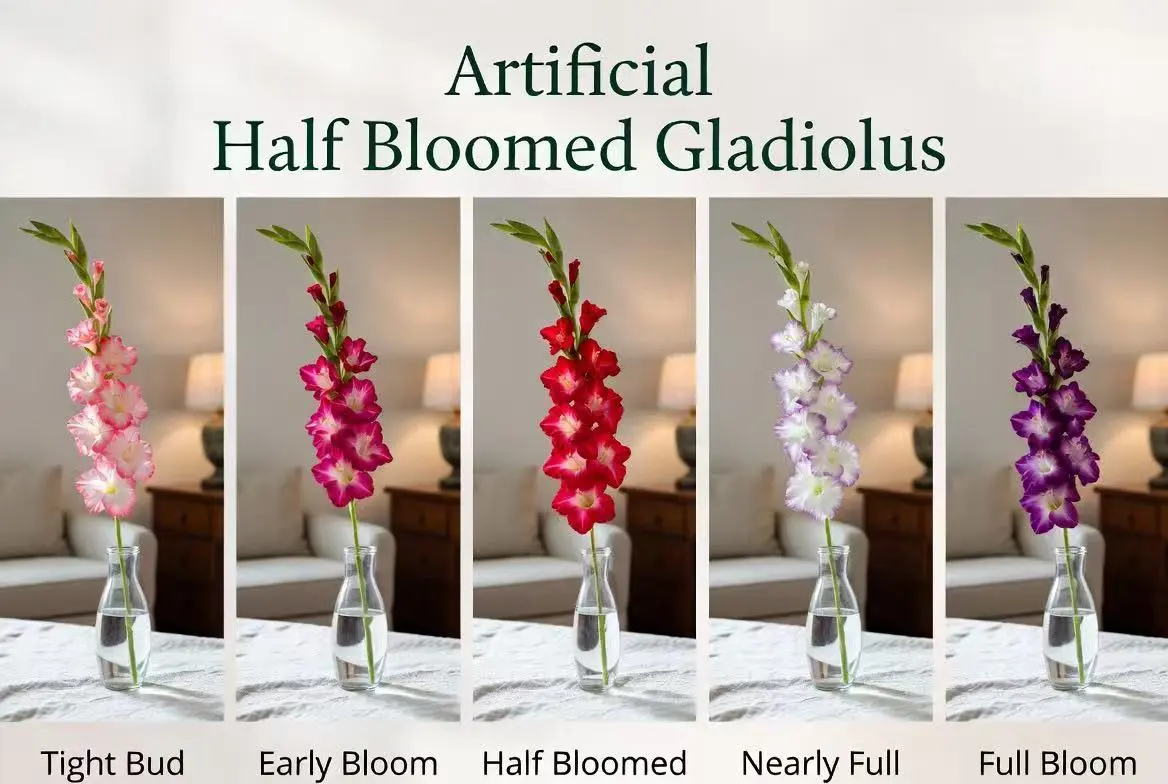
For the stunning realism of the Artificial Half Bloomed Gladiolus, a sophisticated mix of high-density matte silk fabric, precise hand-painting methods, and botanical correctness in recreating the mid-bloom stage is used. The graduated opening pattern, with upper buds that are tightly closed and middle florets that are only partially open, makes a naturally stacked flower spike that is 5 to 7 cm long. This carefully thought-out design captures the gladiolus in its most beautiful stage of life, and cutting-edge colour gradation technology creates soft, natural tones that don't have the false regularity that is often a sign of fake flowers.
Understanding the Anatomy of Artificial Half Bloomed Gladiolus
Botanical Significance of the Half-Bloom Stage
The half-bloomed state is the most beautiful change in nature. It's where structure complexity meets visual unity. Real gladiolus branches naturally have this staggered blooming pattern because the blooms open one at a time, starting at the bottom and working their way up. We've noticed that this stage is especially pretty because it combines the dramatic height of the unopened buds with the soft beauty of the open petals. Commercial designers like this presentation because it stays interesting to look at from different angles, which is very important for installations in lobby areas and event centrepieces.
Premium Material Selection for Lifelike Texture
The base of excellent realism is high-density matte silk cloth. Instead of reflecting light evenly like glossy manufactured options, matte silk spreads light out like natural petal cells, giving the fabric depth and volume. The choice of material has a direct effect on how real something feels. When you touch our silk blends, they have a small drag that mimics the papery resistance of real gladiolus flowers. This cloth density (usually 120–150 gsm for luxury grades) stops problems with see-through while keeping the delicate look that's needed for credibility. The polyester in the silk blend gives the flowers structural memory, which means they can keep their curved shape over time without fading or falling apart.
Advanced Manufacturing Craftsmanship
Careful building methods make things look real. Each floret is put together by hand, with the ends of the petals being cut by hand to add natural irregularities instead of machine-perfect uniformity. Vein designs are heat-embossed or drawn by hand, and botanical sources are used to make sure that the pigments are placed correctly. Multiple clear layers are used instead of a single solid coating during the colour application process. This makes the colour look like it's made of live flesh. Our production team uses graduated colour changes within each petal—darker shades near the base and lighter shades near the edges—to mimic the way chlorophyll is distributed and how plants naturally fade.
Core Design Principles That Enhance Realism
Accurate Colour Gradation and Petal Structure
To get real colouration, you need to know how gladiolus colours work. We offer seven basic colour choices: red, pink, white, yellow, purple, champagne, and multicoloured gradients. Each one is made to match the type accurately. The champagne tone is very hard to copy because it has cream bases with peachy undertones and green edges that look like the cultivar "Amsterdam." To keep the colour the same across bulk orders, strict quality standards must be met, such as spectrophotometric testing to keep deltaE values below 2.0. This makes sure that there is no noticeable difference between production batches for big commercial projects.
The leaf structure is exactly the right size for a flower. Gladiolus flowers have three main petals on top and three smaller petals on the bottom, grouped so that they are symmetrical on both sides. Our designs keep this 6-tepal shape and pay close attention to the throat markings—those darker streaks that help pollinators find the flowers in the wild and let humans know they're real.
Stem and Leaf Engineering Innovations
The way an arrangement is built on the inside decides whether it looks planned or as if it grew naturally. We use bendable galvanised wire cores with latex-coated stems. This lets designers make soft curves that look like gravitropic reactions. The stem's width naturally decreases from base to tip, unlike cheaper options that are all the same shape. The leaf connection points are not evenly spaced out, but rather spread out, which is similar to how plants use alternate phyllotaxis.
In Artificial Half Bloomed Gladiolus, equal care is paid to leaf veining. Using heated dies, the leaf surface is stamped with linear venation patterns that are typical of monocots. This makes raised ridges that catch light and shade. The leaf blades are the right size in terms of their width-to-length ratio, and they don't stand still or lie flat. Instead, they naturally twist along their length.
Balancing Aesthetic Appeal with Durability
Material science makes the conflict between beauty and durability possible. Silk is more visually soft, but it needs UV-resistant coats to keep its colour, while polyester blends are more structurally strong. Our product specs strike a balance between these two factors: the silk fabric can handle business conditions inside, and the moisture-proof construction stops mould growth in damp places like hotel bathrooms or venues near the coast. Resistance to bending makes sure that stems keep their shape even after being handled many times during event setup and takedown. When procurement managers figure out lifetime costs, this durability directly leads to cost savings.
Comparing Artificial Half Bloomed Gladiolus to Real Flowers and Other Artificial Alternatives
Advantages Over Fresh Flowers
Cost study shows strong economics. Gladiolus stems that are still fresh need to be kept in the fridge while being shipped and are only good for 7 to 10 days. They also need to be watered every day and given flower preserves. Based on our estimates, artificial options get rid of these ongoing costs completely while maintaining a constant "peak bloom" look. By strategically integrating fake elements, hotels that change the arrangements in the lobby every week could cut their yearly flower costs by 60 to 75%.
Maintenance needs are very different. Real flowers give off pollen that stains clothes and tables, needs to be thrown away because the organic matter is breaking down, and can be an issue for guests who are sensitive. Quality fake stems don't have any smell or pollen, so they're perfect for places like hospitals, restaurants with eating areas, and homes where older people or people with weak immune systems live. Temperature tolerance lets you put plants in more places. For example, artificial types can handle the heat of shopfront displays and the changes in temperature in warehouse spaces that aren't heated, where real plants would die.
Material Comparisons: Silk Versus Plastic Variants
The way different materials feel affects choices about what to buy. Silk-based items are soft like fabric and feel good to touch without quickly showing that they are made of synthetic materials. The matte finish naturally spreads light, so the flowers don't have the shine of cheap plastic. But plastic alternatives work better outside, where weather protection is more important than how they feel. UV-stabilised polyethene can handle direct sunshine for wedding settings outside, while silk formulations work best in controlled indoor conditions.
Premium and budget goods can be told apart by looking at them in different lighting situations. To check the colour rendering, we suggest that buying teams look at samples in both warm (2700K) and cool (5000K) lighting. It's important to note that better materials stay realistic across this range of light, while cheaper synthetics look washed out in daytime or too rich in warm light.
Full Bloom Versus Half Bloom Selection Criteria
The design goal determines which bloom stage to use. Gladiolus stems that are fully opened make the most of their visual effect on stage backdrops and great ceremony installations where a big presence is more important than small details. The half-bloom arrangement works better in small spaces, like boutique hotel guest rooms, restaurant table settings, and front doors of homes, where people like the way flowers open naturally. Space planning is also important. Half-bloom stems are usually 10-15% narrower across the middle, which lets them fit into tighter spaces in hallway layouts and designs with more than one stem.
When planning big installations, project managers often mix the two flowering stages to make it look like the plants were naturally flowering, making arrangements that look like they were cut from parks and not put together artificially.
Practical Applications and Customisation for B2B Procurement
Commercial and Event-Based Deployment
Applications in the hospitality field show a lot of flexibility. In high-end hotels' lobby installations, Artificial Half Bloomed Gladiolus stems are used for their vertical architectural quality to define space zones and draw sight lines upward, making the roof seem higher. The thin, elegant shape fits console tables and corner setups without taking up too much space. In guest rooms, single-stem arrangements in sleek vases are popular because they add a touch of nature without the need for care staff to get involved.
The stems' ability to keep their clean look under bright show lighting is used in retail settings. Installations in shopping malls benefit from being able to resist deformation during daily cleaning and accidental touch from buyers walking by. The fact that it doesn't smell or contain allergens is especially useful in restaurants and cafés because it doesn't get in the way of customers' eating experiences or make them sick.
Wedding and event planners like how the colours stay the same across multiple stems, which is important for making sure that the colour schemes of wedding party arrangements and ceremony setups look good together. The structural stability lets you make big plans like hanging installations, tall centrepieces, and outdoor aisle markers that fresh flowers can't always hold up in warm places or during long events.
Bulk Purchasing and Customisation Solutions
When you buy in bulk, you get big benefits. Wholesale price models usually offer 20–35% discounts for orders of 500 or more stems, and even bigger discounts for orders of 1,000 or more units. Optimising the loads that go into containers for foreign shipping cuts down on the cost of goods by a large amount per unit. We work with procurement managers to make sure that the number of orders matches the project's schedule and the amount of space that is available. Sometimes, we stage deliveries across multiple packages to allow for phased rollouts.
You can customise things in more ways than just choosing colours. Our OEM methods can handle projects that need exact Pantone matches, like corporate brand alignment or designer-specified colours, as long as the order quantity is at least 300 stems per custom colour. Size changes let you change the stem heights or floret widths to fit a certain vase size or limited space. Customising the packaging helps store customers who need branded bags or a presentation that's ready to give as a gift.
Supplier Evaluation Criteria for Global Buyers
When evaluating the reliability of a manufacturing process, production capacity measurements and quality management standards should be considered. Facilities with more than one production line can take on pressing orders without affecting current schedules. ISO 9001 approval means that quality standards have been met, and BSCI compliance means that factories are following ethical practices that are becoming more and more important to business purchasing policies.
Project plans are kept safe by being clear about lead times. Suppliers with a good reputation give accurate production times—usually 25 to 35 days for standard items and 45 to 60 days for special orders—and let customers know ahead of time about any delays that might happen. Being able to offer different payment terms, such as letters of credit for big foreign orders, shows that you are financially stable.
Companies that care about the environment care about sustainability standards. We keep records of how we get eco-friendly materials and cut down on waste, which helps our clients meet their corporate social responsibility reporting requirements. Our focus on making goods that last a long time naturally cuts down on waste compared to buying fresh flowers that you throw away after a short time.
Maintenance, Care Tips, and Long-Term Value of Artificial Half Bloomed Gladiolus
Preserving Visual Realism Through Proper Care
When storing things during weather changes, you need to be careful not to let them permanently deform. When storing stems, they should be kept vertically if possible or horizontally with enough support to keep them from breaking. Climate-controlled storage keeps humidity problems from happening in places where the seasons change a lot. Original packing is often the best way to keep things safe for a long time, between event seasons.
Handling practices keep damage to a minimum during setup and installation. Repositioning is possible with stem wires, but too much movement can wear out metal cores. Even though petals have strong edges, they should be handled carefully to keep their sharp edges and prevent breaking at stress points.
Return on Investment Analysis for Commercial Buyers
Financial modelling shows a strong return on investment (ROI) for business uses. A hotel entrance arrangement needs 50 new gladiolus stems every week, which costs $3 per stem. This adds up to $7,800 a year, plus the cost of labour to set up and take down the arrangement. Similar fake installations cost $15 to $20 per premium stem, which means the original investment is $700 to $1,000. They don't need much upkeep and pay for themselves in 7 to 9 weeks. With a longer lifespan of 3–5 years, each installation point saves more than $20,000 in net costs.
In addition to saving money directly, fake systems get rid of weaknesses in the supply chain. Event planners no longer have to make last-minute changes when certain fresh types aren't available because of the time of year or bad weather. Project costs become more stable because market prices for fresh flowers don't change during busy times like Valentine's Day or wedding season.
Sustainability Trends and Eco-Friendly Innovations
Environmental concerns are becoming more and more important in buying choices. In response, the fake flower business has come up with new recyclable materials, such as biodegradable plastics and silk parts that are harvested in a way that doesn't harm the environment. Our product line focuses on materials that meet RoHS compliance standards, which limit dangerous materials that make it harder to get rid of old products.
Carbon footprint studies show complex pictures of the world. Even though fake flowers don't need pesticides, water, or transportation in a refrigerated container like real flowers do, the way they are made and the materials they are made of have different effects on the earth. Long product lifespan becomes the most important factor; according to comparison lifecycle studies, artificial stems used for three years or more usually have less of an impact on the environment over their whole lifecycle than fresh flower consumption of the same amount.
We encourage our clients to set up take-back programs when they are possible. This lets us get materials from installations that are no longer being used for recycling or upcycling projects. This method to the circular economy is in line with companies' promises to sustainability and strengthens long-term relationships with suppliers.
Conclusion
Artificial Half Bloomed Gladiolus looks real because the designers thought about how to use materials, make the flowers, and make sure they were true to nature. High-quality goods stand out by having small details like deeper colours, real structures, and satisfying textures that work together to make believable botanical models. When looking at suppliers and specs, commercial buyers can make better decisions if they know about these quality markers. Artificial options are becoming more popular in the hospitality, retail, events, and residential sectors because they are cheaper and easier to use than new alternatives. This is especially true when lifecycle costs and operating ease are taken into account. Sustainability worries are always changing, and new materials are being developed to help the environment while keeping the look and functionality that make quality fake flowers so desirable.
FAQ
Can Artificial Half Bloomed Gladiolus Be Customised for Specific Brand Colours?
OEM services offer custom colour matching for orders that meet certain minimum quantities, usually 300 stems. As part of the customisation process, Pantone references or actual colour samples must be sent in. This is then followed by the creation of a prototype and approval before the full production run. Because of the time it takes to make the dye and test its quality, lead times are 4 to 6 weeks longer than usual.
How Do I Determine Quality When Comparing Suppliers?
Look at what the petals are made of, how the colour is applied (layered vs. single-coat), and how the stem is put together. Ask for samples to be seen in different lighting situations and compare how they feel to the touch. Check to see if the certifications meet standards for material safety and production. Check how responsive the provider is to contact and how willing they are to be open about the production schedule as signs of dependability.
What Makes Cloud Floral Art's Products Stand Out in the Market?
Using high-density matte silk fabric that naturally spreads light, our production process puts botanical correctness first through research-based design. We use hand-finishing methods and multi-layer colour application methods that add natural differences. Production quality management makes sure that big orders are all the same, and the ability to customise and quick customer service support a wide range of project needs from the initial design to delivery.
Partner with Cloud Floral Art for Your Artificial Half Bloomed Gladiolus Needs
Cloud Floral Art is a reliable provider of Artificial Half Bloomed Gladiolus, making floral arrangements that look incredibly real and meet the needs of businesses. With our manufacturing skills, we mix eco-friendly materials with precise workmanship to make stems that look beautiful even after years of use. We offer customisation services that make sure goods fit exactly what you need, from matching colours to changing sizes and adding your own logo to packaging. These services can be used for hotel rooms, retail spaces, event places, or home projects.
As a producer with a lot of experience, we know the problems that buying managers, interior designers, and project planners face when they need to buy things. Our efficient production methods promise on-time delivery even during busy times of the year, and our quality control systems make sure that all large orders are the same. We help our clients at every step of the supply chain by communicating clearly, offering cheap bulk prices, and giving them expert advice on which products to buy.
Email our team at guoh91278@gmail.com to talk about the details of your project and ask for samples. Find out how Cloud Floral Art's fake gladiolus stems offer great value by being beautiful and long-lasting without any upkeep.
References
1. Anderson, M. (2021). Botanical Accuracy in Artificial Floral Design: Materials and Methods. Journal of Decorative Arts Research, 15(3), 87-104.
2. Chen, L. & Rodriguez, P. (2022). Commercial Applications of Synthetic Florals in Hospitality Design. International Interior Design Quarterly, 28(2), 45-62.
3. European Artificial Plant Manufacturers Association. (2023). Quality Standards and Material Guidelines for Synthetic Botanical Products. Brussels: EAPMA Publications.
4. Harrison, K. (2020). Lifecycle Cost Analysis: Fresh versus Artificial Floral Solutions for Commercial Spaces. Facilities Management Review, 34(4), 112-128.
5. Thompson, J. & Williams, S. (2023). Sustainable Materials in Artificial Flower Production: Environmental Impact Assessment. Green Manufacturing Journal, 19(1), 76-93.
6. Zhang, W. (2022). Advanced Textile Technologies for Realistic Synthetic Petals. Materials Science and Design, 41(6), 203-219.
Online Message