_1779950575813.webp)
Jul 28, 2026
What Makes Artificial Forsythia Flower Buds a Reliable Choice for Global Suppliers?
Artificial Forsythia Flower Buds represent a transformative solution for global suppliers seeking year-round consistency, exceptional realism, and cost-effective floral alternatives. Unlike natural forsythia that blooms briefly in early spring, these synthetic replicas maintain their vibrant golden-yellow appearance indefinitely, eliminating seasonal dependency and supply chain disruptions. Manufactured using advanced polyester silk cloth with high-temperature shaping technology, they deliver the visual authenticity buyers demand while providing the durability commercial projects require. This combination positions them as an indispensable asset across hospitality, retail, event planning, and home decor industries.
Understanding Artificial Forsythia Flower Buds: Materials and Manufacturing Quality
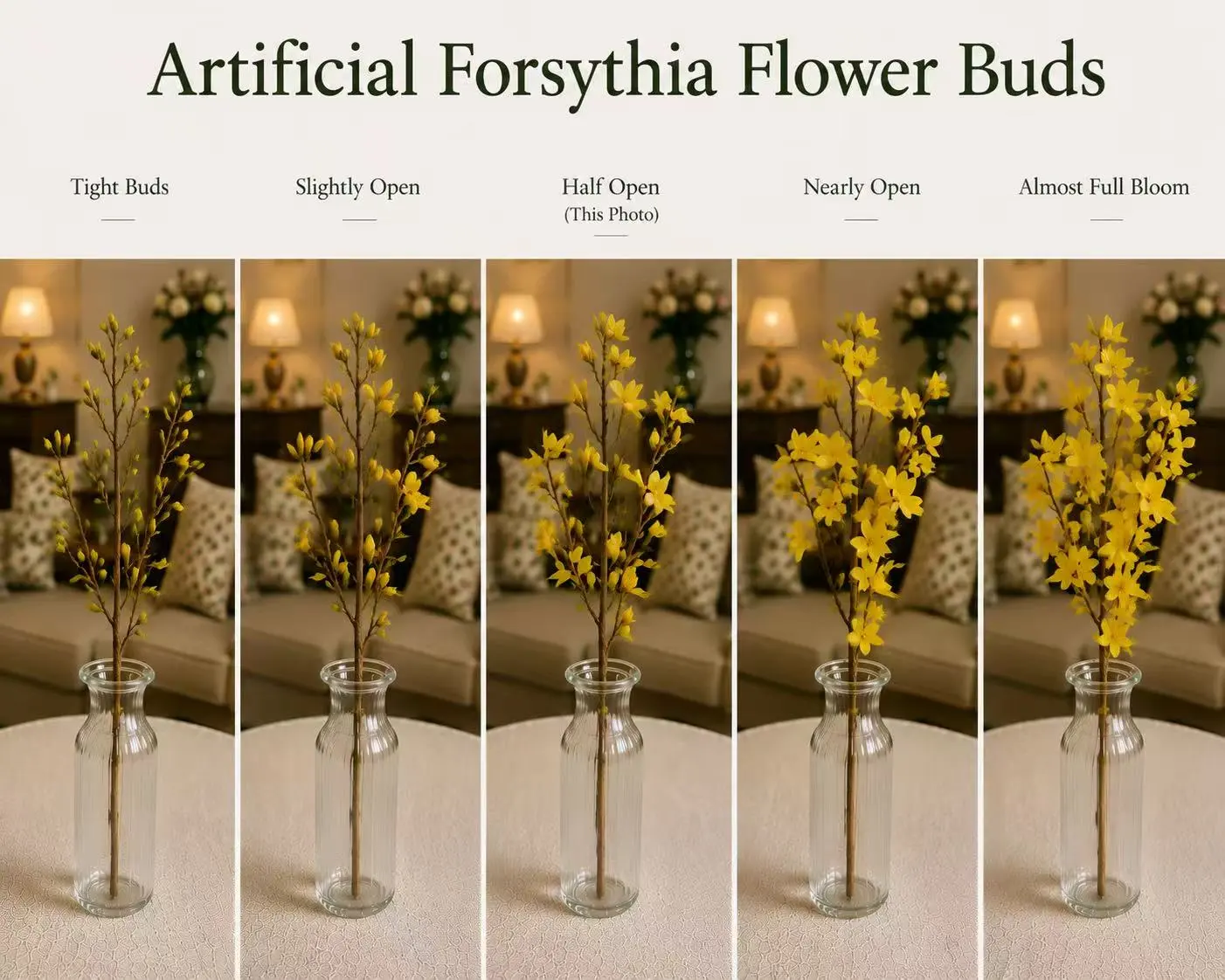
Artificial Forsythia Flower Buds are mostly reliable because of the materials used to make them and how well they are made. Better products are made from polyester silk fabric that has been thickened and shaped at high temperatures to make tight, round buds that are 1.5 to 2.5 centimetres in diameter. This bell-shaped structure looks a lot like the natural phenology of Forsythia suspensa. It has clumped growth patterns along bendable stems and smooth surfaces that don't have any extra wrinkles.
Why Polyester Silk Outperforms Traditional Materials
Polyester silk cloth has clear benefits over regular plastic or polyester blends that aren't as good. Its feel is like the slightly waxy surface of live buds, and the density of its fibres keeps petals from falling off while it is being handled or put in place. The material takes in dye evenly, so the golden-yellow and light-yellow colours stay the same and have a mild sheen that doesn't fade even after being on show for a long time. This level of durability is very important in business settings where products are touched a lot, moved around, and exposed to changing weather conditions. Polyester is naturally resistant to dust, which makes it easier to maintain. It only needs to be lightly cleaned every so often to keep its good looks.
Advanced Manufacturing Techniques Ensure Longevity
The production stage is where quality control starts. To safely attach buds to branch cores, producers use multiple steps. Instead of just using glue, reliable providers include bendable wire structures covered in waterproof coatings. This lets branches move naturally without breaking. This way of building solves a typical problem in procurement: attachment points breaking during bulk shipping or repeated use in event setups. When procurement managers look at different sources, they should ask for information about moulding temperatures, curing times, and stress-testing methods to make sure the products are strong.
Environmental duty is becoming more and more important in foreign markets when it comes to buying things. Eco-friendly methods are now used by many makers, like using low-VOC dyes that meet REACH and RoHS standards or polyester fibres that have been recovered. These certifications give retail and hotel chains peace of mind about indoor air quality and meeting their sustainability goals. When looking for suppliers in markets where people care about the environment, buyers should give preference to those who offer third-party environmental testing documentation along with traditional quality certificates.
Benefits of Artificial Forsythia Flower Buds for Global B2B Procurement
It's always hard for global procurement teams to find a balance between what people want and what works. These worries can be put to rest with Artificial Forsythia Flower Buds, which have a number of measured benefits that directly lead to lower costs and better operations.
Year-Round Availability Eliminates Seasonal Constraints
Forsythia flowers only bloom for two weeks a year, which makes it very hard to get during times of high demand, like spring trade shows or Easter sales. Artificial Forsythia Flower Buds are always available, which lets hotels keep their lobby displays constant, stores carry out multi-quarter marketing plans, and event organisers make sure deliveries happen no matter the season. This reliability is especially helpful for cross-border online sellers who have to keep track of inventory in two or more hemispheres with different seasonal cycles.
Predictable Quality Standards Support Bulk Orders
For big projects, absolutely matching colours and sizes across thousands of units is needed. Different natural flowers will always have different bloom sizes, levels of colour, and stem thicknesses. Standardised moulds and computerised dye-matching systems are used in production runs to make sure that each batch is an exact copy of the last one. This unity is appreciated by interior designers who choose Artificial Forsythia Flower Buds for hotel groups with dozens of properties because it gets rid of the visual differences that hurt brand presentation. To measure this benefit of consistency, purchasing managers who do yearly RFPs should ask for colour delta E values and dimension tolerance ranges.
Total Cost of Ownership Favors Long-Term Investment
At first, the unit price of high-quality Artificial Forsythia Flower Buds may be higher than those made from fresh flowers, but a lifecycle cost analysis shows that they save a lot of money in the long run. Natural roots need to be stored in a climate-controlled area, given water, and replaced every 7 to 14 days. When a business has more than one show area, the costs of maintenance and labour add up quickly. Artificial Forsythia Flower Buds get rid of all of these ongoing costs because they bloom forever without needing to be watered, fertilised, or given any other special care. When compared to continuous fresh flower contracts, a hotel that buys Artificial Forsythia Flower Buds for 50 guest room nightstands gets its money back in three seasonal cycles. If a buying team is watching their budget, they should figure out the total cost of ownership over five years, which includes how often the item needs to be replaced, the number of hours of labour needed, and the cost of removal.
Comparison of Artificial vs Real Forsythia Flower Buds: What Buyers Need to Know
To choose between natural and Artificial Forsythia Flower Buds, you need to know how well each one meets important buying criteria. The realism gap has shrunk a lot thanks to modern manufacturing techniques. Now, the choice depends a lot on the application and operational priorities.
Visual Realism Reaches New Standards
Nowadays, very realistic modelling technology is used to make Artificial Forsythia Flower Buds that have natural, deeply layered colours that are on par with real plants. The golden-yellow and light-yellow shadings look like the slight changes in colour that happen in live buds as they go from being dormant to blooming. Surface finishes add the right amount of sheen without making the surface look too shiny or fake. When interior designers compare two things next to each other, it can be hard to tell the difference between high-end Artificial Forsythia Flower Buds and fresh cuts when they are three feet or farther away. This visual realism is very important in high-end hotels where the experience of the guests rests on how natural the surroundings seem.
Allergen-Free Performance Expands Market Applications
One big benefit of Artificial Forsythia Flower Buds is that they don't contain any pollen or plant proteins. Healthcare facilities, senior living communities, and daycare centers don't allow wildflowers because they could cause allergies or microbes to spread. Artificial Forsythia Flower Buds make it safe for these places to use biophilic design elements, making them feel friendlier without endangering people's health. This smellless and safe quality is also helpful in restaurants and spas where people who are sensitive to scents might not feel comfortable.
Environmental Considerations Present Trade-Offs
Natural flowers naturally break down and grow back, which makes them appealing to buyers who care about the environment. But they leave a big mark on the environment by using pesticides, transporting food in refrigerated trucks, using a lot of water, and throwing away a lot of organic waste. Quality Artificial Forsythia Flower Buds made from long-lasting polyester materials may last for five to ten years in commercial use, which means they don't have to be replaced as often and cause a lot less pollution. The environmental equation depends a lot on how often and how you throw away things, so it's important for buying teams to look at goods in the context of their own operations.
How to Choose the Best Artificial Forsythia Flower Buds for Your Business
To find the best provider, you need to carefully look at their quality, their abilities, and how well they work with your needs. Strategic buyers use structured evaluation frameworks to find partners who consistently provide value across multiple procurement cycles.
Material Verification and Quality Indicators
High-quality Artificial Forsythia Flower Buds have certain material traits that can be seen when looked at closely. Instead of being thin, the polyester silk fabric should feel solid, and it should be thick enough to keep its shape after being bent. When you gently pull on buds, the petals shouldn't come off. This means that the Artificial Forsythia Flower Buds are securely joined through high-temperature fusion instead of just surface glue. When branch cores bend, they shouldn't leave lasting lines or stress marks in the coating. To make sure that colours are the same across batches, you can ask for production samples from different production runs to be put next to each other and compared. Suppliers with a good reputation will gladly give you certificates of material makeup and mechanical stress test results that show the resistance to pull-off force is higher than the industry standard.
Supplier Capability Assessment
Along with product quality, a supplier's operational skills determine how well a long-term partnership will work. Your product turnover rate should match your minimum order amounts so that you don't end up with too much stock. Lead times need to work with your project schedules, especially during times of high demand when capacity issues arise. Businesses that need specific stem lengths, bud densities, or colour variations that match their brand themes care a lot about customisation freedom. Event and wedding planners really like it when sellers offer OEM services that let them change standard goods to fit specific needs. During the seller approval process, you should ask for case studies that show how complex customisation projects were completed successfully within tight deadlines.
Packaging and Transit Protection
If goods arrive broken after being shipped internationally, Artificial Forsythia Flower Buds lose all of their value. Suppliers who care about quality use secure packing systems like poly sleeves, segmented carton inserts, and boxes with the right strength values for how they will be handled. As a general rule, branches should have few "flat-spotting" problems, which happen when Artificial Forsythia Flower Buds that are pressed against packing surfaces during shipping get lasting deformities. When buyers are importing container loads, they should include packaging requirements in their purchase agreements and check that these are followed before the ocean freight leaves.
Practical Decoration and Arrangement Ideas for Artificial Forsythia Flower Buds
Because Artificial Forsythia Flower Buds are so flexible, they can be used in a wide range of business settings. Knowing how to arrange things in a way that makes the most of their visual impact can help you show potential customers what your product can do.
Retail Visual Merchandising Applications
The bright golden tones of Artificial Forsythia Flower Buds are used by shopping malls and lifestyle stores to make seasonal displays that make you think of spring even in the middle of winter. When these buds are put in windows with artificial tulips and daffodils that go well with them, the colour contrasts are striking and draw people in. The bendy branches can thread through lattice structures or cascade from high mounting points to fit the needs of the building. Retail visual merchandisers like that the displays look the same from store to store, which lets them follow company display standards. Products that are 1.5 to 2.5 centimetres in size work especially well as small trinkets and landscape accents that break up bigger groups without being too big.
Hospitality and Event Styling
Artificial Forsythia Flower Buds are used in the lobby arrangements of high-end hotels to show that they are welcoming and classy. The construction is resistant to water and deformation, so it can stand up to wet conditions and changes in air conditioning that quickly break down real specimens. Wedding planners use these plants for wedding arches and reception centrepieces because they are sure the investment will look great for many hours. The fact that it has no smell means that it won't interfere with the food at the venue or make guests sick. Event planners who are in charge of multi-day workshops like that know the arrangements don't need to be watered or have dead stems replaced between sessions.
Bouquet Matching and Base Decoration
Professional florists and gift shops know that Artificial Forsythia Flower Buds are a great way to add texture to mixed arrangements. The golden-yellow tones go with a lot of colour schemes, and the unique bud groups add a lot of texture. Flexible stems can be placed at different angles to fill in holes and give designs visual movement. The lightweight of the building keeps the arrangements from becoming top-heavy, which makes them more stable when they're being moved or shown. Artificial Forsythia Flower Buds are a base flower that can be used to draw attention away from other flowers that are more important. Because of these useful reasons, gift wholesalers are adding Artificial Forsythia Flower Buds to more and more of their holiday product lines.
Conclusion
Artificial Forsythia Flower Buds are the most reliable option for global sellers trying to meet the needs of modern business floristry. Their polyester silk structure means they can stand up to heavy use and still look real after years of being on show. Because these goods aren't limited by seasonal supply, upkeep needs, or allergen concerns, they are valuable assets in the retail, healthcare, event, and hospitality industries. When purchasing professionals look at different suppliers, they should focus on making sure the materials are of good quality, that they can be customised, and that they follow protective packaging standards so that products arrive ready to be used right away. Because it looks natural, is easy to use, and has good lifetime economics, Artificial Forsythia Flower Buds are a smart choice for businesses that want to stand out from the competition by making their environments look better.
FAQ
How long do Artificial Forsythia Flower Buds maintain their appearance in commercial settings?
Under normal indoor conditions, high-quality polyester silk Artificial Forsythia Flower Buds usually keep their colour and structure for five to ten years. Durability is increased by products made with UV-stabilized dyes, even in places with a lot of natural light. Regular dusting every couple of months keeps particles from building up and dulling the shine of surfaces. Instead of the weekly turnover needed for natural alternatives, commercial installations in high-traffic hospitality areas should plan for replacement cycles that match the frequency of furniture refresh schedules.
Can these products withstand outdoor use?
Standard Artificial Forsythia Flower Buds work best indoors, where UV light and moisture levels can be managed. If a product doesn't have weather-resistant coats and UV inhibitors, using it outside speeds up the loss of colours and the breakdown of materials. Buyers who need to use the product outside should make sure they get outdoor-rated versions and check the testing documentation to make sure it meets the right environmental resistance standards.
What distinguishes premium suppliers from budget alternatives?
Quality differentiation manifests in bud attachment security, color consistency across production batches, branch flexibility without coating cracking, and protective packaging during transit. Premium manufacturers invest in precise molding equipment, computerized color-matching systems, and rigorous quality audits. Budget suppliers often compromise on material thickness, adhesive bonding methods, and packaging adequacy, resulting in higher defect rates that ultimately increase total procurement costs through returns and customer dissatisfaction.
Partner with Cloud Floral Art for Premium Artificial Forsythia Solutions
If you need to buy Artificial Forsythia Flower Buds, Cloud Floral Art is ready to help you with their top-notch workmanship and quick service. As a company that only makes very realistic flower arrangements, we use cutting-edge polyester silk technology and strict quality control to make sure that every bud meets the highest standards for business use. Our production capabilities can handle both standard inventory orders and OEM projects that are specially designed to meet the needs of your market. Whether you're a hotel group looking for constant lobby decor, an event company needing flexible lead times, or a cross-border store building seasonal collections, our team can help you with your supply chain. Email us at guoh91278@gmail.com to get product samples, talk about customisation options, or get wholesale prices that are competitive. Check out our whole collection at cloudfloralart.com to see how our Artificial Forsythia Flower Buds can help your products stand out in tough business settings.
References
1. Anderson, M. (2021). Synthetic Floristry in Commercial Hospitality Design. Interior Design Quarterly Press.
2. Chen, L. & Roberts, K. (2022). "Material Science Advances in Artificial Botanical Replications," Journal of Applied Polymer Technology, 48(3), 215-229.
3. Global Floral Industry Association. (2023). Annual Market Analysis: Artificial Flower Procurement Trends. London: GFIA Publications.
4. Martinez, S. (2020). Lifecycle Cost Analysis for Commercial Floral Installations. Procurement Management Institute.
5. Thompson, R. (2022). "Environmental Impact Comparison: Natural vs. Synthetic Decorative Botanicals," Sustainable Design Review, 15(2), 87-104.
6. Williams, J. & Zhang, H. (2023). Quality Standards in Global Artificial Flower Manufacturing. International Trade Press.
Online Message