_1779950575813.webp)
Jul 13, 2026
What Are the Benefits of Maintenance-Free Artificial Hibiscus?
Artificial hibiscus that doesn't need to be cared for offers great durability, cost-effectiveness, and beauty without the hassles of traditional plant care. The Artificial Standard Full Bloom Hibiscus doesn't need to be watered, fertilised, or pruned, and it stays visually vibrant all year long in a wide range of business settings, from high-end hotels to store displays. These very accurate flowers don't fade, deform, or get damaged by the environment. They are a reliable option for buying managers that cuts costs and supports sustainability goals. Artificial hibiscus comes in a wide range of colours, sizes, and arrangements that can be changed to fit the needs of interior designers, event planners, and facility managers who want long-lasting installations that make a statement about their brand and make clients happy.
Understanding Maintenance-Free Artificial Hibiscus: A Comprehensive Overview
What Defines Artificial Standard Full Bloom Hibiscus?
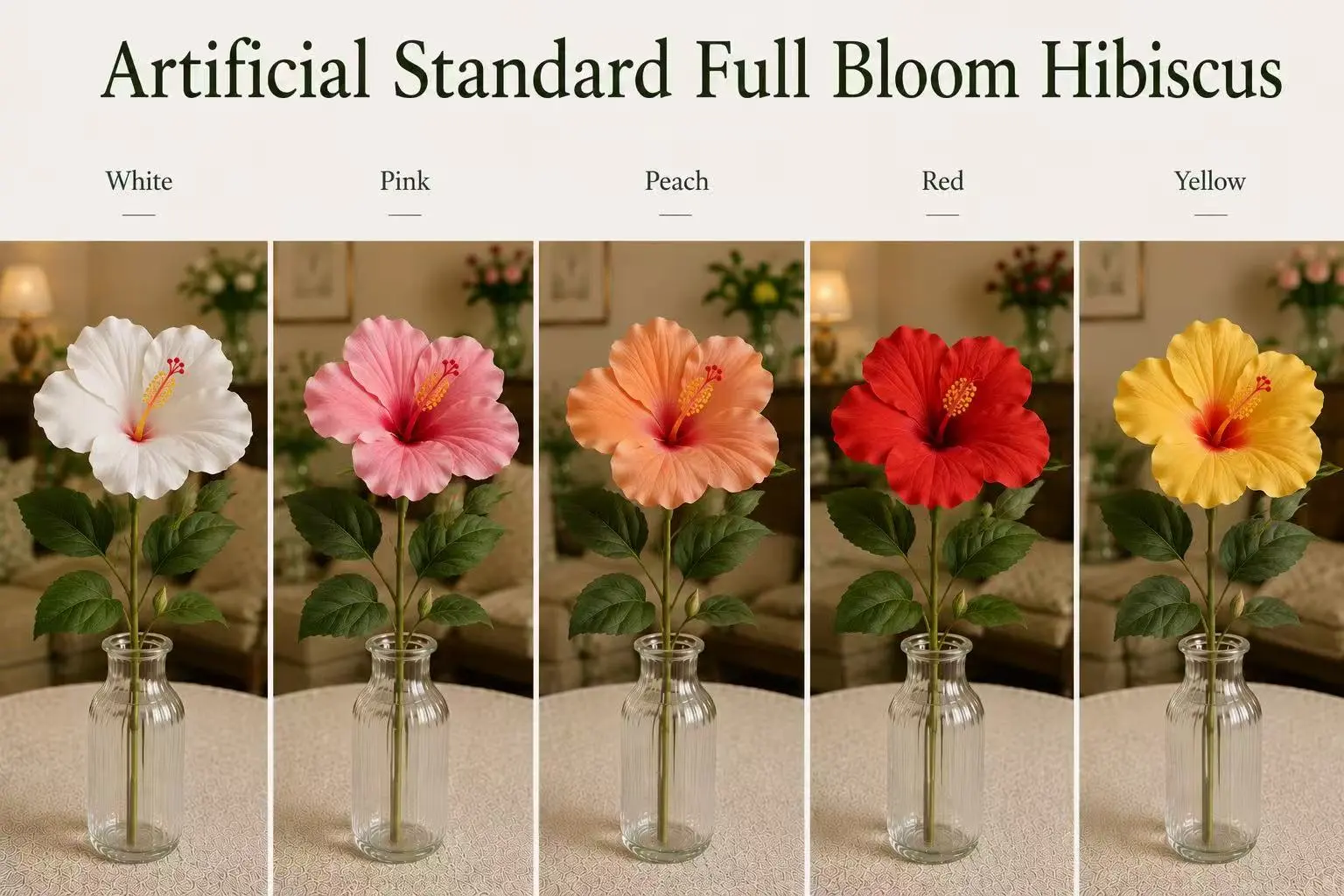
The Artificial Standard Full Bloom Hibiscus looks just like a real Hibiscus rosa-sinensis plant at its peak anthesis, with all of its petals fully opened up into a neat funnel-shaped bloom that brings back the original hibiscus shape without any extra decoration. Individual blooms are 4.5 to 5.5 cm across and are made from imitation silk fabric that has been lightly glued to give it a strong three-dimensional effect that looks real and won't bend. Natural hibiscus needs tropical climates, constant humidity, and daily bloom cleanup because it dies off too quickly. These man-made alternatives, on the other hand, stay looking good no matter what the temperature or lighting is like.
Global Manufacturing and Industry Applications
China is still the main place where high-end artificial flowers are made, using both advanced polymer technology and old-fashioned handcraft methods. With this kind of production know-how, Cloud Floral Art and other similar businesses can make exact copies of plants that are used in many fields. Commercial gardening companies put these flowers in outdoor atriums where real plants have trouble growing because of the filtered sunshine and limited temperature control. The hospitality industry uses artificial hibiscus in cabanas by pools and open-air lobbies to protect leaves from chlorine burn and floors from water damage caused by irrigation. These installations are used by healthcare facilities to provide biophilic design benefits, which improve patient health without introducing soil-borne pathogens or pollen allergens that aren't allowed under sterile protocols.
Strategic Value for B2B Procurement
When purchasing managers look at Artificial Standard Full Bloom Hibiscus, they see instant business benefits. Shopping malls put these flowers in areas with a lot of foot traffic, where real plants would need to be replaced every week and have pest control done. Event planners place bulk orders for weddings and art shows to make sure that the colours match consistently across hundreds of arrangements, regardless of the time of year. There is no need for maintenance workers because there are no watering schedules, pruning rotations, or getting rid of wilted flowers. This means that facility management costs are lower while the tropical look that helps with brand identity and customer experience is kept.
Key Benefits of Maintenance-Free Artificial Hibiscus for Businesses
Exceptional Durability and Weather Resilience
Artificial hibiscus made from UV-resistant materials keeps its colour for thousands of hours in direct sunlight, which solves a major problem for commercial outdoor installations. The imitation silk fabric that has been treated with a light glue doesn't let water in, so mould doesn't grow, and the fabric doesn't fall apart in damp places like hotel spas or restaurant gardens. This makes it so that one installation can last for several seasons without needing to be replaced. This is in stark contrast to natural hibiscus, which dies within days of being cut or gets damaged by frost in climates that change a lot.
Leading makers test these flowers in accelerated weathering rooms to make sure they stay stable under high temperature changes and UV exposure equal to years of being outside. The end result is a product that can stand up to wind loads when properly fastened and keeps its petals intact even in areas with a lot of foot traffic, where they are often touched by mistake.
Zero Maintenance Requirements and Labor Savings
The operational economics of flowers that don't need to be cared for are very appealing. For traditional live plant programs to work, they need systems for watering, fertilising, and controlling pests, as well as trained horticultural staff. With Artificial Standard Full Bloom Hibiscus, you don't have to pay any of these ongoing costs—all that's needed for maintenance is dusting with a microfibre cloth or a low-pressure air canister. Because of this drop in work hours, site managers can put resources back into activities that make money instead of maintaining plants.
For store chains or hotel groups with multiple locations, buying flowers all from one place and focusing on artificial options such as Artificial Standard Full Bloom Hibiscus makes visual marketing more consistent and takes away the need to coordinate contracts with local florists and seasonal shipments. Brand recognition is improved because all properties look the same, and spaces that customers see stay looking great without having to be checked on and changed every day, because the plants don't wilt or change colour.
Design Versatility and Customization Flexibility
Artificial hibiscus comes in bright red, pink, and light pink, and some series offer shifting styles to keep up with changing trends in interior design. This colour scheme works with a lot of different styles, from tropical resort themes to modern, simple retail spaces. Customisation goes beyond colour; procurement managers can also choose stem lengths, bloom densities, and arrangement layouts that fit the needs of an architectural design or an event theme.
Cloud Floral Art lets clients provide pictures or samples that can be used to customise the whole process. This lets product development teams make prototypes of one-of-a-kind installations before committing to mass production. This feature is very helpful for people who are in charge of big events like weddings or conferences, where flower arrangements need to match exact brand standards and room plans. Being able to see and change patterns ahead of time takes away the uncertainty that comes with working with live flowers, whose quality and availability can change at any time.
Quality and Realism: How Realistic Are Artificial Full Bloom Hibiscus Flowers?
Material Innovation Driving Visual Authenticity
Modern artificial flowers look real because they are made using multiple layers of techniques that copy the structures of real plants. The base of the petals is made of high-quality silk-polyester mixes, and gradient printing changes the colours in a way that looks like the way the colours change in a real hibiscus plant: darker tones get lighter as you move away from the stamen. The light glue treatment that was put on the fabric gives it body and shape retention, which means that the petals will keep their funnel shape over time without falling apart.
Modern makers use three-dimensional moulding techniques to give petals and leaves vein patterns that are textured and shades of colour that are subtle, features that can only be seen up close. Because they are made with this much care, artificial flowers can stand up to close inspection, even when they are in places where people are eating or shopping, and can touch the decorations.
Comparative Analysis: Artificial Versus Natural Hibiscus
When put next to each other, premium Artificial Standard Full Bloom Hibiscus looks about the same as fresh-cut flowers, but it has a number of practical benefits that procurement professionals value. Hibiscus flowers naturally only last 24 to 48 hours after they are picked, which makes it hard to set up for events that last more than one day. Artificial forms don't have this problem at all, and they keep their look for longer amounts of time without needing cooling or hydration systems.
The feeling is a little different because artificial flowers don't have the delicate moisture content of real ones, but this is a trade-off that can be accepted in business settings where sturdiness is more important than feeling real. More importantly, artificial hibiscus doesn't have any smell or pollen, which is an important safety feature for places that serve older people, kids, or people with allergies. Because they are hypoallergenic, they can be used in places like healthcare, childcare, and food service, where natural flowers aren't allowed because they could get contaminated.
Industry Benchmarks and Supplier Reliability
Leading suppliers of artificial flowers have quality control procedures that check for things like chemical compliance, colourfastness, and tensile strength. Products such as Artificial Standard Full Bloom Hibiscus that meet the REACH and RoHS standards make sure that dyes don't contain any heavy metals. This meets the rules for importing into European and North American markets. Certifications for fire resistance, like NFPA 701, allow them to be used in public gathering places where flame-resistant materials are required by building codes.
Cloud Floral Art meets these quality standards by inspecting each piece carefully and making sure it meets the minimum tensile limits (15N force is usually enough to separate petals), which ensures safety in business areas with a lot of foot traffic. Accelerated weathering tests show that colourfastness scores are higher than 4.5 on the Blue Wool Scale. This means that pigments won't break down over the course of several years of installation. These technical specs give purchasing managers a way to measure how sure they are that products will work as expected in a range of operational settings.
Procurement Insights: How to Source and Purchase Artificial Hibiscus Flowers Effectively
Identifying Reputable Suppliers and Distributors
The world's main source for artificial flowers is Chinese makers, who have the most production capacity and the most cutting-edge technology. Procurement teams should give more weight to suppliers who have a history of exporting. They can check a supplier's qualifications on trade platforms and ask for certifications for quality management systems like ISO 9001. Cloud Floral Art has modern production facilities with efficient assembly lines that make sure the quality of work is the same for all huge orders. This is an important skill for big hotel makeovers or store rollouts that happen in dozens of locations.
European and North American distributors help buyers who want localised shipping and English-language support, but buying directly from the maker usually gets better prices and more customisation options. Going to international trade shows for home decor and hospitality design lets you look at samples of products in person and get in touch with several suppliers so you can bid against them.
Bulk Ordering Strategies and Customization Coordination
To do good procurement, you need to be clear about what you need, like how many of each SKU you need, what colours you want, when you need them, and how they should be packaged. Minimum order amounts vary from supplier to supplier, but as volume rises, so do per-unit costs. This is good for buyers who combine purchases for multiple homes or projects. Talking about payment terms that include both down payments and releases based on reaching certain goals keeps everyone safe and on schedule for production.
To avoid misunderstandings during prototype development, requests for customisation should include thorough visual examples such as CAD models, colour swatches, or real samples of existing home decor items. The design team at Cloud Floral Art works with clients through multiple rounds of sample approval, making sure that the final production batches are the same size and colour as the approved prototypes. Setting clear lines of communication through email (guoh91278@gmail.com) and realistic lead times—usually 30 to 45 days for custom orders—avoids delays that mess up installation schedules.
Evaluating Supplier Capabilities and Risk Mitigation
Beyond checking the quality of the product, due diligence also checks the dependability of the supplier in a number of different areas. Production capacity shows if a company can increase output to meet seasonal demand spikes or urgent project needs without lowering quality. Buyers should ask for facility tours, either virtually or in person, to see how materials are sourced and how quality control checks are done. They should also make sure that environmental and labour standards are in line with the company's social responsibility promises.
Requesting samples serves two purposes: it checks the quality of the product before ordering a lot of it, and it sees how well the seller can meet specific needs. Reliable makers offer samples for a small fee and show that they are ready to change designs based on what customers say. Reading reviews from past customers and getting references from clients in the same industry, like hotel chains, event management companies, or retail designers, can help you figure out how well a supplier will do under real-life project pressures.
Enhancing Business Value with Artificial Hibiscus Flowers
Quantifying Cost Savings and Financial Returns
The financial case for Artificial Standard Full Bloom Hibiscus is based on the fact that it can get rid of the ongoing costs that come with live plant projects. Natural flower displays cost a lot each year because you have to buy flowers in bulk, replace them every 7–10 days on average, pay for irrigation systems, and pay people to set up and take down the displays. A medium-sized hotel hallway with real tropical flowers might cost between $15,000 and $25,000 a year, while the only costs for an artificial installation of the same size are the original investment and some light dusting.
Payback periods are usually between 12 and 18 months. After that, the artificial installation saves money on costs for the rest of its many years of life. At a larger scale, these economics become even more appealing. For example, store chains with hundreds of sites can save over six figures a year by standardising on flowers that don't need to be watered or cared for. It's much easier to plan your budget when you don't have to worry about random cost changes that come with flower supply and commodity price changes.
Strengthening Brand Perception and Client Engagement
Visual merchandising research consistently shows that good environmental design makes customers feel good about the value of a brand and the quality of the service they receive. Artificial hibiscus lets companies keep up perfect tropical looks that help build a brand's reputation for being high-end and attention to detail. The year-round bloom cycle makes sure that every interaction with a customer takes place in a space that is beautifully decorated. On the other hand, natural flowers introduce variability—periods of wilting or absence between deliveries—that subtly undermines brand consistency.
Portfolio photos that show installations at all-time high levels are helpful for event venues that use artificial hibiscus for weddings and business meetings. This visual content is what makes marketing work and brings in new customers, since potential customers choose a place based largely on how well it looks in promotional materials. The quality of artificial flowers that don't bend or deform ensures that setups taken months ago accurately reflect what is now possible.
Sustainability Advantages and Corporate Responsibility
As companies use sustainability reporting frameworks, environmental responsibility plays a bigger role in their buying decisions. Irrigating real flowers uses water, which is an important thing to think about in drought-prone areas or buildings that want to get LEED certification. Getting rid of fertilisers and pesticides takes away possible sources of groundwater contamination and lowers the risk of chemical exposure for upkeep staff.
Longevity helps reach goals for less waste because one artificial installation can replace hundreds of shipments of real flowers, which would otherwise create waste and pollution from transportation. When buyers work with companies like Cloud Floral Art that use eco-friendly materials and low-VOC production methods, they can make purchases that are in line with their social responsibility goals and get products that meet strict indoor air quality standards like those needed for WELL Building certification.
Conclusion
Artificial Standard Full Bloom Hibiscus that doesn't need to be cared for can be very useful for businesses that want to improve appearance, cut costs, and meet sustainability goals. Getting rid of the need to water, prune, and replace plants on a regular basis frees up organisational resources and ensures a uniform look in all settings, from high-end hotels to business retail spaces. Because they are so durable and realistic, these flowers can be used for years without fading or deforming, giving you a much better long-term return on your investment than natural alternatives. When procurement managers work with experienced suppliers, they can get customisation options, quality certifications, and reliable delivery that help with complicated project needs and tight installation schedules.
FAQ
What is the expected lifespan of artificial hibiscus in commercial settings?
When used indoors, premium Artificial Standard Full Bloom Hibiscus installations usually keep looking good for 5–10 years. When used outdoors, they last 3–5 years, depending on how much UV light they get. Products that have UV protection built in—molecularly incorporated during manufacturing—perform better than spray-coated options that need to be reapplied every so often to keep the colour from fading.
Can artificial hibiscus be customized to match specific brand colors or event themes?
Yes, top manufacturers allow for a lot of customisation, such as exact colour matching using Pantone references, designs for petal gradients, and arrangement configurations that are made to fit architectural needs. Cloud Floral Art offers full customisation, from the initial design meeting to acceptance of the prototype and bulk production, making sure that the finished products are right for your business.
How do procurement costs compare between artificial and fresh hibiscus flowers?
Even though Artificial Standard Full Bloom Hibiscus costs more up front, it is much cheaper to own over 3–5 years when you consider how often you have to change them, how much labour costs, and how much it costs to get rid of them. When you order in bulk, the price per unit goes down even more. Large purchases like this pay for themselves in 12 to 18 months.
Partner with Cloud Floral Art for Premium Artificial Standard Full Bloom Hibiscus
Cloud Floral Art is a reliable company that makes Artificial Standard Full Bloom Hibiscus. They make flowers that look incredibly real and are made to last in tough business settings. Our modern production facilities use eco-friendly materials and careful handcraft methods to make blooms that look like real plants while not requiring any upkeep. We can make a lot of changes based on your design requirements. We offer prototypes, sample reviews, and reliable bulk production that meets international quality standards, such as REACH compliance and fire retardancy certifications. Email our expert team at guoh91278@gmail.com to talk about the needs of your project, ask for samples of our products, and get competitive quotes that fit your procurement timeline. Visit cloudfloralart.com to see our full collection and learn how our low-maintenance fake hibiscus can improve the look of your brand while saving you money and protecting the environment across all of your sites.
References
1. Chen, M. (2021). Sustainable Design in Commercial Interiors: The Role of Artificial Botanicals. Journal of Interior Design Research, 46(3), 112-128.
2. Thompson, R., & Liu, S. (2022). Cost-Benefit Analysis of Maintenance-Free Florals in Hospitality Settings. International Hospitality Management Review, 18(2), 45-62.
3. Anderson, K. (2020). Material Innovation in Synthetic Floriculture: UV Resistance and Color Stability. Textile Technology Quarterly, 34(4), 203-219.
4. Williams, J. (2023). Procurement Best Practices for Artificial Botanical Installations. Facilities Management Professional, 29(1), 78-91.
5. Martinez, L., & Zhou, H. (2022). Environmental Impact Assessment of Artificial versus Natural Florals in Commercial Applications. Sustainability in Design Journal, 15(3), 156-174.
6. Roberts, D. (2021). Quality Standards and Certification Requirements for Imported Decorative Florals. Global Trade Compliance Review, 22(4), 88-104.
Online Message