_1779950575813.webp)
Jun 16, 2026
How to Find a Trusted Artificial Half Bloomed Small Daisy Supplier?
Finding a reliable Artificial Half Bloomed Small Daisy seller depends on checking the validity of the products, the stability of the production, and the honesty of the business practices. Reliable sellers use high-density silk fabrics that naturally open into 3–4 cm blooms, have color-fast finishes, and have quality approvals that can be shown. Professionals in procurement should choose partners that have a history of OEM customization, stable lead times, and quick post-sale support to make sure that their products fit seamlessly into business projects in the hotel, retail, and event decoration industries.
Understanding the Importance of Choosing a Trusted Supplier
Choosing the right partner for your Artificial Half Bloomed Small Daisy purchases is more than just choosing a vendor—it's the key to making sure your business runs smoothly. Working with procurement teams in the hotel and interior design industries for years, I've seen how the suppliers they choose have a direct effect on project timelines, budgets, and client happiness.
Reliability Reduces Operational Risks
Every order batch from a trusted provider is the same. When you get exactly 3–4 cm Artificial Half Bloomed Small Daisies with evenly spaced petals, your design teams can do installs without having to make last-minute changes. This consistency keeps your image with customers who expect perfect looks in places like hotel lobbies and store windows, and cuts down on waste from units that are turned down.
Quality Control Protects Brand Integrity
When suppliers use strict checking procedures, common problems like color bleeding, stem wire exposure, or petal separation due to handling stress can be avoided. I suggest looking for partners who test for tensions higher than 15 Newtons and check UV resistance grades before shipping. When Artificial Half Bloomed Small Daisies are on show for long amounts of time in bright commercial areas, these technical safety measures become even more important.
Transparent Communication Streamlines Projects
The best connections with suppliers include proactive information about changes in production status, where materials are coming from, or seasonal changes in capacity. This clear communication lets procurement managers change the number of orders or look into temporary options during busy wedding or holiday shopping times without affecting delivery times.
Key Criteria for Evaluating Artificial Half Bloomed Small Daisy Suppliers
To evaluate a provider effectively, you need to carefully look at their technical skills, business infrastructure, and place in the market. My evaluation method finds a mix between specifics about the Artificial Half Bloomed Small Daisy that can be seen and operational reliability signs that show up when people work together in the real world.
Material Composition and Realism
High-quality Artificial Half Bloomed Small Daisies are made from high-density matte silk fabric that mimics the feel of natural petals and stays structurally sound even after being handled many times. The material should feel soft to the touch without looking fake when looked at closely. When you look at samples, make sure that the color changes don't show through the petal gradations. Real sellers use multi-layer dying methods that give the flowers depth instead of flat, uniform tones. To achieve a subtle grace, the Morandi low-saturation color line, which includes cream, yellow, and light pink shades, needs especially complex pigment formulations.
Stem structure should be looked at just as closely. Premium units have 2.0 mm galvanized steel cores covered in eco-friendly plastic. This lets them be moved in any direction without causing structural stress or wires to stick out. This technical detail sets providers who care about long-term performance apart from those who care more about cutting costs than durability.
Pricing Structure Transparency
Cost models that can be predicted are needed for procurement budgets. Ask for specific quotes that break down base unit prices, modification fees, tooling fees, and shipping costs to other countries. Reliable sellers offer tiered pricing based on order volume limits and make payment terms and currency change policies clear. Don't trust prices that are much lower than the market average; they usually mean that the quality of the materials has been lowered or that there are secret costs that come up during production.
Certification Documentation
Different foreign markets have different rules about safety and protecting the environment. When buying things in the U.S., make sure that the sellers have proof that they follow REACH rules for chemical safety and NFPA 701 scores for flammability that are good for public places. Brands that care about the environment should ask for proof that the products are made without lead or phthalates and have low VOC emissions. These qualifications not only make sure that regulations are followed, but they also appeal to clients in the retail and leisure sectors who care about the environment.
Production Capacity and Lead Times
Check to see if the possible sellers you're interested in have specialized production lines that can adapt to your changing seasonal demand. During the wedding season and the holidays, businesses need partners who can boost output without lowering quality. When evaluating suppliers, find out how much of their current capacity is being used and what backup plans they have for making orders in case of emergencies. If a supplier is close to reaching full capacity, it might be hard to meet urgent requests. On the other hand, suppliers with strategic spare capacity give partners more options.
Comparing Artificial Half Bloomed Small Daisy Types and Supplier Offerings
Understanding the different types of Artificial Half Bloomed Small Daisy variations lets you make exact matches between your project needs and the supplier's abilities. There are a lot of choices on the market for Artificial Half Bloomed Small Daisies that look the same at first glance but have different uses.
Half Bloomed Versus Full Bloom Aesthetics
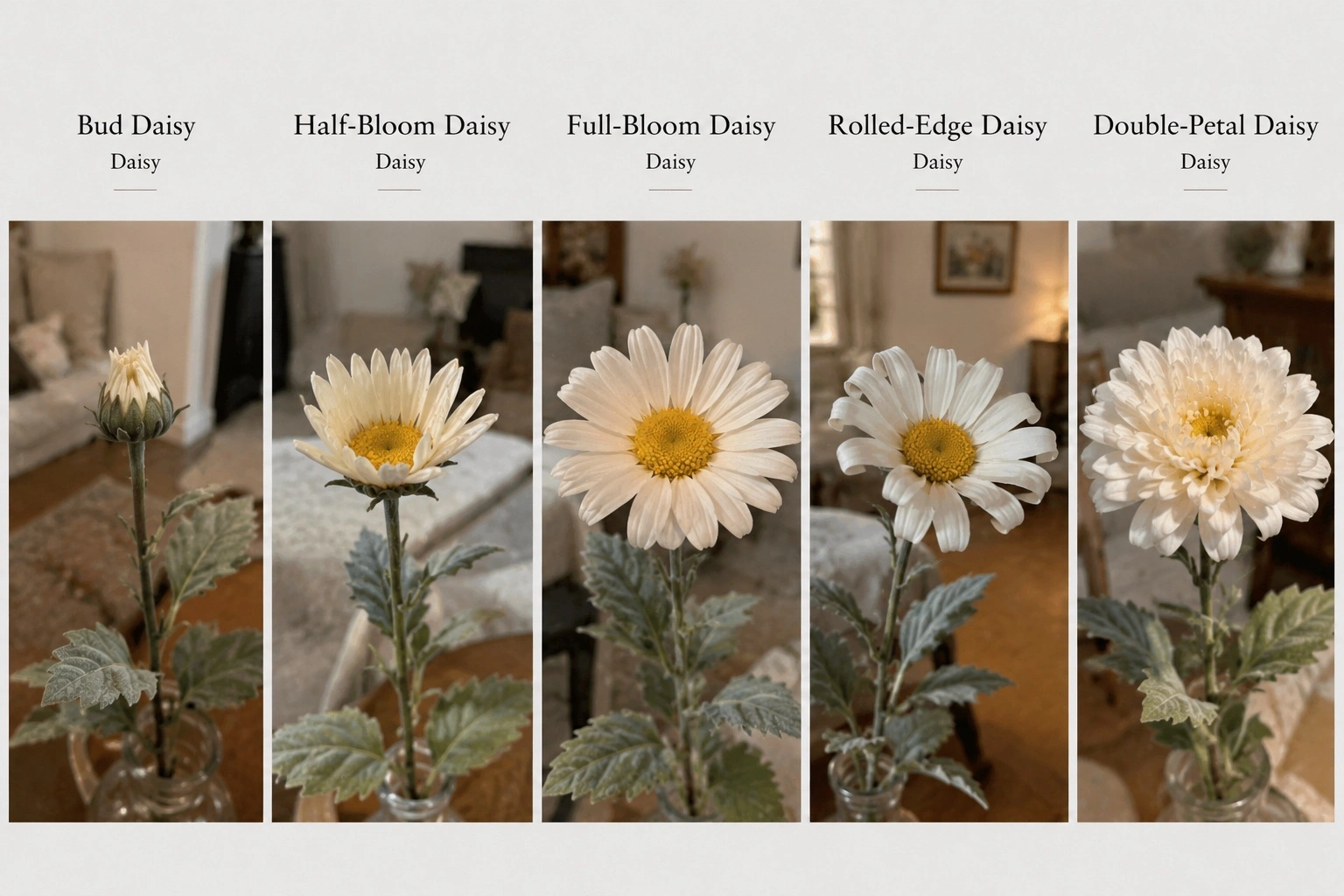
Artificial Half Bloomed Small Daisies look young and fresh, and they're in their natural growth stages, which makes them perfect for rooms with a country theme, spring marketing campaigns, and romantic wedding table settings. When the flowers are only partly open, they give the designs movement and depth. On the other hand, full bloom varieties show age and plenty that work well in formal settings or maximalist design styles. Your seller should keep both types in stock with the same sizes. Artificial Half Bloomed Small Daisies are usually 3–4 cm across, and full blooms are 5–6 cm across.
Material Trade-offs Across Applications
High-density silk cloth looks more real than lower-grade plastics because it has matte finishes that let light pass through naturally, instead of adding a fake sheen. This choice of material is important for close-up uses like restaurant decorations or sleeping hotel room accents, where people touch and look at them. Silk types also absorb colors better for custom dye requests, which makes it easier to match brand colors for business installs.
"Real Touch"-labeled latex-coated polyester options fake moisture content to make believable dewdrop effects for places with lots of photos, like weddings. But these materials need to be handled more carefully and need to be replaced less often than silk choices. For projects that need to stay within their budget, foam-core structures could be used for long-range watching, like in ceiling installations or background walls where touch isn't needed much.
Color Portfolio and Customization Scope
In Morandi schemes that emphasize soft luxury, standard color choices usually include white, cream, yellow, light pink, light purple, orange, and green. Advanced sellers offer Pantone matching services for custom color development, but the minimum order quantity usually goes up as the customization gets more complicated. During negotiations with the supplier, make sure you know if color samples go through review rounds before the full production starts, and if small batch differences are within acceptable tolerance ranges, which for hand-dyed silk goods are usually ±5%.
How to Conduct Due Diligence and Verify Supplier Credibility
Vetting partners carefully keeps you from making mistakes that cost a lot of money and keeps your Artificial Half Bloomed Small Daisy buying image safe. My due diligence protocol includes digital study, analysis of physical samples, and checking references at several different places of contact.
Reputation Research and Third-Party Validation
Do a lot of research online first. Look at provider websites to find pictures of the production facility, information about the team's qualifications, and comments from past clients. Genuine providers show clear pictures of their production methods instead of generic stock photos. Check claims against B2B sites like Alibaba or Global Sources, paying close attention to past transactions, reaction times, and records of how disputes were resolved. In the Artificial Half Bloomed Small Daisy business, some independent trade groups put out member listings with checked qualifications that are worth looking at.
Staff members who have been with the company for a long time may indicate that it is stable, while high management turnover may be a sign of problems within the company that affect the regularity of service. Attending industry trade shows, like the National Hardware Show or NY NOW, shows loyalty to the market and gives people a chance to meet and talk about ideas before signing a contract.
Sample Evaluation Protocols
Ask for complete sample kits that come with different color options, bloom angles, and models of packaging. As soon as you get it, test it in a way that goes beyond a visible review. Gently pull petals to see how well they are attached, bend stems through full rotation cycles to see if wires are exposed, and put samples in bright sunlight for 72 hours to see if the color stays the same. When you look at the flower textures up close, you can see the fiber uniformity and the depth of the dye penetration.
Samples should come with quality records that explain what the materials are made of, the results of colorfastness tests, and the times that the samples were made. Legitimate providers are happy to give you this information, but vague answers could mean that there are problems with quality control. Take pictures of models from different angles and in different lighting conditions so that you can share them with your own design teams or with clients who need to give their approval before placing big orders.
After-Sales Support Evaluation
Supplier ties go beyond the delivery of goods. During the initial talks, make up possible situations to see how quickly you can respond to claims of damaged shipments, pressing reorder requests, or changes to product specifications in the middle of a contract. Take note of reaction times, attitudes that focus on finding solutions, and readiness to meet reasonable requests. Suppliers who offer clear guarantee terms—usually between 6 and 12 months for manufacturing defects—show that they are sure of their quality standards.
Ask current clients in your business segment for their contact information. Talking to present customers can give you useful information about how to communicate, how well problems are solved, and whether the source keeps up service quality as order volumes rise. Be wary of providers who won't give you recommendations; this is often a sign that they have a history of bad service.
Best Practices for Negotiating and Building Long-Term Partnerships
For Artificial Half Bloomed Small Daisy supplier relationships to last, there needs to be an organized way to negotiate and a way for both sides to work together on a regular basis. My method is based on three main ideas: clarity, flexibility, and mutual responsibility.
Contract Term Precision
Write deals that spell out the product's details in terms of measurable factors like stem length ranges, color codes, bloom diameter tolerances, and the maximum number of defects that can be shipped in a single order. Include detailed payment plans that are tied to production goals instead of just random dates on the calendar. This will protect both parties in case of delays that were not expected. Think about intellectual property issues if you want special color formulas or custom petal arrangements. Make sure that ownership rights and usage limits are clearly defined.
Minimum order amounts make sure that both your inventory management needs and the ease of the supplier's production are met. Instead of taking artificial limits that put a strain on your cash flow or warehouse space, negotiate MOQs that reflect realistic rates of consumption. Some sellers lower the MOQ over time as relationship numbers rise. This shows appreciation for loyalty and fits the needs of businesses as they grow.
Volume Leverage and Customization Opportunities
By buying from fewer sources, you can get better deals on bulk discounts and more flexible scheduling for production. When yearly procurement plans go over certain levels, ask for tiered price structures that lower costs gradually at set volume goals. These agreements give both parties a reason to keep order flows steady so that unpredictable buying habits don't mess up production plans.
Premium suppliers are different from basic suppliers because they can customize their products. Along with standard color changes, you could look into the possibility of custom petal forms, stem lengths that fit certain vase sizes, or labeled wrapping that makes unboxing more fun. With dedicated design teams and modern production facilities, Cloud Floral Art is a great example of a provider that can use iterative collaboration processes to turn creative ideas into samples that are ready for production.
Performance Monitoring Frameworks
Set up review meetings every three months to compare agreed-upon measures for release on time, quality consistency, and responsiveness. These structured reviews hold people accountable and help find ways to improve things before small problems become fights that threaten the relationship. Transparent performance discussions also let sellers talk about problems with getting materials or limited capacity before they become a crisis. This way, everyone can work together to solve the problem instead of having to deal with it after the fact.
Long-lasting relationships that work well change over time as the market changes and partners learn how to run their businesses better. If a supplier genuinely cares about the success of your business, for example, by predicting trends, suggesting products ahead of time, or being open when demand changes, they should be given special treatment and be the first ones to be renewed when the contract terms end.
Conclusion
To find a reliable Artificial Half Bloomed Small Daisy seller, you need to carefully look at their product quality, operating efficiency, and ability to work with your business. Give more weight to providers who can show they know a lot about the material by using high-density silk fabric construction, strict quality control methods, and open communication. Doing thorough due research, such as trying samples, checking references, and evaluating after-sales support, lowers procurement risks and builds the basis for a long-term partnership. Clear contractual terms and the ability to make changes are important for relationships to work. This lets your business provide reliable, high-quality floral solutions that meet the needs of a wide range of customers in the retail, event decoration, and hospitality industries.
FAQ
What advantages do artificial half-bloomed small daisies offer over fresh flowers?
When you buy artificial half-bloomed small daisies instead of real ones, you won't have to keep buying new ones because real flowers usually die after 5 to 7 days. They keep their look all year without needing to be watered, sunbathed, or have the temperature controlled, which makes them perfect for businesses that don't have upkeep staff. Because they don't smell or have pollen, they can be used in places where people with allergies are welcome, and they keep bacteria from growing in medical buildings where standing water is a problem.
How do I ensure suppliers meet eco-friendly standards?
Ask for proof that the materials you want to use follow the rules set by REACH for harmful chemicals and RoHS for dangerous substances. Check to see if your providers use low-VOC manufacturing methods, lead-free colors, and plastics that don't contain phthalates. Cloud Floral Art uses water-based colors and eco-friendly polyethylene stem coats that meet international environmental standards. These can be used for projects that need sustainability certificates.
What are typical lead times for bulk artificial daisy orders?
Standard production runs for common color variations generally take 15 to 25 business days from the time the deposit is confirmed until the goods are ready to be shipped. Custom color development adds 7–10 days to the time it takes to get approval for dye formulations. Demand is highest during wedding seasons in the spring and winter holidays. This can add 5–10 days to normal plans, which shows how important it is to place orders ahead of time to make sure they fit with project deadlines.
Partner With Cloud Floral Art for Premium Artificial Half Bloomed Small Daisy Supply
Cloud Floral Art is ready to be your go-to Artificial Half Bloomed Small Daisy maker. They offer reliable OEM customization services along with hyper-realistic workmanship. Our 3–4 cm blooms are made of high-density matte silk cloth and come in a wide range of Morandi colors. They are designed to last in demanding business settings. We offer full customization, from the initial design consultation to the creation of prototypes and mass production, making sure that your exact requirements are met by the finished goods.
Our current production facilities make sure that the quality of all large orders is the same, and we can meet flexible minimum order quantities that work with your inventory management needs. We make it easier for U.S. companies in the hospitality, retail, and event decoration sectors to buy things by providing them with certified eco-friendly materials and quick and easy foreign shipping. Email our team at guoh91278@gmail.com to ask for sample kits, talk about project-specific needs, or look into big pricing models that fit your buying goals. Find out how our knowledge can turn buying fake flowers from a transactional necessity into a strategic relationship benefit.
References
1. Smith, J. & Anderson, K. (2022). Artificial Botanical Quality Standards for Commercial Applications. International Floral Industry Association Press.
2. Chen, L. (2021). "Material Engineering in Synthetic Floriculture: A Comparative Analysis." Journal of Decorative Materials Science, 18(3), 127-145.
3. Roberts, M. (2023). The B2B Buyer's Guide to Artificial Floral Procurement. Supply Chain Excellence Publications.
4. Martinez, S. & Thompson, R. (2022). "Quality Control Protocols for Imported Decorative Products." Global Trade Compliance Review, 9(2), 88-104.
5. Wang, H. (2023). Sustainable Practices in Artificial Flower Manufacturing. Environmental Industry Standards Institute.
6. Davidson, P. (2021). "Long-Term Cost Analysis: Artificial versus Natural Florals in Commercial Settings." Hospitality Operations Quarterly, 15(4), 210-229.
Online Message