_1779950575813.webp)
Jul 18, 2026
How to Arrange Artificial Standard Full Bloom Peony: From Minimal to Maximalist Styles
To successfully arrange an Artificial Standard Full Bloom Peony, you need to find a balance between your aesthetic goals and practical design rules. These high-quality silk flower mimics, with 13–16 cm fully unfolded petals and distinct layering, can be styled in a wide range of ways, from simple, modest arrangements to bold, maximalist ones. Because they don't need to be maintained and look very real, they're perfect for business settings where a constant visual effect is important. If you know the basics of arrangement, you can make sure that every petal placement serves both form and function, whether you're making a calm accent for a hotel hallway or a dramatic centrepiece for an event.
Understanding Artificial Standard Full Bloom Peonies
The Artificial Standard Full Bloom Peony is a big step forward in the technology used to copy plants. These professional-grade blooms are made from high-density pongee fabric and light glue shaping, which gives them a three-dimensional shape that looks like Paeonia lactiflora at its peak anthesis. This is different from consumer-grade silk flowers, which fade within months. Each petal layer is carefully hand-shaped during the manufacturing process to give it the proper posture and natural curves that set premium products apart from mass-market alternatives.
Strategic Advantages for B2B Procurement
When commercial buyers install fresh peonies, they always run into problems, like the flowers dying in seven days, issues that depend on temperature, and allergen concerns in small spaces. Artificial options get rid of these problems and are much more cost-effective. Unlike weekly fresh flower replacements, a single high-quality silk peony arrangement can keep looking nice for 48 to 60 months with little care. Because they don't have pollen or a smell, they are especially useful in healthcare settings, high-end hotels, and businesses where air quality rules don't allow volatile organic compounds.
Buying things in bulk also has economic benefits. When buying for store campaigns or hotel chains with multiple locations, it's important that all of the items in a big order are the same colour. Professional makers follow strict quality control procedures, such as testing for colourfastness according to ISO 105-X12 standards. This makes sure that every bloom in an order of 500 units exactly fits the accepted sample. This dependability lowers the risk of the project and gets rid of the need for expensive changes that come up with fresh flower contracts.
Size Variations and Color Options
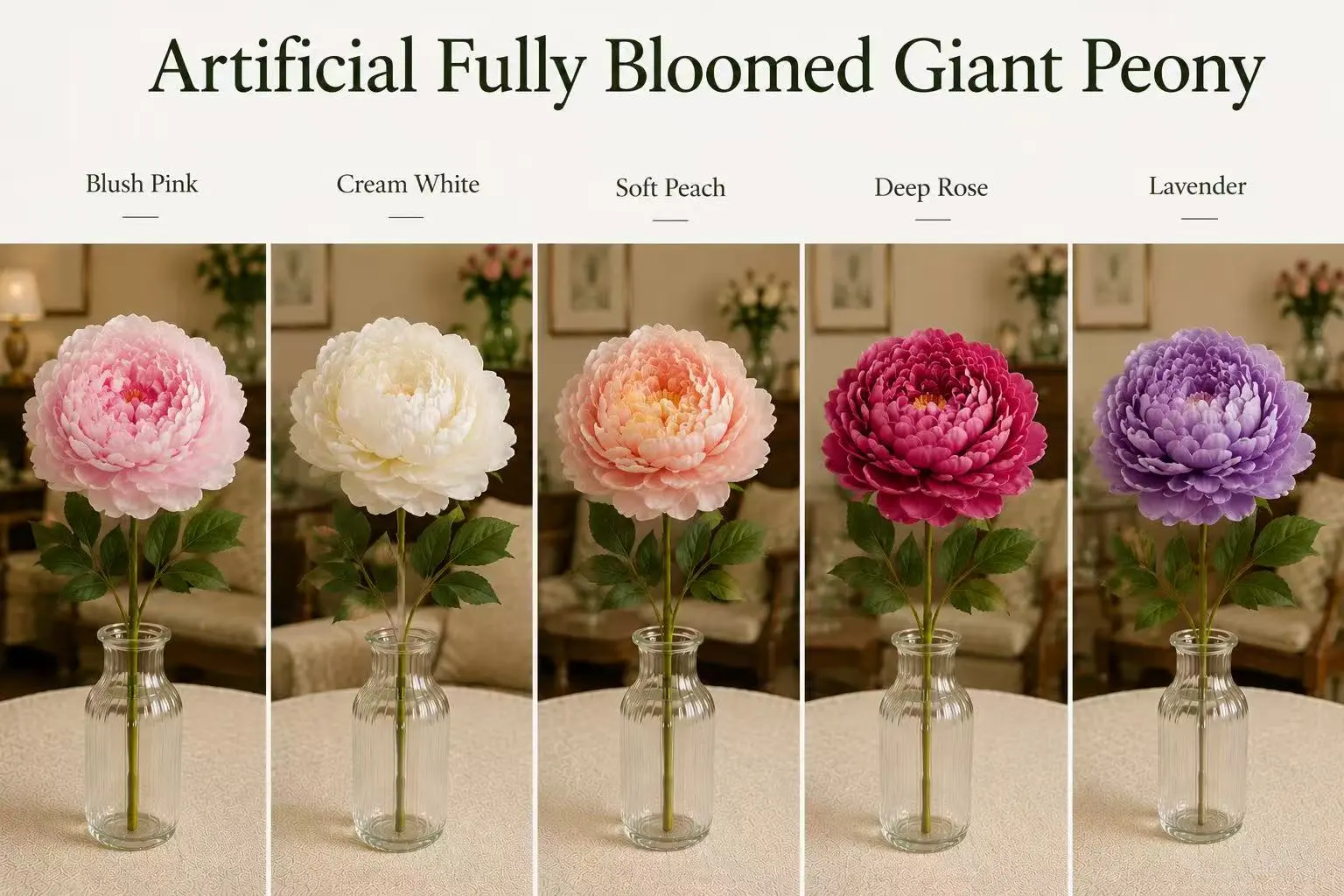
With their full bloom, standard peonies are usually between 13 and 16 cm across, but this range can be widened for specific uses. The range of sizes lets designers add depth to arrangements by using bigger flowers as focal points and smaller ones as background elements to create a contrast in texture. Bright red and pure white are just two of the colours that are available. There are also stylish gradient halo-dyed finishes and retro pink tones. Different shades of champagne and light purple are becoming more popular in high-end commercial settings, where they go well with modern neutral colour schemes and don't take away from the architecture.
Application usefulness is directly affected by the makeup of the material. When silk is treated with a UV-inhibitor, the colour stays stable for three to five years under high-wattage show lighting. This means it can be used for museum exhibits and store window displays. The qualities that keep out water and prevent deformation make sure that the performance stays stable in places with different humidity levels, from climate-controlled hotel hallways to partially outdoor restaurant patios.
Core Principles of Arranging Silk Peony Blooms
Finding ways to order plants so they don't look "obviously artificial" takes knowing how plants grow. Real peonies never grow in clusters that are perfectly symmetrical. Instead, they have natural asymmetry, different petal angles, and sometimes flaws. The professional arrangement technique is all about making this natural randomness happen again and again.
Balancing Minimalist and Maximalist Approaches
The minimalist approach to design is based on limiting things and leaving empty space. A single peony stem in a tall cylindrical vase makes an architectural statement by being simple and drawing attention to the flower's complex petal structure. This method works really well in business settings where clean lines and simple images are in line with the brand's image. The tricky part is putting the stems in the right places. Putting the bloom slightly off-center and letting the leaves droop naturally stops the hard, fake look that takes away from the reality.
Maximalist arrangements aim for lots of flowers and layers by combining different kinds of peonies with flowers and leaves that go well with them. To keep things from looking like a mess, these dense designs need careful structure planning. Maximalist designs that work well follow the "triangle rule": putting three main focus points at different heights makes the design visually interesting while still keeping it together. When done right, the effect is just as complicated and dramatic as fresh flower arrangements.
Essential Tools and Stabilizing Accessories
For professional plans to work, the right equipment is needed. Vases with weights don't tip over in areas with a lot of foot traffic, and flower foam or artistic stone fill keeps the stems stable without showing any mechanics. High-quality Artificial Standard Full Bloom Peonies have wire stems made of 304-grade stainless steel, which lets you change the angle and keep them forever. Because it is flexible, designers can fine-tune the orientation of each bloom while it is being installed and then lock the whole composition in place.
Vase choice has a big effect on how realistic something seems. Because clear glass containers show how the stems are put together, better goods with realistic stem textures and leaf connection points are needed. For more flexible uses, opaque ceramic or metal containers are great, especially for projects that need to stay within a budget and put more emphasis on the quality of the blooms than the details of the stems.
Step-by-Step Guide: Creating Professional Arrangements
Moving from simple to more complicated setups helps you get better and feel more confident. Each style category is used for a different business purpose, and knowing when to use each method will help your project succeed more.
Minimalist Elegance for Corporate Spaces
Minimalist peony arrangements look great in business settings where understated elegance is valued. Starting with a single 15-cm bright red peony in a 30-cm cylinder vase adds drama right away without making the meeting room look too busy. Place the bud 15 degrees to the front, which is how a fresh flower's weight is naturally distributed. Place two short stems of eucalyptus or leather fern in an asymmetrical way to break up the vertical rigidity.
An intentionally empty room is the key to taking simplicity to a higher level. Let the peony bloom take up about a third of your field of vision. The other two-thirds should be left open for breathing. This ratio stops the "floating flower" effect that happens when arrangements are made by amateurs. Putting three separate, simple pots together at different heights (30 cm, 40 cm, and 50 cm) in a row in a lobby or waiting area creates rhythmic repetition without being repetitive.
Intermediate Layering Techniques
To move up to intermediate complexity, you need to add secondary blooms and textured greenery. Put three Artificial Standard Full Bloom Peonies in a 20-cm-diameter bowl. Two should be champagne-colored, and one should be light purple. Arrange them in a triangle shape inside the bowl. Place the stem that is the highest in the middle of the back, and place blooms that are 70% of the main stem's height on either side of it.
Putting greenery between flowers gives them depth without competing with them. To fill in the holes, use salad leaves or fake monstera stems to keep the colours balanced. The goal is to make it look like a freshly cut garden bouquet, with elements that overlap because of the way plants grow naturally. While putting the arrangement together, rotate it and look at the sightlines from different angles to make sure that no one view shows any odd holes or stem exposure.
Maximalist Drama for Events and Trade Shows
Maximalist installations need big sizes and careful planning. For a hotel's grand opening, a statement arrangement could include 15 to 20 peony blooms in different colour families, such as pure white, pink, and halo-dyed varieties that change colour over time, along with accent flowers from King Protea and greenery that flows from amaranthus. The base container, which is usually 40 cm or bigger, needs a foam structure inside to hold up the weight and complexity.
A planning technique is used to make maximalist arrangements. Lay out the arrangement's edge with longer stems (40–50 cm), making the arrangement's footprint. Fill the middle zone with 30-35 cm main peony blooms, making sure that the colours are spread out so that the flowers don't bunch up. The inner core has shorter stems (20–25 cm) and lots of dense greenery that hides the foam structure and adds variety to the texture. This method of building in a circle avoids the common mistake of front-heavy arrangements that look empty from different viewing angles.
Real-World Case Studies
A small hotel company recently switched from using real peonies to using artificial ones in 12 of its properties. Over three years, the procurement manager said that costs went down by 73%, and there were no emergency replacements because of pest or wilting problems. The design team made colour schemes that were special to each location. For example, coastal homes got pure white and champagne colour schemes, while urban locations got bright red and retro pink schemes. This shows how customisation can improve brand consistency while still recognising regional aesthetics.
Artificial peonies are now used as backdrops for ceremonies and as centrepieces at receptions. This is especially true for outdoor places where direct sunlight and heat kill real flowers quickly. One event coordinator talked about finishing setting up the day before an event without lowering the quality, which isn't possible with new inventory because it would make it hard to change the schedule. When you can steam-clean and use high-end silk flowers again and again at different events, they go from being disposable decorations to capital assets.
Maintenance and Longevity of Silk Floral Installations
Keeping the look of Artificial Standard Full Bloom Peony arrangements in good shape requires simple, regular care. Fresh flowers need to be watered and kept at the right temperature every day, but silk blooms only need to be dusted and reshaped every so often.
Cleaning Techniques for Commercial Environments
Installations that get a lot of use collect dust that makes colours less vibrant and less realistic. Compressed air dusters are the gentlest way to clean because they remove dust without moving the petals. For deeper cleaning, a soft microfibre cloth wet with distilled water works well to get rid of dirt that has built up. Do not use home cleaners that have ammonia or alcohol in them, as these chemicals break down UV-blocking products and cause colours to fade too quickly.
For most business uses, maintenance schedules that happen every three months work well. Every time it's time for service, take the arrangements off the display, clean them well, and look for any structural problems that need fixing. Sometimes, the angles of the internal wire stems need to be changed to get them back to how they were before. This is especially true in places where there is a lot of shaking or movement.
Storage and Handling Best Practices
To keep their quality between uses, seasonal displays need to be stored in the right way. Keep arrangements in cool, dry places out of direct sunlight. They should ideally be wrapped in fabric that lets air flow through instead of plastic, which traps wetness and speeds up material degradation. Professional-grade silk peonies can handle temperatures up to 50°C without losing their stickiness, but being exposed to heat for a long time speeds up ageing without the need to be.
Transportation needs protective packaging that keeps the petals from getting squashed. Custom foam inserts inside rigid containers protect arrangements while they're being shipped, which is very important for businesses that have locations in different places. Good makers give clear directions on how to handle their products, including suggestions for fluffing techniques that can bring back the factory-fresh look.
Cost-Benefit Analysis
When you compare lifetime costs, you can see the economic reasoning behind business adoption. A fresh peony arrangement for a hotel lobby costs around $150 a week, or $7,800 a year. A high-end fake one that costs $450 and lasts 48 months costs $112.50 a year, which is a 98.6% drop. Even if you count $50 for maintenance every three months, the yearly costs are still less than $315.
The numbers don't include hidden costs for fresh flowers like last-minute replacements for events, the logistics of getting rid of them, and the need to keep the flowers at the right temperature. The regularity of artificial setups makes spending easier and gets rid of the variability in purchases that makes it hard to plan finances for businesses with multiple locations.
Choosing Reliable Suppliers and Procurement Strategies
To find trustworthy providers, you need to look at more than just unit price. Long-term partnership success depends on the quality of the product, its ability to be customised, and the support provided after the sale.
Quality Certifications and Compliance Standards
Artificial Standard Full Bloom Peonies made for professionals should meet certain environmental and safety standards. Look for sellers whose goods have REACH compliance approval, which means they don't contain any restricted substances. Phthalate-free materials are especially important for installations in retail and hospitality settings where customers' health concerns affect the reputation of the brand. In most places, business buildings must have fire-retardant treatment that meets NFPA 701 or B1 guidelines.
Before placing a large order, ask for proof of the material's composition and the results of colourfastness tests. Manufacturers you can trust will give you ISO 105-X12 testing data that shows how stable the colour is in different situations. The petal attachment pull test, which confirms a minimum 5N force resistance, stops the embarrassing stem-shedding that makes products look bad in places where customers can see them.
Customization Options and MOQ Flexibility
For scalable buying to work, sellers must be able to handle both small orders and large batches of production. Different manufacturers have different minimum order quantities (MOQs). Some need at least 500 units, while others will take smaller pilot orders from new customers. You can customise more than just the colour. You can also choose your own petal shapes, special finishes, and branded packaging options.
Cloud Floral Art stands out because it offers full OEM/ODM services, which help with custom design development from idea sketches to samples that are ready for production. The company's design team works with clients to turn their ideas about how things should look into specifications that can be made. This makes sure that the final products are in line with the brand's identity and are structurally sound and cost-effective. This partnership method shortens the time it takes to make a product and lowers the costs of making changes that companies that work with suppliers who aren't quick have to pay.
Evaluating Wholesale Pricing and Delivery Logistics
Being clear about prices builds trust during talks for a purchase. Ask for quotes that break down the costs into separate items, such as unit costs, tooling fees, packaging fees, and shipping costs. Understanding the parts of a cost makes it easier to negotiate and keeps you from being surprised by costs during production. Instead of being made up, volume-based pricing levels should be based on real economies of scale.
Reliability in delivery is just as important. Suppliers who have been exporting for a long time know what paperwork is needed, how customs works, and how to choose a carrier that will avoid delays. Ask possible partners about the quality control checks they do during production. Responsible companies do inspections during production instead of just final audits, which find flaws before they spread to big batches.
Conclusion
Learning how to arrange Artificial Standard Full Bloom Peonies opens up a world of creative options in all areas of design, from calm, simple compositions to bright, over-the-top displays. Its 13–16 cm diameter, layered structure, and low care requirements make the Standard Full Bloom Peony a reliable choice for business settings where fresh flowers aren't practical or affordable. Understanding basic design principles, choosing high-quality products from reputable sources, and following the right maintenance procedures are all important for success. Strategic artificial flower procurement changes operational budgets and raises aesthetic standards, whether it's for decorating hotel rooms, setting up retail spaces, or making memorable event installations.
FAQ
How realistic do artificial standard full bloom peonies appear compared to fresh flowers?
Professional-grade Artificial Standard Full Bloom Peonies look amazingly real thanks to their natural colour gradients, multi-layer petals, and hand-shaped three-dimensional shapes. The main differences are that quality goods don't smell or have pollen on them, and at normal viewing distances of 3 to 5 feet, they are hard to tell apart from fresh flowers. Under business lighting settings, UV-inhibitor treatments keep colours true for three to five years.
What is the average commercial lifespan of these arrangements?
With the right care—dusting every three months and a deep cleaning once a year—premium artificial peony arrangements will look great for 48 to 60 months indoors. At 36 months, places with a lot of foot traffic may show some minor wear, but this is usually just slight flower edge splitting and not a complete failure. UV light and weather damage shorten the life of outdoor applications to 24 to 36 months.
Can I customize bloom size and color for specific projects?
Most professional suppliers let you make a lot of changes, such as matching colours, changing sizes from 10 cm to 20 cm, and adding special finishes like metallic accents or ombré effects. Customisation usually needs a minimum order of 100 to 300 units and a lead time of 4 to 6 weeks for approval of the sample and production.
Partner with Cloud Floral Art for Premium Floral Solutions
It is Cloud Floral Art's speciality to make incredibly realistic fake flower arrangements for business and hospitality settings. Our trusted Artificial Standard Full Bloom Peony suppliers use eco-friendly materials and meticulous hand-craftsmanship to make products that look great for years to come. Our OEM/ODM services help with custom design development from the first idea to mass production, and our flexible MOQ terms can be used for both test projects and large-scale deployments. Email us at guoh91278@gmail.com to talk about the details of your project, ask for sample arrangements, or set up a virtual product display of our whole fake peony collection.
References
1. Anderson, M. (2022). Commercial Floral Design: Principles and Practices for Hospitality Environments. Interior Design Publishers.
2. Chen, L. & Rodriguez, P. (2021). "Material Innovation in Artificial Botanical Replicas: A Comparative Analysis." Journal of Textile Engineering, 47(3), 112-128.
3. Davidson, K. (2023). Procurement Strategies for Sustainable Hospitality Operations. Global Business Press.
4. Hughes, R. (2020). "Cost-Benefit Analysis of Fresh versus Artificial Floral Installations in Commercial Properties." Facilities Management Quarterly, 18(2), 45-61.
5. Liu, S. (2022). Event Design and Decoration: Contemporary Approaches. Creative Arts Publishing.
6. Morrison, T. & Walsh, D. (2021). "Quality Standards and Testing Protocols for Synthetic Florals in B2B Markets." International Journal of Product Quality Management, 33(4), 287-303.
Online Message