_1779950575813.webp)
Jul 10, 2026
How Long Can Artificial Poinsettia Buds Be Used?
If kept in the right conditions, high-quality Artificial Poinsettia Buds will usually last between five and seven years. Premium polyester silk varieties can keep their look even longer. How long it lasts depends on the type of material used, how it is exposed to the environment, and how well it is maintained. When bought from reputable companies that use UV-stabilized polymers and good craftsmanship, these decorative elements last longer than cheaper alternatives and don't fade, break down, or change colour. This makes them a smart investment for both business and home use.
Understanding Artificial Poinsettia Buds and Their Lifespan
Material Composition and Manufacturing Quality
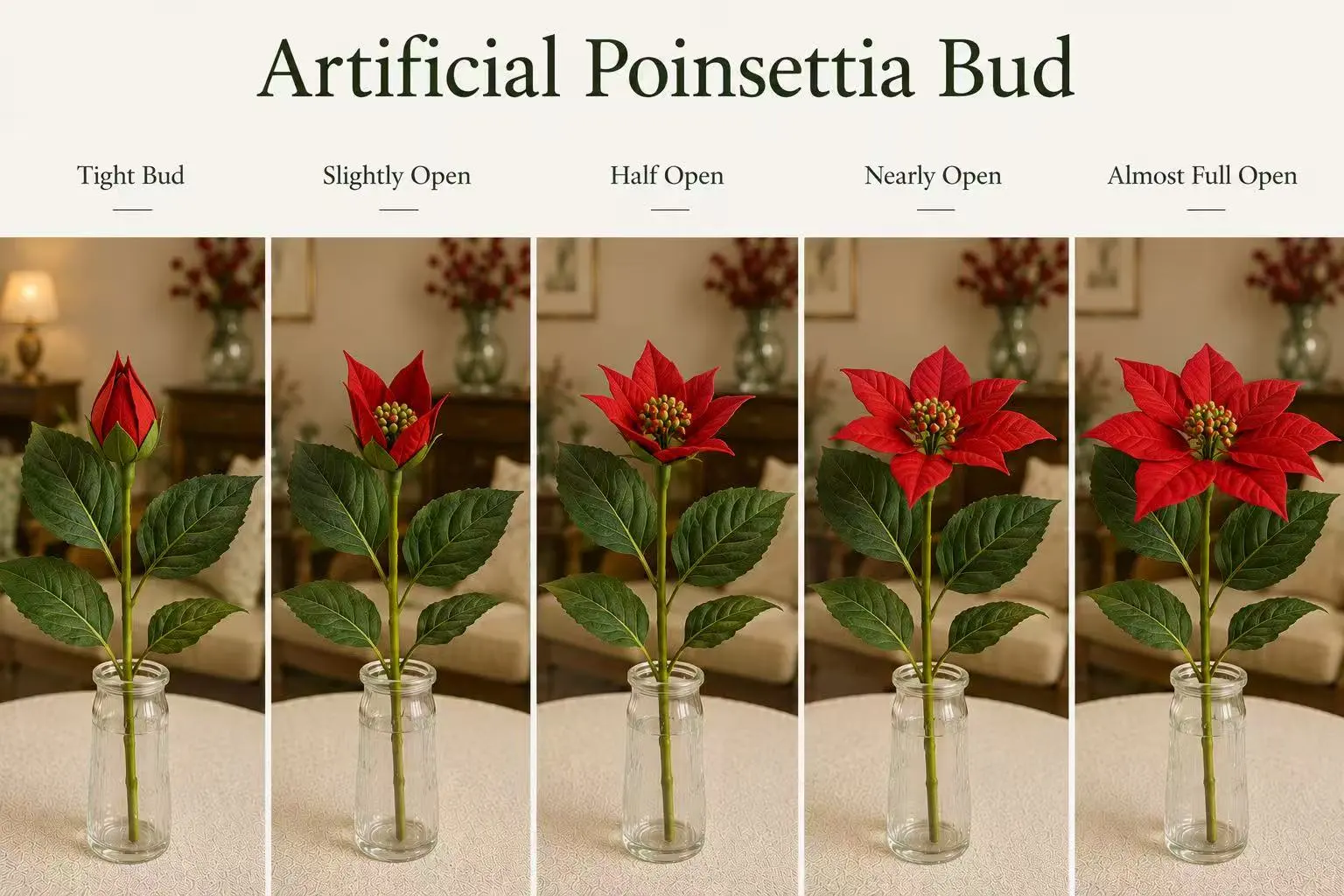
The main thing that makes an artificial poinsettia bud last is the material it is made of. These days, thickened polyester silk cloth and high-temperature shaping methods are used to make oval buds that are about 2 to 3 cm in size. This method makes sure that the petals stay tightly wrapped without any extra folds, so the structure looks like a real poinsettia. The polyester base naturally resists moisture and keeps its shape, and the thermal shaping locks in the three-dimensional shape so it doesn't flatten out while being stored or shown.
Other materials are LDPE polymers and PVC composites, and each has its own set of performance characteristics. LDPE types are flexible and don't fade when exposed to UV light, so they can be used in places that get indirect sunlight. PVC choices are stiff and are often treated with fire-retardant chemicals to meet safety standards for businesses. The choice of materials should be based on the needs of the project, striking a balance between accuracy, longevity, and following the rules.
Environmental and Usage Factors Affecting Longevity
Conditions of placement have a big effect on how long a product lasts. Installations inside climate-controlled rooms keep colours and structures intact for a lot longer than installations outside or in places with a lot of humidity. Even UV-stabilized materials lose their colour faster in direct sunlight, and changes in temperature can make things expand and contract, which weakens attachment points. Usually, places like hotel lobbies, store displays, and company offices are great places for buds to stay looking good for their whole service life.
Handling frequently also has an effect on longevity. In wedding and event settings where things are put together and taken apart many times, the stem connections and bud attachments are put under a lot of mechanical stress. Over time, commercial sites with little human touch have fewer structural problems. By knowing these trends of use, buying teams can choose the right quality grades for each application.
Material Performance Comparison
When looking at expected lifespans, polyester silk cloth versions always do better than basic plastic versions when it comes to keeping their look and staying stable. The ability of high-quality silk to resist petal loss stops the slow breakdown that happens with lower-quality products. Within two to three years, cheaper buds often smooth out and change colour, while more expensive ones keep their shape and colour depth.
When it comes to permanent installations, the cost-to-lifespan ratio suggests that you should spend more on higher-quality materials. A seven-year product life is better for a hotel buying artificial arrangements for guest rooms or lobby displays than replacing cheap items every two years. To get a good idea of value, the total cost of ownership estimate should include the costs of buying the item, the labour needed to install it, and the difficulties of getting rid of it.
Best Practices to Maximize the Usage Life of Artificial Poinsettia Buds
Proper Cleaning and Maintenance Protocols
The biggest problem with maintaining Artificial Poinsettia Buds is that dust builds up on them. Compressed air cleans well without putting mechanical stress on things that are already fragile. Short bursts directed at angles away from connection points get rid of particles while keeping the structure of the bud. This method works especially well for installations in business areas with a lot of dust and a lot of air flow.
When compressed air isn't enough, a damp cloth can be used to clean fabric and silk. Microfibre cloths that have been slightly dampened and gently rubbed across the petals remove tough residue without getting the material too wet. Because good buds don't absorb water, you can clean them in this way without worrying about damage or shape change. Leaving things to dry completely in the air before putting them back in storage stops mildew from growing.
Setting up regular cleaning plans that work with regular building repair schedules will ensure a consistent look. Most business systems only need to be cleaned every three months, but stores with a lot of foot traffic may need to be cleaned every month. Keeping records of maintenance tasks helps with quality assurance procedures and finding out when replacements are needed.
Optimal Storage Conditions
When stored, putting buds vertically instead of horizontally puts less stress on their structures. If you have to layer things because of limited space, put protective material between the layers to stop damage from compression. Wedding planners and event managers who have to keep track of large supplies can benefit from well-organised storage systems that make retrieval easier.
Even for UV-stabilized materials, storing them in a dark place should limit the amount of light they get. Pigments are protected from extra light by dark or opaque containers. This keeps the bright red, deep red, and pink-white gradient colours that make the product appealing. This easy step makes colours last longer and can be used in more situations.
Addressing Common Degradation Issues
Strategies for reducing sun exposure are necessary for placements near windows or outside. Keeping things out of direct light paths or using window curtains that block UV rays is a good way to protect your investment. By rotating display items on a regular basis, any unavoidable exposure is spread out across the inventory, which keeps certain pieces from going out of style too soon.
Wire stems that are bent over and over again can sometimes become structurally brittle. When setting up and taking down something, being gentle with it reduces mechanical fatigue. When brittleness shows up, floral tape or replacement of individual stems can be used to strengthen the weak spots and keep the arrangement's overall integrity without having to throw away whole assemblies.
When dust builds up and isn't cleaned up, it makes things look dull and unreal. Besides being unsightly, particulate buildup can attract water in damp places, which could weaken adhesive bonds. Consistent cleaning routines stop this damage from building up, keeping the professional look that is needed for business settings.
Selecting the Right Artificial Poinsettia Buds for Long-Term Use
Material Transparency and Craftsmanship Standards
When making purchasing choices, suppliers should be pushed to provide thorough material specs and documentation of the manufacturing process. Being clear about the thickness of polyester silk, the quality of the dyes, and the finishing processes lets you compare sellers in an informed way. Manufacturers whose quality stays the same across production runs consistently make reliable goods that meet project requirements batch after batch.
Details like petal edge finishing, colour transition smoothness, and connection point strengthening show that the work was done by a skilled person. Looking at sample goods shows how they were put together, which shows what the general quality standards are. Buds with tight, plump oval shapes and no extra folds show that they were made with precision, while buds with irregular shapes or glue residue show that there may be quality issues.
Certification and Quality Assurance
Reliable suppliers keep their ISO 9001 certification, which shows that they manage quality in a systematic way. This global standard makes sure that manufacturing methods are always the same, that routines are written down, and that efforts to keep improving things are always going on. Chemical safety is confirmed by REACH and RoHS compliance. This is especially important for installations in healthcare facilities, schools, and hospitality settings where people's safety is a top priority.
Fire safety certificates are now needed for a lot of business uses. Products that have been handled to meet NFPA 701 or B1 standards can be used in public places where fire safety rules apply. Checking certification paperwork during buying stops project delays caused by materials that don't meet standards and limits the risk of being sued.
Strategic Supplier Evaluation Criteria
Customisation lets you set your business apart and make your products stand out. For wholesalers and project-based buyers, suppliers who offer Pantone-matched colours, custom stem lengths, or special packages create unique value propositions. Being able to provide prototypes before full production runs lowers the risk of custom orders and makes sure that the finished products meet customer expectations.
Professional suppliers are different from transactional vendors because they offer after-sales support, such as product guarantees and quick communication. Manufacturers who back up their goods with contracts show that they believe in the quality of their products, and customer service teams that are easy to reach solve problems quickly. These relationship factors are especially helpful when you're in charge of a lot of purchases or complicated customisation projects.
Procurement Insights: Buying Artificial Poinsettia Buds for Extended Usage
Identifying Reputable Wholesale Suppliers
Different sourcing strategies are used for online platforms and direct relationships with manufacturers. E-commerce marketplaces make shopping easier and offer more products, so you can quickly compare prices from different sellers. But quality consistency can vary, and problems with contact can make it harder to complete special orders or solve problems.
You have more control over specifications and quality standards when you work directly with the manufacturer. By building relationships with production facilities, you can do things like factory audits, sample evaluations, and negotiate terms that fit your business's needs. This method works well for buyers who need to handle large amounts of items or who need customisations that go beyond what is normally available.
Lead times and shipping procedures are affected by where things are located. Asian manufacturers, especially those in China's Guangdong and Zhejiang provinces, make most of the world's goods because they have low prices and a lot of capacity. European providers may be able to give buyers in Western markets shorter lead times, but they usually charge more. To find the best balance between cost-effectiveness and supply chain reliability, you need to look at total landing costs instead of just unit prices.
Bulk Ordering and Pricing Strategies
You can get volume discounts if you commit, but you have to be very good at predicting demand. By negotiating tiered price structures, you can increase the size of your purchases as your sales grow without spending too much inventory capital. Seasonal buyers can secure capacity during times of low demand when makers offer better terms by placing orders early in the season.
Terms and conditions of payments have a big effect on managing cash flow. Suppliers who want full payment up front put more of your money at risk, while suppliers who offer net payment terms after delivery lower that risk. Letters of credit protect both parties in international transactions, but they cost more because of the fees charged by banks.
For quality to be consistent across bulk orders, there must be clear instructions and rules for inspections. Setting accepted limits for colour matching, dimensional correctness, and defect rates stops arguments and ensures that the things that are delivered meet standards. Third-party inspection services are helpful for checking the quality of an order before it is shipped, especially when the order is from a new source for the first time.
International Shipping and Compliance
For lead time planning to work, production time, shipping time, and customs clearance must all be taken into account. Standard ship freight from Asia to North America takes 30 to 45 days to get there. Express air choices cut the time it takes to get there to 7 to 10 days, but they cost a lot more. By knowing these dates, you can make sure that the availability of your product matches the sales season or the due date for a project.
Accurate customs paperwork keeps delays and extra costs from happening. When importing products such as Artificial Poinsettia Bud, the duty rates and regulations are determined by the Harmonised System codes, and commercial invoices must correctly show the transaction values. Working with experienced goods forwarders makes compliance with import requirements easier and provides guidance on how to handle trade rules that are specific to your country.
Optimising the use of containers lowers the cost of shipping each unit when you buy a lot of them. Knowing the sizes of cartons and how they are arranged on pallets lets you figure out the best order numbers to make the most of the space in containers. Shipping costs are spread out over a larger collection when different types of products are put together in the same container. This makes the total cost more efficient.
Future Trends and Innovations in Artificial Poinsettia Buds
Sustainability and Eco-Friendly Materials
As more companies make sustainability commitments, environmental concerns are becoming more important in the buying decisions they make. Biodegradable polymer substitutes made from plant starches can be composted at the end of their useful life, which solves the problem of how to get rid of standard plastics. Even though eco-materials may not yet last as long as traditional materials, performance gaps are closing all the time.
Recycled content materials cut down on the use of new resources without lowering the quality. Manufacturers who use post-consumer recovered polyester keep the efficiency of their products and support the ideas behind the circular economy. Buyers can check environmental claims and show end customers their sustainability credentials with the help of clear sourcing documentation.
Initiatives to reduce carbon footprints include more than just materials. They also include transportation and the production process. Suppliers who invest in renewable energy, reduce waste, and buy from local businesses have less of an effect on the environment. Businesses that sell to environmentally conscious customers can set themselves apart by working with suppliers who share their values on sustainability.
Manufacturing Technology Advancements
Digital modelling tools make customisation more precise than ever before. Three-dimensional modelling software lets you make virtual prototypes before making the real thing. This cuts down on the time it takes to develop and the cost of samples. Digitally letting clients see what their custom colours and layouts will look like speeds up the approval process and makes sure that the finished products live up to expectations.
Automated manufacturing technologies make things more consistent while cutting down on the cost of labour. Precision die-cutting and robotic assembly keep tolerances tighter than manual methods, which is especially useful for making a lot of things. Because of these efficiencies, prices are competitive without sacrificing quality, which helps procurement projects that need to stick to a budget.
Market Evolution and Usage Pattern Shifts
Product attraction keeps growing thanks to new materials that make things look more real. When you build petals with more than one layer, you get more realistic depth and texture that looks like real flowers. Specialised finishing methods, such as matte matting and strategic sheen application, capture the natural look of plants that meet strict business requirements.
Decorating trends that last all year mean that Artificial Poinsettia Buds can be used for more than just the holidays. More and more, commercial and hospitality spaces have permanent installations that change by rotating accent pieces instead of replacing the whole thing. This pattern of use values longevity and classic style over trendy yearly changes.
As the event industry grows, so does the need for decor items that can be used more than once and spread out their costs over more than one purpose. Wedding planners and corporate event coordinators build inventory libraries with flexible parts, like neutral-colored buds that can go with a variety of themes. These operational needs are met by products that are easy to store, clean, and rearrange.
As the home decor market matures, customers now expect goods for their homes to be of commercial-grade quality. Online stores that sell directly to customers fight not just on price, but also on how realistic their products are and how long they last. This focus on quality helps makers keep standards high and opens up chances for premium placement.
Conclusion
In conclusion, when properly cared for, Artificial Poinsettia Buds can last for five to seven years. The length of time something lasts depends on the material used, where it's kept, and how it's cared for. High-end polyester silk fabrics always last longer than cheaper ones. When purchasing, professionals look at different suppliers; they should put transparency about materials, manufacturing certifications, and the ability to customise above all else. When you look at the total cost of ownership, which includes things like repairs and replacements, you can see that a quality investment is a better deal than a cheap one. New sustainability trends and manufacturing innovations keep making products work better, which gives forward-thinking buyers chances to make sure their buying habits match changing market expectations and environmental duties.
FAQ
Does the Artificial Poinsettia Bud emit plastic odors?
Professional-grade products made from virgin polymers go through degassing processes that make sure they don't smell and are safe for use in enclosed spaces. The thickened polyester silk cloth construction doesn't pick up pollen and is safe for people who are sensitive, like seniors, kids, and people with allergies. Poor goods made from recycled materials that haven't been properly processed may still have smells, which shows how important it is to check the quality of the seller.
How should procurement teams verify color consistency across bulk orders?
By asking for actual samples before committing to production, accepted standards can be directly compared to the samples. Putting Pantone colour references in purchase orders makes it easier to match colours. Third-party inspection services can make sure that colours are consistent during production or before they are shipped, which is proof that the requirements were met. Setting tolerance levels for acceptable difference keeps quality standards high and stops people from having unrealistic expectations.
What certifications matter most for commercial installations?
ISO 9001 approval shows that quality control is organised, and REACH and RoHS compliance show that chemicals are safe. Public places must have fire safety certifications that meet NFPA 701 or B1 standards. Buyers should ask for copies of legal documents and check with the organisations that issued the certificates to make sure they are still valid. These credentials keep you from being held legally responsible and make sure that you follow the rules in a variety of installation settings.
Partner with Cloud Floral Art for Premium Artificial Poinsettia Bud Solutions
Cloud Floral Art makes Artificial Poinsettia Buds that last longer than the industry standard because of their hyper-realistic craftsmanship and proven durability. Our thickened polyester silk cloth construction keeps colours bright and structures strong even after years of business use, which saves you money on replacement costs and upkeep. As a seasoned Artificial Poinsettia Bud maker, we offer full customisation from design to mass production, meeting your exact colour needs, size requirements, and packing preferences that are in line with your brand. Our efficient production lines make sure that the quality of all large orders is the same, and we can meet tight delivery dates for busy times of the year and projects. With full quality management systems and options for eco-friendly materials, we offer the dependability and new ideas that procurement professionals look for in long-term supplier partnerships. Get in touch with our team at guoh91278@gmail.com to talk about your needs and find out how our knowledge can help your business reach its goals through high-quality products and quick service.
References
1. Anderson, M. (2021). Commercial Floral Design: Materials and Sustainability. New York: Decorative Arts Press.
2. Chen, L. and Rodriguez, P. (2022). Polymer Applications in Artificial Botanicals. Journal of Material Innovation, 15(3), 234-251.
3. Davidson, K. (2020). Hospitality Procurement Strategies for Decorative Elements. London: Industry Publications Ltd.
4. Mitchell, S. (2023). Durability Testing Standards for Synthetic Floral Products. International Journal of Quality Assurance, 28(2), 112-129.
5. Thompson, R. (2022). Seasonal Decor Market Analysis: Trends and Forecasts. Boston: Market Research Collective.
6. Williams, J. and Park, H. (2021). UV Stability in Decorative Polymers: A Comparative Study. Materials Science Quarterly, 44(4), 567-582.
Online Message