_1779950575813.webp)
Jul 29, 2026
How Can Artificial Bud Carnation Improve Large-Scale Floral Decoration Projects?
Artificial Bud Carnation transforms large-scale floral decoration projects by eliminating maintenance burdens, ensuring consistent visual quality, and reducing long-term operational costs. These compact, hyper-realistic blooms maintain their appearance year-round without watering, wilting, or seasonal availability constraints. For procurement managers overseeing hotel lobbies, wedding venues, or commercial installations, these synthetic buds deliver predictable aesthetics and reliable supply chains, solving critical pain points associated with fresh flower logistics and durability.
Understanding Artificial Bud Carnations and Their Advantages in Large-Scale Projects
What Defines an Artificial Bud Carnation?
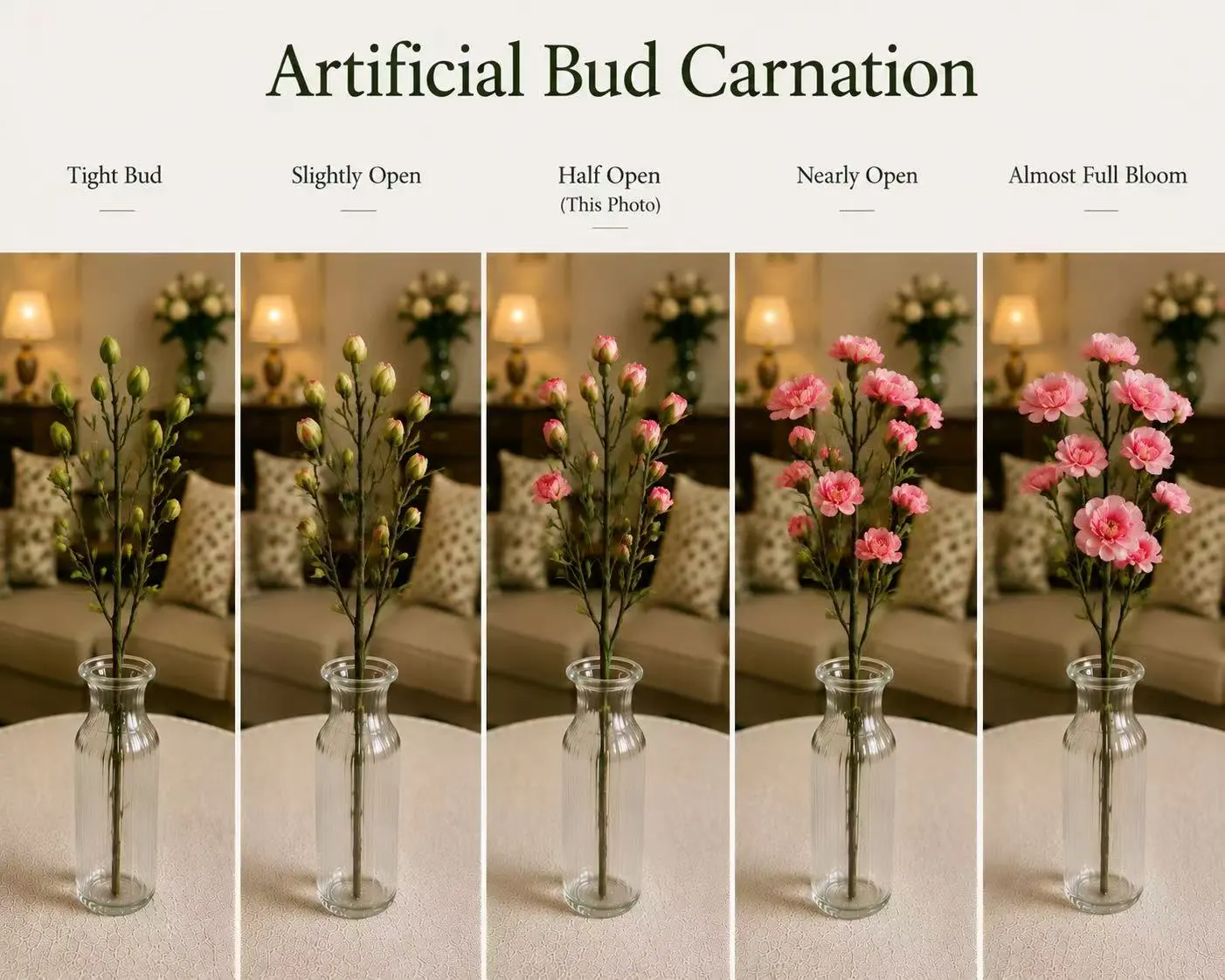
An Artificial Bud Carnation is a very accurate botanical copy that was made to look like the Dianthus caryophyllus plant before it blooms. In contrast to fully opened fake flowers, these buds capture the tight, cylindrical calyx structure and rising serrated petal tips, giving displays a sense of renewal and texture. These small flowers, which are 3 to 4 centimetres across and have petals that are tightly closed, are made from thickened polyester silk cloth using special shaping techniques. The makeup of the material makes them resistant to petal loss and long-lasting, which makes them perfect for high-traffic business areas where replacing them all the time wouldn't work.
The building is made up of several layers, with polyester cloth flowers and galvanised steel wire cores that are covered in thermoplastic elastomer that doesn't melt in water. This building lets you bend it in any direction without damaging the structure, so designers can make natural curves and moving patterns. The calyx is made of high-density plastic, which has the same shape and structure as a real flower. Each flower is treated with advanced UV-stabilized pigments that give it ISO 105-B02 colourfastness grades that keep it from fading even in bright store lights or outside.
Cost Efficiency and Durability Benefits
For large projects, it's important to have a clear budget and few ongoing costs. Real flowers only last seven to ten days in a bowl, so they need to be kept in the fridge, watered every day, and replaced often. These operational costs are completely eliminated by artificial alternatives. When compared to fresh flower programs, hotels that use Artificial Bud Carnations in guest rooms save more than 70% a year because maintenance teams don't have to go through special training or make daily service runs.
Durability is more than just saving money; it also includes building strength. These buds can handle temperature changes from -10°C to +50°C without losing their shape or adhesive. This makes them good for places where HVAC systems cycle quickly. The construction keeps out moisture, which is good for spas and poolside installations where flowers quickly die in humid conditions. The light weight of these synthetic blooms makes them perfect for shopping malls that want to put up ceiling displays. They don't put much stress on the mounting hardware and keep their visual impact for months without any maintenance.
Availability and Consistency Across Bulk Orders
Fresh carnations are hard to get because they are only available during certain times of the year. Prices also change a lot during wedding and holiday seasons. Artificial Bud Carnations always have the same price and are always available, even when farming seasons or weather problems happen. Because of this, event planners can set budgets months in advance without worrying about running out of supplies or costs going up.
Another major problem is fixed by making sure that the quality of bulk orders is the same. When you need to find 5,000 units for an installation at a convention center, colour matching is very important. Natural flowers have different shades because of how they were grown, but buds made from a single production run have the same amount of colour. Cloud Floral Art uses strict AATCC 61 guidelines for colour migration research to make sure that pigments stay stable and don't spread, even in places with a lot of moisture. This consistency stretches to the accuracy of measurements; each bud comes within 0.2 mm of the exact measurements that were given, allowing for precise design execution.
Core Considerations for Procuring Artificial Bud Carnations in Bulk
Supplier Selection and Production Capabilities
To find manufacturers with proven large-scale production capacity, you need to look at a number of operational indicators. Lead times are directly affected by how well the production line works, especially during times of high demand when many projects are competing for the same manufacturing spots. Suppliers with dedicated facilities that have automated petal-cutting machines and quality control stations can handle orders of more than 10,000 units in two to four weeks, but smaller businesses may need six weeks or more.
Premium suppliers are different from regular wholesalers because they can customise their products. There are times when projects need colour choices that aren't available in stock. For example, corporate branding efforts may need custom Pantone matching, and themed events may need gradient effects or shiny finishes. Cloud Floral Art can be customised using drawings or models, and they offer full services from design development to mass production. This adaptability meets the specific needs of each project without making creators give up on their creative vision because of limited Artificial Bud Carnation options.
Quality Assessment Metrics
Systematic sample testing is needed to figure out the quality of a product before placing a big order. Digital tension meters are used to test the petals to make sure they can handle at least 5 Newtons of force. This keeps the buds from falling off during shipping or cleaning. This measure is especially useful for long-distance travelling where the roughness of the handling can't be changed.
Realistic colour depends on techniques for layering pigments that add depth and natural variation. The minor colour changes you see in live flowers are caused by three to five layers of pigment in good buds. When looked at closely from 30 centimetres away, high-quality flowers should have petal edge serrations and calyx texture that make it impossible to tell if they are real or fake. So that procurement teams can see how colours look in different installation settings, they should ask to see samples that have been lit up in daylight, warm LED, and cool fluorescent light.
When checking for material quality, the stem's flexibility and the coating's ability to stick are looked at. The steel wire core should be able to bend many times without the thermoplastic coating cracking or leaving metal that could rust exposed. When the stem is cut, the wires should come apart cleanly, and the cloth should not come apart. These features show how well the product was made and how well it will work in the long run, even when it is installed and moved around a lot.
Budgeting Strategies for Optimal ROI
To find the right balance between investment and quality, you need to know more than just the unit price. You need to know the total cost of ownership. Alternatives that are cheaper and use thin polyester fabrics and basic colours might have good prices at first, but they break down after six months and need to be replaced. Premium options that cost 30–40% more per unit usually last three to five years, which means they are a better investment for permanent installations.
Volume pricing structures encourage buying in bulk, but they need careful planning of inventory. Suppliers usually offer discounts that go down in levels, with bigger discounts at 2,000 and 5,000 units. The lowest discount is usually for 500 units. But buying too much to get a discount leads to storage problems and capital lock-up. Framework deals that allow for staggered deliveries that fit with installation plans are good for projects with phased installation timelines because they secure volume prices.
Payment terms have an effect on managing cash flow, especially for projects that last over more than one fiscal period. Standard terms require 30-50% deposits with balance due before shipment, but established relationships may unlock net-30 or net-60 arrangements. Letters of credit protect foreign transactions and increase the amount of working cash that is available, which is important when handling several projects at the same time.
Optimizing Design and Installation with Artificial Bud Carnations
Color Selection Aligned with Event Themes
Colour psychology affects how people feel when they look at decorative spaces, so choosing a palette is a strategic choice. Neutral colours like white, champagne, and light purple are popular for corporate installations because they look professional without clashing with branded colour schemes. These colours go well with the finishes on modern office buildings and add visual interest to simple rooms that makes them feel more human.
For weddings, a wider range of colours is needed to show personal tastes and seasonal trends. Rose reds and pinks are popular for love themes, and graduated mixed colours look good with a boho style. There are eight basic colours: bright red, pink, rose red, white, champagne, light purple, light orange, and gradient mixed. This gives designers enough options to fit most colour schemes without having to order custom Artificial Bud Carnations. This standard range also guarantees faster turn-around times when project deadlines get squished.
Bold colour blocking makes brands easier to see in busy places like trade shows and exhibitions. Bright reds and light oranges make focal points with a lot of contrast that draw people in from a distance. Strategic placement near signage reinforces brand recognition through colour association. The small (3 to 4 centimetre) bud size lets you pack them tightly, creating saturated colour fields that look great in photos for social media and marketing materials after the event.
Mixing with Botanicals That Go Well Together
To make things look natural, you need to mix Artificial Bud Carnations with leaves and accent flowers that look like they belong in a yard. Because their leaves are shaped like lances and have soft blue-green tones, eucalyptus sprays add texture contrast and effectively fill empty space. Baby's breath adds soft white clusters that soften the sharp geometry of carnation buds. This works especially well in romantic wedding arrangements.
Putting down layers of different bloom stages gives the flower more depth. Putting together closed buds, partly opened carnations, and full blooms creates the progression seen in live flowers, which suggests ongoing life rather than static display. This method works especially well for hotel arrangements that are changed every three months, because the different stages of blooming keep the arrangement interesting to look at even for longer periods of time.
According to the proportion rules, carnation buds should make up 40 to 60 percent of the total bloom count. Larger flowers like peonies or roses should make up 20 to 30 percent, and the rest should be filled with filler materials. This proportion makes sure that the carnations add a lot of visual weight to the arrangements without taking over, so the buds can keep doing their natural job of supporting the flowers. When designers are making installations for corporate lobby areas, they often flip this ratio around and use carnation buds as the main element to make modern, simple compositions that look like flowers without actually being flowers.
Maintenance Advantages for Long-Term Displays
When compared to fresh flower programs, artificial setups require a lot less work. Hotels that get fresh flowers delivered once a week spend 8 to 12 hours a week getting, organising, and getting rid of organic materials. If you switch to manufactured arrangements, this task drops to once a month, which only takes two to three hours. This frees up workers to do more profitable tasks like greeting guests.
For regular upkeep, low-pressure compressed air or soft-bristle brushes are used for cleaning. To get rid of accumulated dust, all you have to do is run an ionic brush across the petals. You don't need any special training to do this. When there is a need for deep cleaning, like after building work that leaves behind dust, damp microfibre cloths with pH-neutral agents work well, but this level of cleaning doesn't happen very often.
As companies try to get environmental certifications and lower their carbon footprint, sustainability factors are becoming more important in their buying decisions. Getting rid of weekly flower deliveries cuts down on transportation emissions, and since fake flowers last longer, they don't create the organic waste that comes from throwing away fresh flowers. In a typical hotel lobby, 52 new deliveries are replaced every year by a single synthetic installation that lasts three years. This saves 98.5% of the material used over the lifecycle of the product.
Decision Framework for Choosing Artificial Bud Carnations in Procurement
Aligning Product Features with Project Needs
The type of event affects how long something needs to last and how often it should be maintained. Temporary setups for week-long workshops can use lower-quality materials because they are only used once and then replaced, so saving money is the main goal. Permanent hotel entrance displays, on the other hand, need high-quality materials that can stand up to repeated cleaning and exposure, which means they cost more at first.
Instead of just looking at purchase costs, budget factors should take into account the total cost of the project over its entire life. The economics of a place that hosts 200 events a year are very different from those of a corporate headquarters that doesn't change its decor. Modular systems that can be reconfigured are good for event spaces, but corporate spaces want consistency and little disruption, which drives the choice of Artificial Bud Carnations toward strong, long-lasting solutions.
The installation environment has a big effect on the material specifications. Outdoor uses need better UV protection and weather defence, so products made for those uses usually cost 15-20% more than products made for indoor use. Products that have been tested for thermal cycling are needed in places where the temperature changes a lot because of the air conditioning. For indoor air quality standards, healthcare facilities need to test for VOC emissions to make sure they don't give off any smells.
Evaluating Supplier Reliability
Track record of delivery is very important when project deadlines depend on materials being available. Operational consistency can be seen by asking suppliers for references on similar-sized orders that were completed in the last twelve months. Suppliers who keep a buffer stock of popular colours can speed up orders, but suppliers who only make to order create uncertainty about when things will be delivered.
Flexibility in customisation is what sets flexible sellers apart from rigid makers. Sample prototypes can be made in just one week, which allows for iterative design improvement without slowing project goals. During the development process, Cloud Floral Art's experienced design team works together with procurement managers to make sure that the end products exactly match the project requirements. This way, costly redesigns don't have to be done after mass production starts.
After the sale, service includes getting replacement products and getting computer help. Well-known providers keep production records that let you match colours for future orders, which is very important when projects need to be expanded or fixed from time to time. If you have access to installation instructions, you can avoid making common mistakes that ruin the look of the job, like bending the stem incorrectly, which leaves wires showing.
Future Trends and Innovations in Artificial Bud Carnation Products
Sustainable Material Advancements
Material innovation is moving toward biodegradable plastics and recyclable content because people care about the environment. New materials made from PLA (polylactic acid) and maize starch look like polyester made from petroleum, but they break down in industrial composting conditions. Even though they are very expensive right now, these materials are popular with businesses that want to get zero-waste certifications and LEED building standards.
When you design parts that can be recycled, you can reuse or recycle them instead of throwing them away in a landfill. Manufacturers make products with separate steel stems, fabric petals, and plastic calyces that make it easier to sort materials through the stream. This can raise the rate of recycling from less than 5 percent to up to 80 percent. This circular economy approach fits with the need for companies to report on their sustainability, which is being looked at more closely by stakeholders and customers.
Solvent-based glue systems have been replaced by water-based ones. This lowers the amount of volatile organic compound emissions that happen during production. Even though these systems change the way things are made, they get rid of the chemical smell that can be found in mass-produced fake flowers, which is especially important for items that will be used in small areas with limited airflow. The change doesn't require much change from end users and has clear environmental benefits all along the supply chain.
Modular Design Systems
Standardised connection interfaces let scalable installation frameworks work with projects of all sizes. Individual bud stems can be snapped into grid panels or flexible mesh backing in modular systems. This lets designers make flower walls or suspended ceiling displays that go on forever without having to do any custom engineering. Compared to standard wire-tying methods, this method cuts installation time by 60%, which means that labour costs are much lower.
The ability to be reconfigured makes a product more useful for more than one event with different style needs. Instead of keeping whole arrangements, venues can keep a stock of Artificial Bud Carnations in basic colours and rearrange them into new arrangements for each event. This stocking strategy makes the best use of storage space and design freedom, which is especially helpful for buildings that are used for more than one thing and host business, social, and public events with different looks.
Integrated lighting systems bring together floral design and technology for the user experience. Buds made of flower materials that are see-through can have LEDs added to them so that smartphone apps can control color-changing effects. This new technology isn't very popular yet, but it's in high demand among clients who value technological differentiation. It's especially popular with high-end event productions that want to create memorable visual experiences that static arrangements can't.
Conclusion
Artificial Bud Carnation products change the way large-scale floral arrangements are made because they offer consistent quality, operational efficiency, and long-term value that fresh flowers can't match. Because they are small, don't shed petals easily, and come in many colours, they are perfect for a wide range of uses, from hotel hallways to wedding setups. Costs that are predictable, supply chains that work, and low maintenance needs free up resources for strategic initiatives that help procurement professionals. As material science improves and sustainability becomes more important, these fake flowers will keep changing, becoming more realistic and better for the environment while still having all the useful benefits that make them essential for business flower design.
FAQ
How realistic do artificial bud carnations appear compared to fresh flowers?
Premium Artificial Bud Carnations are made with multi-layer colouring and physical shaping that make them look a lot like real carnations. Quality craftsmanship guarantees a natural look with deep layers of colour and a construction that is safe for all environments and doesn't smell or have pollen. At a normal viewing distance of one metre, high-quality goods are almost impossible to tell apart from real flowers. This is especially true when mixed with matching greenery in arrangements.
Can we customize colors and sizes for specific project requirements?
Customisation options include matching colours based on Pantone charts and making changes to sizes within the limits of manufacturing. The normal size of 3 to 4 centimetres works well for most uses, but stem lengths can be cut with wire cutters, and special orders may be able to handle different bud diameters with different minimum order numbers.
What lead times should we expect for bulk orders?
Lead times usually range from two to six weeks, but they depend on how many orders there are and how complicated the customisation is. Stock colour orders of 1,000 to 5,000 units generally ship within three weeks. However, if you need a custom colour match or special finishing, the time frame could be extended to five or six weeks, which includes the time it takes to ship internationally.
Partner with Cloud Floral Art for Your Next Project
Cloud Floral Art stands ready to support your large-scale floral decoration initiatives with premium Artificial Bud Carnation solutions tailored to your specifications. Our hyper-realistic craftsmanship, strong design innovation, and stable quality management ensure that every project goes above and beyond what was expected. Whether you require standard colours or Pantone matching, our experienced team can help you with everything from the first consultation to the final installation. Hotels, event planners, furniture designers, and business property managers all over the world trust us to provide them with Artificial Bud Carnations. Email us at guoh91278@gmail.com to get samples, talk about bulk prices, or look into how you can make your order unique. Visit cloudfloralart.com to see our full catalogue and learn how our low-cost, low-maintenance flower arrangements can make your places look better.
References
1. Johnson, M. & Williams, R. (2021). Synthetic Florals in Commercial Design: A Practical Guide for Procurement Professionals. New York: Interior Architecture Press.
2. Chen, L. (2022). "Material Science Advances in Artificial Botanical Products." Journal of Decorative Materials Research, 18(3), 142-159.
3. Thompson, K. (2020). Event Design Economics: Cost Analysis of Fresh versus Artificial Floral Programs. Chicago: Hospitality Management Publications.
4. Rodriguez, S. & Patel, N. (2023). "Sustainability Assessment of Long-Duration Decorative Installations." International Journal of Green Building Practices, 11(2), 88-104.
5. Anderson, P. (2021). The Visual Merchandising Handbook: Strategic Use of Botanical Elements in Retail Environments. London: Commercial Design Institute.
6. Liu, H. & Yamamoto, T. (2022). "Quality Control Standards for Mass-Produced Decorative Florals." Manufacturing Excellence Quarterly, 29(4), 201-218.
Online Message