_1779950575813.webp)
Jul 25, 2026
Buyer's Guide: How To Choose an Artificial Phalaenopsis Bud
Selecting the right Artificial Phalaenopsis Bud demands careful consideration of material quality, visual realism, and supplier reliability. Purchasing managers and interior designers face mounting pressure to source floral elements that deliver lasting aesthetic impact without the maintenance burdens of fresh botanicals. This comprehensive guide walks you through critical evaluation criteria, material science insights, and procurement strategies tailored specifically for commercial buyers in hospitality, retail, event management, and home décor sectors. Understanding these fundamentals ensures your investment aligns with project timelines, budget parameters, and sustainability commitments while achieving the hyper-realistic appearance that modern commercial spaces demand.
Understanding Artificial Phalaenopsis Buds: Key Insights for Buyers
What Defines a Quality Artificial Orchid Bud
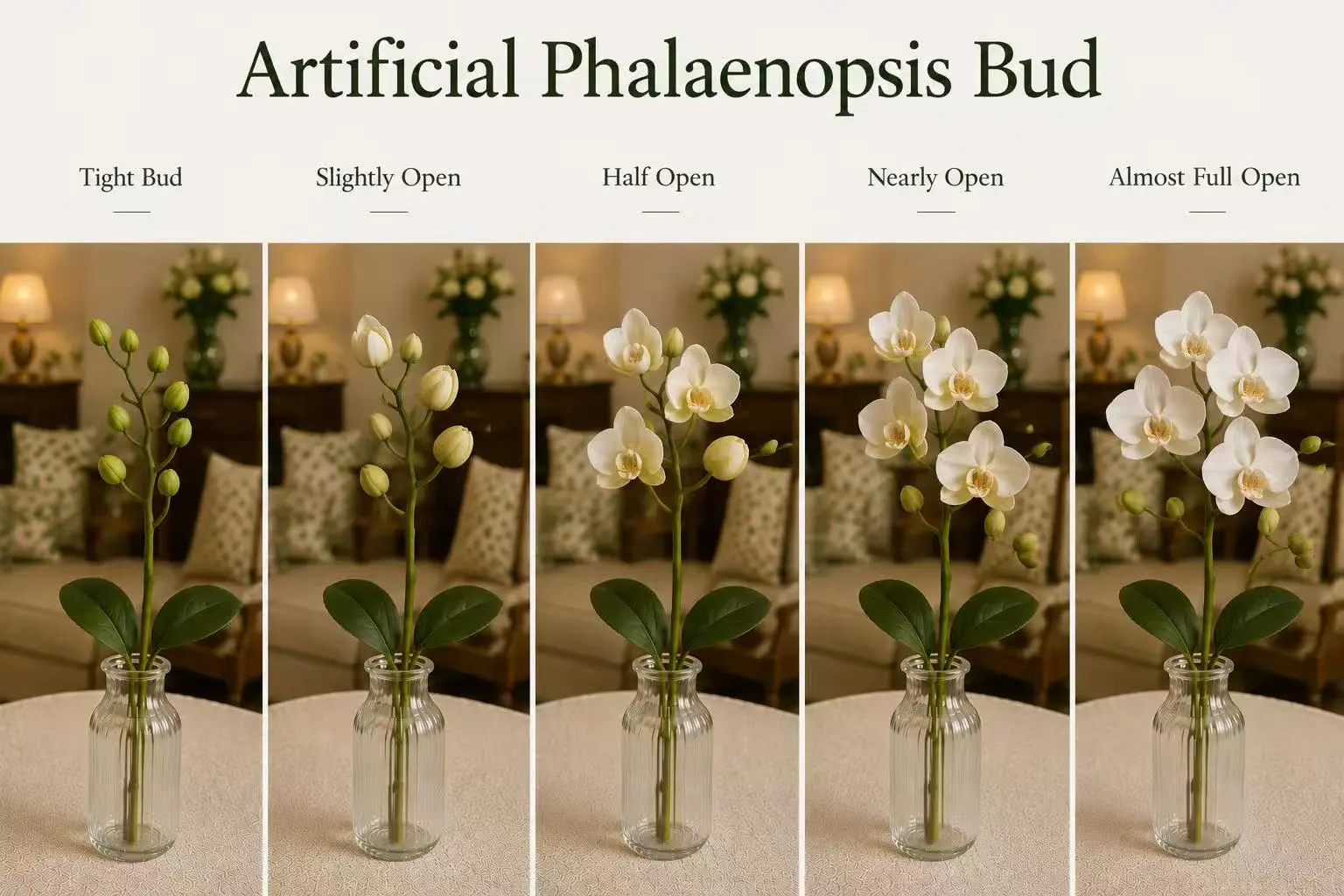
An Artificial Phalaenopsis Bud is a highly accurate replica of the moth orchid genus's growing flower bud. When the weather changes or low humidity causes buds to fall off early in natural orchids, this is called bud blast. Synthetic orchids, on the other hand, always have buds that are growing. More and more, commercial florists like these parts because they don't have to be transported in a refrigerator, have a short shelf life, or be sensitive to ethylene gas, which are all problems that come with fresh-cut orchid stems.
The best Artificial Phalaenopsis Buds are very accurate reproductions of real flowers. When they are closed and not opened, Cloud Floral Art's Phalaenopsis buds are about 3 to 5 cm across and have long, neatly arranged flower stalks that look like the growth patterns of real plants. This level of detail in three dimensions is very important when making layered designs where scale uniformity affects the general harmony of the look.
Material Science Behind Superior Realism
Material makeup has a direct effect on how long something lasts and how well it looks. The best ones are made of thicker matte polyester silk fabric that has been shaped in special ways to make it look like real flowers. This is very different from cheap plastic versions that have an artificial sheen that makes them instantly recognisable as man-made.
To get gradient colouration that looks like natural pigment distribution, high-end manufacturers use thermal transfer printing or multi-layer hand-painting. Because it's matte, the finish spreads light out like natural plant tips, so the product doesn't look like cheap plastic. The different colours that are available—white, fuchsia, pink, champagne, light yellow, and spotted gradient—fit a wide range of design styles needed in dining settings, store displays, and home staging projects.
Commercial Advantages Over Natural Botanicals
More and more businesses are choosing Artificial Phalaenopsis Buds because they are more efficient. For natural Phalaenopsis to grow, they need controlled settings with certain amounts of light, temperature, and humidity. A small change causes buds to fall off, which leads to unpredictable inventory losses that throw off project schedules.
These weaknesses are completely fixed by Artificial Phalaenopsis Buds. They can handle drafts caused by HVAC systems in hotel lobbies, keep their good looks in hallways without windows, and don't need any gardening knowledge. The structure is resistant to wetness and deformation, so the quality of the show stays the same no matter what the environment is like. Because of these features, labour costs go down, repair costs go away, and it's easy to plan a budget for installs in more than one place.
Core Criteria to Evaluate When Choosing Artificial Phalaenopsis Buds
Visual Realism Assessment Parameters
Texture evaluation is the most important quality indicator. Feel the surface of the bud with your fingers. High-quality goods have small differences and a natural-feeling flexibility instead of being stiff all the way through. When you hold the edges up to the light, they should have a slight transparency, just like real petals do.
Colour precision is more than just how it looks on the surface. Pay close attention to colour changes. Natural orchid buds have light changes in colour from the base to the tip, and the colour is stronger along the lines. Better computer versions copy these subtleties by applying pigments in layers. Cloud Floral Art uses very realistic simulation technology to make colours that look natural and have many layers, unlike mass-market options that have flat, uniform tones.
Shape accuracy is just as important. The bud should naturally narrow from a larger base to a pointy tip, with no uneven flaws. When more than one bud appears on the same stem, they should be placed in a way that mimics how real flowers grow in order: slightly off-center instead of perfectly lined up, and with small differences in size.
Durability and Structural Integrity
Commercial buyers have to look closely at the building methods used because they affect how long a product lasts. Flexible arrangement is made possible by internal wire frameworks that can be shaped, but weaker metals rust in damp places. High-quality makers use galvanised or coated stainless steel lines that don't rust, even in places with a lot of moisture, like hotels.
Pay close attention to attachment strength. The point where the bud and stem meet is a usual place for plants to break. When evaluating the sample, do light pull tests. The bud should stay firmly connected and not come loose or form a gap that can be seen. This is especially important for installations in places with a lot of foot traffic, where people often touch things by mistake.
Long-term aesthetic retention depends on how well something resists fading. UV-stabilized materials keep their colours bright even after being exposed to indoor lighting and indirect sunlight for a long time. Within six months of being displayed, standard goods often start to yellow or lose their colour. A process called accelerated ageing under xenon arc lights is used to make sure that the colour fastness meets ISO 105-B02 standards. This simulates years of normal indoor contact.
Supplier Credentials and Compliance Standards
Certifications for manufacturing provide objective quality assurance. Standardised quality control methods across production batches are shown by ISO-certified makers. This is important for big orders that need consistent colour and size. REACH compliance confirms that the chemicals are safe to use, which addresses concerns about indoor air quality in businesses where safety rules apply.
The success rate of a project is greatly affected by how reliable the delivery is. Check how well the seller is doing by looking at things like the percentage of on-time shipments, the rate of damage during transit, and how quickly they respond to pressing order requests. Established makers keep extra stock and extra production capacity on hand to handle seasonal demand spikes that happen a lot in the wedding and holiday decoration industries.
Professional-grade suppliers are different from basic sellers in how they handle customer service after the sale. Full warranties that cover structural flaws, clear return policies for products that aren't up to par, and the ability to get technical help all show that the supplier is committed beyond the initial transaction. These parts of the service lower the risk of buying and make it easier for long-term partnerships to form.
Price Analysis and Value Optimization
For initial cost comparisons, more information than just per-unit prices is needed. Find the total cost of ownership by adding up the money you'll save on repairs, replacements, and time spent on care because of less work that needs to be done. When durability and reality keep people from replacing things too often, a slightly higher initial investment often pays off in the long run.
Different suppliers have very different pricing structures for volume orders. When you buy 50 to 100 units, you usually get a discount. When you buy 500 or more units, you get even bigger discounts. Talk to the maker about payment terms that work with your project's cash flow. For established business accounts, many manufacturers offer net-30 or net-60 terms, which makes managing your working capital easier.
Customisation fees should be looked at separately. Stock colour variations usually don't come with any extra costs, but custom gradient patterns or sizes that aren't standard may come with 15–30% extra costs. Make it clear if the prices given include packaging that can be used for retail display, or if you need to buy extra presentation materials separately. When picking Artificial Phalaenopsis Buds, the price must be weighed against realism.
Comparing Artificial Phalaenopsis Buds with Other Floral Products
Material Category Distinctions
Premium polyester silk fabric has better drape and light-diffusion qualities than other fabrics in the same group. This way of building is resistant to damage and keeps its shape even after being handled many times. The thickened matte finish gets rid of the fake look, and the structural stability is kept up by shaping treatments that are built in.
Latex-based options have very realistic textures and surfaces that are soft and bendy, just like real tissue. They do, however, tend to be more expensive and last less long when put under mechanical stress. This means they can be used for display-only tasks instead of setups that need to be moved around a lot.
Buds made of plastic and polymer are in the economy segment. Even though advances in technology have made them look a lot better, they can still be told they are fake when you look closely. These are good for big installations that are seen from a distance and don't need to be looked at closely at each individual part, like displays at convention centers or backdrops for shows. Looking at real and Artificial Phalaenopsis Buds reveals significant material differences.
Industry-Specific Application Suitability
In hospitality settings, display quality must stay the same over long periods of time. Artificial Phalaenopsis Buds don't react to changes in temperature or air flow, which is good for hotel hallways and guest rooms. Their low maintenance and low cost—they don't need to be watered or fertilized—means they don't need the special staff that fresh flowers do, and they look nice all year.
Event planners like having options for how things can be set up. Artificial Phalaenopsis Buds can be placed at very odd angles without wilting, which lets architects build complex structures that would not be possible with real flowers. Because they don't smell or have pollen, they're good for people with allergies and make event venues more flexible. They also don't interfere with the smells of food preparation.
Longevity and impact accuracy are important for retail display uses. Artificial Phalaenopsis Buds keep their regular look throughout the year without slowly losing their quality. This dependability supports brand appearance standards across multiple locations of chains that can't afford or easily replace fresh flowers every week.
Sustainability Considerations
Environmental effect assessment plays a bigger role in purchasing choices. Artificial Phalaenopsis Buds get rid of the carbon effect that comes with flying in fresh flowers every week from cultivation areas. The longer lifespan means less trash than fresh plants that need to be thrown away every 5 to 7 days.
Sustainability in manufacturing changes a lot from one company to the next. In their factories, progressive suppliers use water-based dyes, recycled polyester content, and energy from renewable sources. These ways of buying things are in line with rules about business social responsibility, and they also meet the environmental standards for LEED-certified buildings and hotels that care about the environment.
Practical Buying Guide: How and Where to Procure Artificial Phalaenopsis Buds
Sourcing Channel Evaluation
For regular large needs, direct ties with manufacturers offer the best value. Producers like Cloud Floral Art offer customisation services that support designs based on sketches or samples. They also help with the whole process, from making prototypes to mass production. This method makes sure that the standards are aligned and sets up ways for people to talk so that production questions can be answered quickly.
Wholesale distributors help buyers who need a variety of products from different manufacturers. They combine their goods, which lowers the minimum order quantity for each product line and makes shopping easier by letting customers do it all in one place. But customisation options are usually limited to configurations that are already in stock, and prices include distributor margins that make them less cost-effective.
Online B2B sites make it easier to find suppliers and do preliminary comparisons. These platforms collect information about products, including their features, prices, and customer reviews. This makes the initial study steps easier. When checking a supplier's credentials on your own, be careful because platform vetting processes vary in how strict they are. How to Buy Artificial Phalaenopsis Buds: A Guide to the Best Places to Look.
Pricing Negotiation Strategies
Ask for quotes that break down the costs of each unit, the cost of packaging, and the cost of shipping. This openness makes it possible to compare accurately between sellers who bundle in different ways. Ask about bulk discount levels and incremental price tiers to find the best order amounts that balance the cost of inventory with the savings per unit.
Negotiating payment terms has a big effect on cash flow. Instead of demanding full payment up front, established suppliers often accept deposit-plus-balance arrangements, such as 30% up front and 70% due upon shipment. This plan lowers the financial risk and shows loyalty on both sides.
As a general rule, samples are evaluated before large commitments are made. Reputable makers offer free samples of their products so that you can check the quality yourself. Check out samples in lighting conditions that are similar to where they will be installed, because natural daylight, warm incandescent light, and cool LED light can all have a big effect on how something looks.
Logistics and Quality Assurance
Shipping times for goods across international borders need to be carefully coordinated with project plans. Standard ocean freight from Asian makers takes 25 to 35 days to arrive, while air freight cuts the time to 7 to 10 days but costs a lot more. Take into account the time it takes to clear customs and the time it takes for local ground transportation when setting arrival dates.
Packaging standards keep the quality of the product safe while it's being shipped. Good sellers put protective sleeves around each stem separately, and stacked box packing keeps damage from happening when the stems are compressed. Check the package details before confirming orders. If the safety isn't good enough, wires will bend, buds will get crushed, and there will be more defects that need to be returned.
Incoming inspection procedures should be part of quality control protocols. Assign people to look over the first shipment samples and make sure that the colour, size, and quality of the building match the accepted samples. Write down any problems right away with picture proof to make it easier for the seller to fix the problem.
Maintenance and Care Tips to Maximize Your Artificial Phalaenopsis Bud Investment
Cleaning Techniques for Material Preservation
Regularly dusting keeps the buildup of dirt that dulls the look of surfaces from happening. Using compressed air canisters to remove particles from complex bud textures works well without touching the buds directly, which could damage them. Hold the canister upright and keep 6 to 8 inches of space between it and the surface. Spray in short bursts instead of continuously to stop condensation from forming.
Deeper cleaning every so often gets rid of environmental leftovers in business settings. Soft microfibre cloths that have been slightly wet with pure water are used to remove film buildup gently, without adding mineral deposits. Do not use strong cleaners or agents that contain alcohol because they can remove surface treatments or move colours around. These products are great for busy commercial settings because they only need to be dusted every once in a while for maintenance.
Storage and Handling Best Practices
During the off-season, things need to be stored safely so they don't shift. If you can, store stems vertically. If not, lay them out horizontally with enough space between them to keep them from getting squished. Instead of using plastic bags that trap moisture, use cloth covers that let air pass through in climate-controlled spaces that keep the relative humidity between 40 and 60%. Maintenance and care help you maintain your Artificial Phalaenopsis Buds to get the most out of your investment.
Troubleshooting Common Issues
Strategic shifting can fix minor fading in places with a lot of light. By turning the setups every three months, you can make sure that all sides are facing the main light sources. UV-blocking window films slow down damage in places that get a lot of sun.
Handling a plant over and over again can sometimes cause the buds to become loose. To make things stable again, use small amounts of hot glue where things are connected. Colour the glue to match the stems, and use as little as possible so that there is no obvious residue. This fix makes the stem last longer instead of having to be replaced completely.
A soft-bristle paintbrush works well for getting rid of dust that has built up in cracks and crevices that are hard to reach. Natural hair brushes keep static from building up and gently move particles out of the way. As you work your way from the top to the bottom, let any dust that comes loose fall away instead of moving to areas that have already been cleaned.
Conclusion
When choosing the right Artificial Phalaenopsis Buds, you have to think about how they look, how long they should last, and your budget. Long-term satisfaction and return on investment depend on the quality of the materials, the dependability of the supplier, and the right way to maintain them. This guide gives procurement professionals specific criteria that help them easily explore the market and find goods that are accurate botanically without putting fresh flowers at risk. For businesses to be successful, they need to work with makers who can show they can do a great job, are flexible with customisation, and offer quick help throughout the whole procurement process.
FAQ
How Can I Assess Artificial Phalaenopsis Bud Quality Before Bulk Purchase?
Feel the feel of the surface—premium Artificial Phalaenopsis Buds are naturally flexible with small differences instead of being stiff all the way through. Closely look at the colour gradients; better products have layered pigmentation with deeper saturation along the veins that match natural patterns. Check the connection places by gently pressing on them to make sure there are no gaps and the bond is strong. Ask for pictures that were taken in the real lighting you have, because the way something looks changes a lot depending on the type of lighting you have. Make sure that the material specifications include UV stabilisation and that the supplier has the right quality certifications.
Are These Artificial Buds Suitable for Outdoor Event Applications?
Artificial Phalaenopsis Buds that are standard work best in indoor environments. For use outside, you need items that are especially rated for UV light and are made to last for a long time without losing their colour. Even models that have been protected from UV light age faster than when used indoors. For outdoor events, think about weather protection like canopies, and only use outdoor-rated goods for fixed setups outside, where they will break down more quickly over time.
What Customization Options Exist for Color and Design?
Reliable manufacturers allow for a lot of customisation, such as matching colours that aren't standard, changing gradient patterns, and changing the size of the items. For custom specifications, the minimum order quantity is usually between 100 and 200 units, but this depends on how complicated the order is. Development times range from two to four weeks for samples to be approved before production starts. For exact matches, give Pantone references or real colour samples. Early involvement of suppliers in the design and development stages of custom projects is helpful to make sure that the project is technically possible.
Partner with Cloud Floral Art for Premium Artificial Phalaenopsis Bud Solutions
Cloud Floral Art has the best Artificial Phalaenopsis Bud products on the market, and they are ready to help you with your commercial flower needs. These products are made to look very real and last a long time. As a maker and provider with a lot of experience, we can make a lot of changes, from custom colour development to custom sizing. Our quality management is ISO-certified, and we ship our products all over the world quickly and easily. Our design team stays up to date on foreign trends while still meeting the high standards for botanical accuracy set by hospitality, retail, and event pros. Email us at guoh91278@gmail.com to talk about the needs of your project, ask for samples, or look into volume pricing options that fit your buying goals.
References
1. Johnson, M. & Williams, R. (2021). Commercial Floral Design: Material Selection and Longevity Factors. Hospitality Design Press.
2. Chen, L. (2022). "Polymer Science in Artificial Botanical Manufacturing." Journal of Decorative Materials Engineering, 18(3), 127-145.
3. American Society of Interior Designers (2023). Sustainable Material Sourcing Guidelines for Commercial Interiors. ASID Publications.
4. Martinez, K. (2020). Event Design Handbook: Floral Elements and Installation Techniques. Creative Events Publishing.
5. Thompson, E. & Roberts, S. (2022). "Quality Assessment Protocols for Artificial Botanicals in Hospitality Environments." International Hotel Management Review, 35(2), 89-104.
6. Global Floral Industry Association (2023). B2B Procurement Standards for Artificial Floral Products. GFIA Industry Report Series.
Online Message