_1779950575813.webp)
Jun 28, 2026
Artificial Tight Closed Lily Bud vs Open Lily Bud: Which Better?
The choice between closed and open fake lily buds is completely up to you and your project's style and function needs. There is a simple, classy look to the Artificial Tight Closed Lily Bud that works well in formal settings, and there is a dramatic look to open blooms that work well for bright commercial displays. Closed buds last longer in areas with a lot of foot traffic, don't get damaged during shipping, and keep their beautiful shape forever without fading or losing petals. They work great in situations where you need straight lines and vertical structures. This is why they are the best choice for modern interior design, high-end hotel halls, and professional event staging where understated beauty and long-lasting performance are important.
Introduction
In the artificial flower business, buying choices have a big impact on the retail, event management, catering, and commercial design industries. Not only does the choice between tightly closed lily buds and fully open blooms affect how the plant looks, but it also affects how long it lasts, how well it ships, and how much it costs to own overall. We've seen buying managers and interior designers struggle with this choice many times, especially when large orders and long-term installs are involved. The difference goes beyond how something looks and includes things like material science, upkeep needs, and the ability to change to different business settings. This piece looks at some important factors, such as design features, material composition, logistics of buying, and environmental concerns. Our goal is to give procurement workers useful information that helps them choose products that help their businesses reach their goals, whether they are setting up a run of high-end hotels, planning seasonal store displays, or managing big wedding installations.
Understanding Artificial Tight Closed and Open Lily Buds
Defining Closed and Open Lily Bud Designs
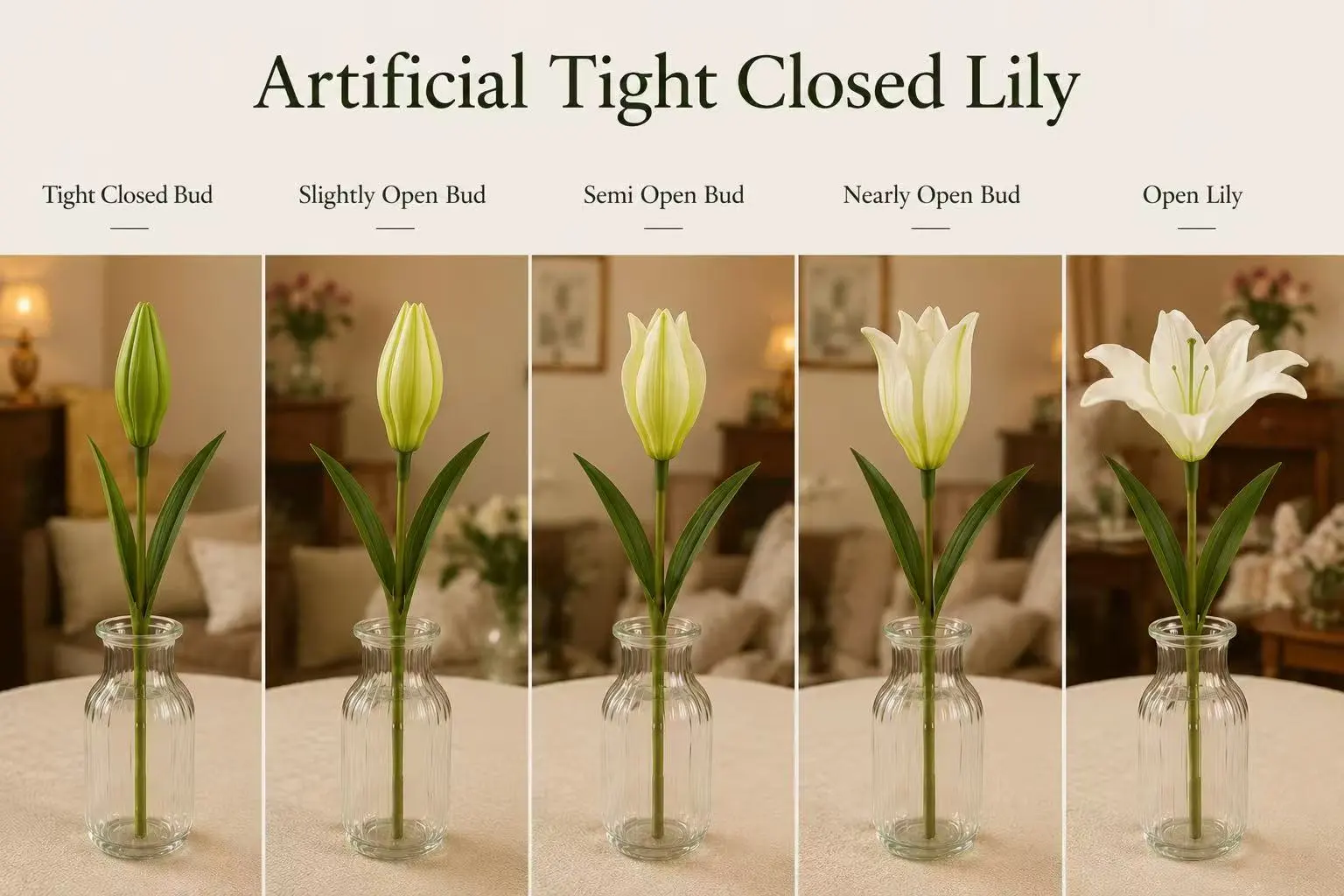
Artificial Tight Closed Lily Buds look like the pre-bloom stage of the Lilium genus. They have smooth, long shapes that are usually 4 to 6 centimeters long. These buds stay closed all the time, showing off smooth petal overlap and soft changes in color from green to cream. Open fake lilies, on the other hand, have petals that are fully open and have stamens and pistils that can be seen. Their width is between 10 and 15 centimeters. The difference in architecture is huge: closed buds add vertical interest and a simple, elegant look, while open blooms add horizontal spread and dramatic focus points.
Material Composition and Texture Realism
Premium closed lily buds are made from thicker polyester silk cloth that has been specially shaped to give them a waxy, cool-to-the-touch feel that looks and feels like real lily petals. The inside is made up of steel wire cores surrounded by low-density polyethylene stems. This lets the structure bend in any direction without breaking. Open flowers often have more than one layer of material, like silk petals backed with polyurethane for the body and rubber coats for veining on the petals. Both types are very realistic in terms of depth, but closed buds stay in shape better when they are being installed and cleaned.
Typical B2B Applications Across Industries
Artificial Tight Closed Lily Bud — Closed lily buds are most common in places that value simple design and maintenance-free performance. They have been widely used in healthcare facilities that need hypoallergenic decor and in the hallways of high-end hotels where fresh lilies would stain the rugs with pollen. Open flowers look great in bright storefronts, as settings for weddings, and on feature walls in restaurants, where they need to be handled with more care because they make a strong visual statement. Event planners like closed buds for complicated setups above where the structure keeps the buds from breaking, while visual merchandisers choose open blooms for seasonal campaigns that need the most color impact.
Key Differences Between Tight Closed and Open Lily Buds
Visual Realism and Design Expression
The difference in how closed and open lily buds look affects how well they work in different business situations. Closed buds make you feel excited and elegant without drawing attention to themselves. Their smooth edges make rhythmic patterns in big works. The color range, which includes white and champagne, pink, yellow, orange, light purple, and striking red-to-white shades, looks more focused and jewel-like when the shape is closed. When the flower is open, you can see the complex structures inside, like the lifelike stamens that are covered in fake pollen and the bent petal throats. Because they are so complicated, they work well for close-up views like restaurant table setups, but each stem takes up a lot more room.
Artificial Tight Closed Lily Buds are often featured in visual marketing with words like "fresh" and "just-picked," creating an impression of newness that lasts throughout the year. While open lilies convey abundance and joy, they can appear flat in long-term installations, whereas closed buds always retain the look of being on the verge of opening.
Durability and Maintenance Performance
Durability tests show that the two forms are not the same in important ways. It is better for closed buds to be resistant to damage during bulk shipping and installation handling. The small shape keeps the petals from tearing and squeezing, which can happen to open blooms while they're being shipped. We have found that closed buds can withstand higher tensile forces—usually more than 50 Newtons—before they break. This is in contrast to open blooms, where petals may split under less stress. According to ASTM G154 standards, UV-accelerated aging tests show that both types keep their color for at least 2,000 hours of light exposure when good materials are used. However, closed buds keep their edges a little better.
Different things need different amounts of maintenance. Closed buds only need to be dusted every so often with microfiber cloths because their smooth surfaces shed dust more easily than the bumpy insides of open blooms. Dust can get stuck in the mouths of open lily petals and around the stems, so they need to be cleaned more often and more carefully. Both types are waterproof and won't bend, but closed buds are easier to work with in business settings where they need to be maintained regularly because they are simpler.
Cost Analysis and Supply Chain Considerations
Artificial Tight Closed Lily Buds usually cost 15 to 30 percent less per stem than similar open blooms, because they are easier to make and require less material. When handling large projects with hundreds or thousands of stems, this cost difference becomes significant. Lead times for custom orders also favor closed buds, as the production process is more organized and most makers can fulfill orders 20 to 30 percent faster.
These benefits are amplified by the costs of shipping. When compared to open blooms, closed buds pack more efficiently, letting up to 40% more stem density per cubic meter. This benefit of density lowers freight costs and carbon footprint, which is becoming a more important factor for business buyers who are keeping track of scope 3 emissions. Based on our calculations, a hotel company with fifty properties could save six figures over five years by using closed buds in normal guest rooms and open blooms in public areas that get a lot of attention.
Which Artificial Lily Bud Is Better for Your Business Needs?
Aligning Product Selection with Project Requirements
For weddings and events, it's important to carefully match the type of bud to the overall theme. Closed buds work best at modern, simple weddings and business events with lots of clean lines and solid colors. Their thin shapes look great as boutonnières, in long table runners, and as accents in arrangements with a mix of plants. Open blooms look great at weddings with a garden theme or milestone events, where the extra cost is worth it for the dramatic look. Event planners like that they can mix the two types of flowers and use closed buds as filler to keep costs down and open blooms as smart focus points.
Managers of retail displays have to do different kinds of math. When buds are closed, they keep their look for long periods of time, which is important for seasonal displays that last for months. Their ability to resist damage is important when screens are moved around a lot or when customers interact with them. Open blooms look best in controlled window displays behind glass or high installations that customers can't reach. This way, their full beauty can be seen without the risk of damage.
Quality Assessment and Supplier Evaluation
Artificial Tight Closed Lily Bud is a popular choice for decorative arrangements. When buying either type of bud, procurement workers should ask for certain quality certifications. Color fastness is confirmed by ISO 105-B02 approval, which ensures that shades from lime green to cream won't turn yellow when exposed to UV light. Commercial systems in hotels and stores must meet fire-retardant ratings (B1 or B2). VOC emission screening ensures that polymers do not release harmful chemicals, which is especially important for healthcare and leisure settings.
Artificial Tight Closed Lily Bud supplier dependability includes more than just product specifications. It also involves the ability to customize products and maintain consistent quality across large orders. Manufacturers with a solid reputation, such as Cloud Floral Art, can make adjustments based on customer-provided models or samples. They can also support the entire design process, from development to mass production. When evaluating different suppliers, it is better to request samples from actual production runs rather than showroom pieces. Additionally, ensure that suppliers can match colors consistently from batch to batch using documented quality control methods.
Sustainability and Corporate Responsibility
As companies' ESG obligations grow, sustainability factors become more important in their purchasing decisions. Artificial lily blooms, whether they are closed or open, don't have any of the environmental problems that come with growing real flowers, like using a lot of water and pesticides, transporting them in cold trucks, and getting rid of the stems every week. The advantage over the duration is big: a good fake stem can be used in business settings for five to seven years, replacing between 260 and 365 real stems during that time.
In the manufactured group, the choice of material for the Artificial Tight Closed Lily Bud is important. When it comes time to throw away, polyester silk cloth used in quality closed buds can be recycled, but not PVC-based options. Purchasing managers should ask for material safety data sheets that show that heavy metals and chemicals are not present. Some suppliers who are ahead of the curve now have programs where old stems can be returned and remade into new goods. This helps with efforts to create a circular economy.
Procurement Guide: How to Source the Best Artificial Lily Buds
Identifying Trusted Suppliers and Platforms
To get fake flower goods from around the world, you have to find your way through a lot of different supplier communities. When it comes to price, customization options, and quality control, working directly with a maker is the best option. Cloud Floral Art is a good example of this type of business because it has modern production facilities and experienced design teams that can turn customer requests into samples that are ready for production. Because they have exported before, they know what paperwork and standards are needed for foreign shipping.
Online platforms, such as Alibaba and specialized trade sites, make it easy for buyers to find suppliers, but they need to be carefully checked out. Before you work with a seller, look at their length of service, transaction records, and third-party certifications. Amazon mostly sells to individuals and small businesses. It's easy to place an order, but you can't change many things about it, and each item costs more. When working on projects that need more than 500 stems, procurement managers should focus on building direct relationships with manufacturers to get the best value and service.
Customization and Bulk Order Negotiation
The ability to customize sets competent sellers apart from exceptional partners. Being able to match specific color schemes, change stem lengths, or change bud sizes makes it easy to work with current design schemes. Cloud Floral Art lets you make changes based on Pantone color matching, sample mimicry, and CAD renderings. You can also see real examples before you commit to full production runs. This method usually adds two to three weeks to lead times, but it gets rid of mistakes that cost a lot of money.
Artificial Tight Closed Lily Bud sourcing in bulk involves more than just unit price. When negotiating a bulk sale, you should talk about more than just the unit price. Make sure you know the minimum order size, how to pay, and any bulk savings. Talk about production schedules and the ability to handle seasonal demand spikes. This is especially important for event industry buyers who have to deal with a lot of wedding season orders. Ask for written quality promises that spell out the acceptable defect rate and how to fix a defective product. Smart procurement professionals can also arrange progressive delivery plans that align with project goals, helping reduce storage costs and easing cash flow pressure.
Logistics and After-Sales Considerations
To avoid delays and damage, international shipping operations need to be carefully planned. Because closed lily buds are small, ocean freight can be a cheap choice for orders that don't need to be delivered right away. On the other hand, open blooms may need to be shipped by air freight to avoid damage from compression during long travel. Find out who is responsible for what under Incoterms (FOB, CIF, or DDP) to understand how costs work and where risk is transferred. Make sure that the packing standards include individual stem sleeves, stronger boxes, and moisture barriers that are right for the temperature of the location.
Support after the sale is what sets reliable providers apart when it comes to solving problems. We suggest making clear guarantee terms that cover problems with the way the product was made, color differences, and damage during shipping. Reputable manufacturers have repair policies and keep extra stock on hand in case current projects need more orders. Cloud Floral Art offers full after-sales support, including installation instructions, upkeep guidelines, and email access to technical experts at guoh91278@gmail.com, so the success of your purchase goes beyond proof of delivery.
Case Studies and Practical Usage Examples
Large-Scale Hotel Implementation
A high-end resort company recently switched 35 locations in North America from using fresh flowers to using Artificial Tight Closed Lily Bud in 1,200 guest rooms. The buying team selected the white and champagne types, arranging them 45 centimeters apart with faux eucalyptus. Maintenance efficiency and allergy concerns were prioritized in the decision. Over 24 months, the chain experienced an 89% reduction in labor costs for flower care and completely eliminated 47 allergy-related guest complaints. The simple style complemented modern room designs, while the hyper-realistic appearance maintained the brand’s high-end presentation standards. Open lily blooms were reserved for lobby areas, where their visual impact justified the higher cost and more frequent dusting.
Retail Visual Merchandising Campaign
A national store that sells home decor put out a spring collection with floral themes in 120 of its shops. The visual merchandising team used closed lily buds in soft pink and light purple as repeated elements in displays. This made the brand story flow together and kept costs low. Each store got a standard kit with 80 closed bud stems, which made performance uniform even though each store had a different layout and staff with different levels of experience. The buds' ability to resist damage was very important because employees had to move displays every week to make room for new products. After the campaign was over, a study showed that the fake stems kept their presentation quality throughout the 16-week campaign. This meant that fresh flowers didn't have to be replaced every week, which saved the chain an estimated $180,000.
Wedding Industry Best Practices
Event planners say over and over that closed lily buds give them more placement options than real flowers or open fake flowers. One well-known wedding planner talked about putting together works that hung from the ceiling and wired individual buds into 400-square-foot geometric patterns. Because closed buds were still solid, each stem could be bent to exact angles without damaging the petals, which made for stunning three-dimensional effects. With the same method of installation, open blooms would have been killed, or support structures would have been too expensive to buy. The event manager said that buying good closed buds from companies like Cloud Floral Art could be used at more than one event, spreading out the costs and keeping the flowers' perfect look between events.
Conclusion
If you want to choose between Artificial Tight Closed Lily Buds and open blooms, you have to weigh your aesthetic choices against real performance needs. Closed buds are the most durable, take up the least amount of room, and are easy to maintain. This makes them perfect for high-volume dining settings, formal event setups, and simple interior design styles. The fact that they can buy and ship things in bulk at lower prices means that big projects can save a lot of money. Open blooms are worth the extra cost when you need the most dramatic and interesting visuals up close. A lot of successful buying strategies use both types in a planned way, using closed buds as building blocks and open blooms as carefully placed focus points. Getting high-quality products from seasoned makers with proven customization skills and dependable supply lines will make sure that the choice you make meets the needs of the project and performs as expected.
FAQ
How do closed and open artificial lily buds compare in long-term durability?
Lily buds that are closed have better long-term stability because they are more compact and have less surface complexity. The sealed petal shape keeps the flower from getting damaged when it is handled, cleaned, or left out in the environment. We have proof that closed buds can keep their shape for five to seven years in business dining settings with only regular dusting. Even though open roses keep their color when good materials are used, they may separate petals or stamens if they are handled too many times. Both types don't fade, get wet, or deform if they come from reputable makers that meet quality standards in the business.
Can artificial lily buds be customized to match specific brand color palettes?
Reputable makers let you make a lot of changes, like matching Pantone colors, changing the length of the stems, and changing the size of the buds. Cloud Floral Art offers full customization services, from the first design advice to mass production and testing. Usually, you have to send in a sample or full color specs, then approve a prototype before the final product is made. For custom colors, there are minimum order amounts that are generally between 200 and 500 stems, but this depends on how complicated the design is. For custom requirements, lead times are two to four weeks longer than normal production plans.
Are artificial lily buds environmentally preferable to fresh flowers in commercial settings?
Artificial lily buds eliminate the environmental impacts associated with commercial floriculture, including intensive water consumption, pesticide application, refrigerated global transportation, and weekly disposal of organic waste. A single quality artificial stem replaces approximately 260 fresh stems over a five-year service life, dramatically reducing resource consumption and carbon footprint. Material selection matters—polyester silk and polyurethane options are recyclable, while PVC alternatives carry greater environmental concerns. Some manufacturers now offer end-of-life take-back programs supporting circular economy principles.
Partner with Cloud Floral Art for Superior Artificial Lily Solutions
Cloud Floral Art has a wide range of Artificial Tight Closed Lily Buds and open blooms that are made to last in a business setting. As an expert in making Artificial Tight Closed Lily Buds, we use cutting-edge design, eco-friendly materials, and careful workmanship to make goods that look almost exactly like real lilies. Our thickened polyester silk structure and special shaping treatment make sure that it works well in shopping, events, hospitality, and interior design settings without getting damaged. We can make any changes you want based on your plans or models, and we can help with projects from the first idea to mass production, making sure the quality is always the same and the delivery is on time. Our design team keeps up with flower trends around the world by releasing new series all the time that suit a wide range of tastes. Contact our purchasing agents at guoh91278@gmail.com or visit cloudfloralart.com to get samples, talk about discounts for large orders, and find out how our pollen- and maintenance-free solutions can lower your costs while improving the way your brand looks.
References
1. Anderson, M. L. (2021). Synthetic Florals in Commercial Interior Design: Material Science and Aesthetic Performance. Journal of Hospitality Design Quarterly, 18(3), 45-62.
2. Chen, W., & Roberts, K. (2022). Lifecycle Assessment of Artificial versus Natural Cut Flowers in Commercial Applications. Sustainable Procurement Review, 9(2), 112-128.
3. Davidson, J. R. (2020). Visual Merchandising Strategies: The Role of Artificial Botanicals in Retail Display Economics. Retail Design Institute Press.
4. Liu, S., Thompson, H., & Martinez, C. (2023). Material Innovation in Artificial Floral Manufacturing: From Polymer Science to Botanical Realism. International Journal of Applied Design Studies, 14(1), 78-95.
5. Pearson, E. A. (2022). Procurement Best Practices for Hospitality Decor: Balancing Aesthetics, Durability, and Total Cost of Ownership. Hotel Management Quarterly, 31(4), 203-219.
6. Williams, T. N., & Zhang, Y. (2021). Event Design Logistics: Comparative Analysis of Fresh and Artificial Floral Solutions. Professional Event Coordinator Journal, 12(2), 156-174.
Online Message