_1779950575813.webp)
Aug 3, 2026
Artificial Standard Full Bloom Maple Leaf Creates Year-Round Botanical Spaces
When we think about transforming commercial and residential spaces with botanical beauty, seasonal limitations often pose significant challenges. The Artificial Standard Full Bloom Maple Leaf eliminates these constraints entirely, delivering the warmth and visual richness of autumn year-round without the burden of maintenance or seasonal replacement cycles. This premium botanical replica represents a strategic solution for businesses seeking consistent aesthetic impact across diverse environments—from hotel lobbies and retail displays to corporate offices and event venues. Unlike natural foliage that demands precise climate control, constant care, and frequent replacement, these meticulously crafted maple leaves provide enduring color stability and structural integrity that meets the demanding requirements of B2B applications.
Understanding Artificial Standard Full Bloom Maple Leaves: Features and Benefits
The science behind making high-quality Artificial Standard Full Bloom Maple Leaves shows a deep knowledge of both how to make the leaves look like real plants and how long they need to last in a business setting. The best replicas are able to catch the exact moment when real maple trees are at their most colorful. This is only possible for two weeks in nature, but with modern simulation technology, it can be done all the time.
What Defines a Standard Full Bloom Maple Leaf?
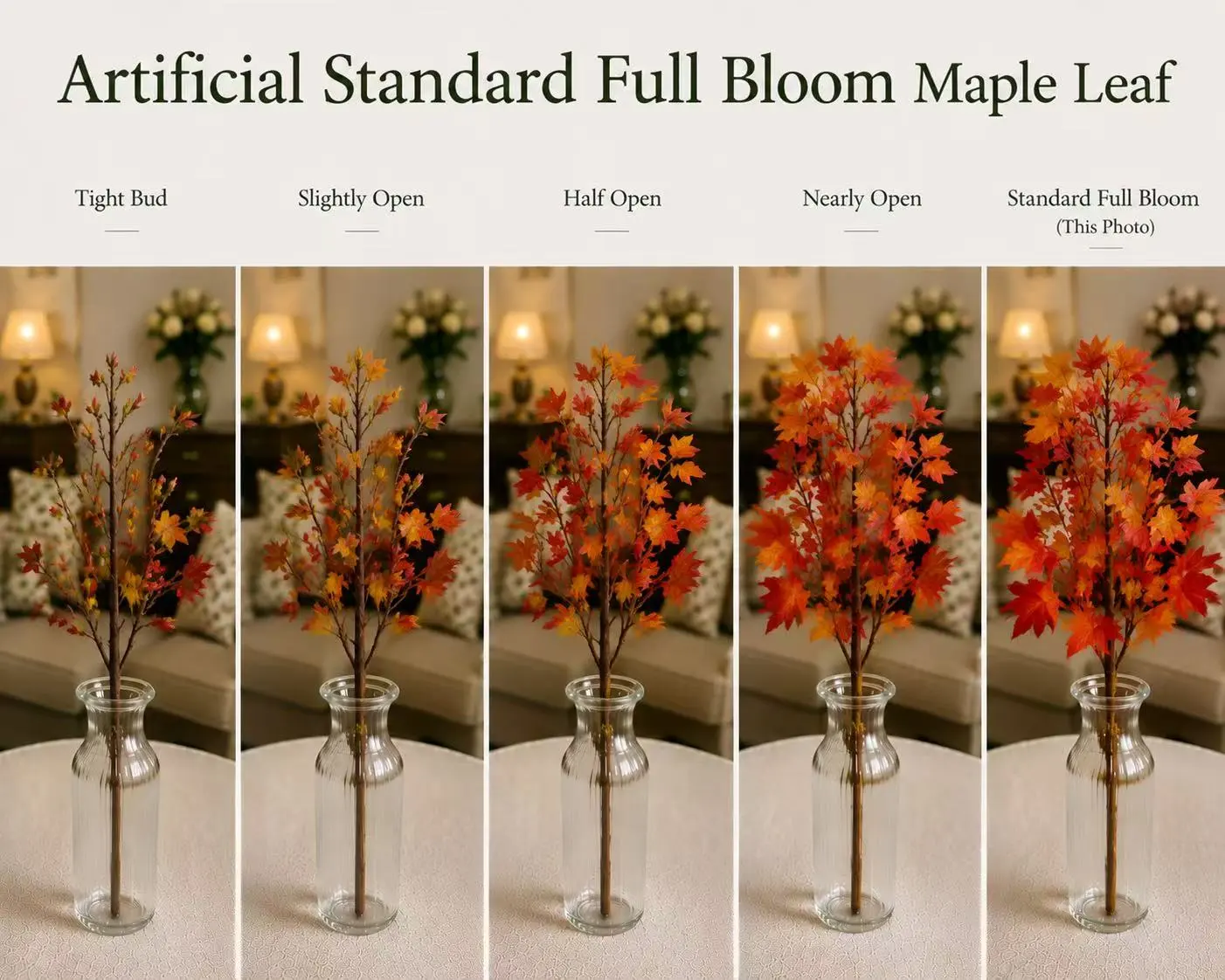
The phrase "standard full bloom" refers to specific quality standards, not just any fake plants. The leaves on these Artificial Standard Full Bloom Maple Leaves are fully spread out and have clear palmate outlines and distinct vein patterns that look like real maple trees. The leaves are about 5–6 cm across and are connected to stems that are 25–30 cm long. The construction uses fake silk cloth that has been shaped with light glue. This gives the finished product a tactile quality that sets it apart from cheaper plastic options.
The color scheme is mostly made up of warm fall colors like red, orange, and yellow, which are carefully graduated to look like the natural change in color that happens during senescence. By paying close attention to color details, installations look more like real plants than obviously man-made ones. This is a very important difference for high-end commercial settings where how people see a brand rests on the quality of the surroundings.
Core Benefits for Commercial Applications
Eliminating maintenance is the most obvious way to save money. These plant parts don't need to be watered, fertilized, or pruned during certain times of the year, so they don't incur ongoing work costs after they are installed. When comparing costs on a large scale, the difference is especially clear: natural maples in a hotel atrium might need maintenance visits every week, which would cost thousands of dollars a year, while Artificial Standard Full Bloom Maple Leaves only need to be dusted every so often.
Durability is more than just lasting a long time. When properly placed out of direct sunlight for long periods of time, the construction doesn't bend or break and stays moisture-proof. This stability is very important for businesses that work in climate-controlled spaces where plants don't do well or in areas with a lot of foot traffic where people will inevitably touch them by accident. Because these items don't have any smell or pollen, they are also good for your health and can be used in healthcare facilities, assisted living communities, and places where sensitive guests are welcome.
You can't say enough about how important environmental consistency is to how a brand looks. Because natural maple leaves change a lot depending on how they are grown, you can't be sure that the same color will show up in different places or during different replacement cycles. Artificial Standard Full Bloom Maple Leaf options have a similar look that helps brands stay consistent across franchises, hotel chains, or retail networks where visual consistency helps customers recognize brands.
Comparing Artificial Full Bloom Maple Leaf Alternatives: Making Informed Procurement Decisions
Comparative analysis is an important part of a good buying strategy because the materials you choose have a direct effect on both the original investment and the long-term value. By knowing the differences between the choices that are out there, decision-makers can match the product's features to the needs of the application and the budget. An Artificial Standard Full Bloom Maple Leaf made with quality materials ensures better performance.
Material Quality and Its Impact on Longevity
Artificial foliage made of silk, like the fake silk fabric used to make Artificial Standard Full Bloom Maple Leaves, has better texture and light interaction than rigid plastic options. The fabric absorbs and reflects light as real leaf tissue does. This gives the fabric depth and reality that plastic surfaces can't match. This optical quality is very important in high-end settings where close viewing distances show that lower-quality products have serious flaws.
Plastic versions usually cost less at first, but their colors tend to change after 12 to 18 months of being displayed indoors, especially in places with bright store lighting. The breakdown of the polymer that causes this fading also makes it delicate, which makes it more likely to break when cleaning or touching it by mistake. When you look at the full cost of ownership, which includes how often you have to replace the product and how much it costs to put it back together, the extra cost for silk-based items usually goes away completely after three years of planning.
Real foliage that has been preserved is another type that is sometimes thought about for permanent installations. While real leaves don't need to be kept at a certain humidity level, preserved leaves do. They are also still susceptible to bug damage in some areas and lose their color over time. Maintenance needs and replacement cycles make preserved botanicals more like fresh material in terms of total cost of ownership than real permanent alternatives.
Evaluating Supplier Capabilities and Pricing Structure
Professionals in procurement should look at possible providers in more than one way, not just by price per unit. The quality of bulk orders stays the same depends on how consistently they are made, which is very important when filling multiple sites or finishing big projects. Suppliers who have written down quality control procedures, such as color matching protocols and tensile strength tests, show that they have what it takes to build trusting business relationships.
The ability to customize adds strategic value that general supplies can't. Changes in color ratios, branch arrangements, or leaf densities make it possible to create custom solutions that support a brand's visual identity. Private labeling services help businesses market their own lines of goods, and made-to-order options meet the unique size needs of a project that standard products can't.
When there are yearly peaks or project deadlines, lead time dependability is very important. Costly installation delays are less likely to happen when suppliers make their production schedules clear and have a history of on-time deliveries. Shipping operations and clearing customs become more complicated when you buy things from other countries. Suppliers who have experience with doing business across borders are a great way to tell possible partners apart.
How to Incorporate Artificial Full Bloom Maple Leaves into Year-Round Botanical Spaces
When quality botanical elements are strategically put into place, they go from being just decorations to being useful design elements that improve the brand experience and operational efficiency. Different business sectors have very different application tactics because each one offers its own possibilities and practical issues for the Artificial Standard Full Bloom Maple Leaf.
Retail and Commercial Display Strategies
Landscape installations in shopping malls benefit from the visual warmth that autumn foliage provides. This creates a seasonal atmosphere that makes people more likely to browse and stay longer. Unlike natural installations that need fences to keep people safe and rules for cleaning up fallen leaves, Artificial Standard Full Bloom Maple Leaves can be put right into busy paths without any problems. The dustproof surface treatment makes maintenance easier in places where air circulation systems move dust around, since the surface only needs to be cleaned with compressed air every once in a while instead of being washed by hand.
Biophilic design principles—the psychological need for connection to nature—are becoming more and more recognized in corporate office settings as factors that affect employee happiness and productivity. Installing Artificial Standard Full Bloom Maple Leaves in common areas, meeting rooms, and greeting areas gives this benefit without the problems that live plants cause with building management. Since they don't need water, there are no overflow risks near electronics and furniture, and because they are static, they don't get pest problems like soil-based plants do.
Hospitality and Event Application Techniques
Installations in hotel lobby areas make arrivals unique and can change how guests feel and what they share on social media. You can get the effect you want by putting Artificial Standard Full Bloom Maple Leaves in large vessels or building them into architectural details. The branches will look the same in morning, afternoon, and evening lighting. The color stability is especially useful in rooms with a lot of glass, since natural plants would quickly turn yellow in direct sunlight.
Permanent plants are useful for weddings and events because they can be used in a variety of ways. Decorators can plan, build, and take pictures of works weeks before an event without worrying about damage, which makes complicated production plans easier to follow. The fact that they can be used for more than one event changes the economics of rental inventory. Event companies can spread out their initial investment over dozens of bookings while keeping the perfect look that fresh flowers can't.
Maintenance Guidelines for Extended Performance
The long-lasting benefits of these products can be fully realized with the right care instructions. Regular dusting with soft microfiber cloths or low-pressure air gets rid of accumulated dust without hurting the tips of delicate leaves or breaking down adhesive bonds. When storing, keep the plants away from damp places, because long-term exposure to moisture can damage the light glue that keeps the leaves' shape. Strong pulling or too much handling can stress attachment points, which could cause leaves to fall off too soon.
Keeping colors out of direct sunlight makes them last longer. Even though these items have pigments that won't fade, long-term exposure to UV light will cause the colors to change. If you put installations away from unfiltered southern exposures or use window treatments that block UV rays, you can protect your investment in places with a lot of natural light. The balance estimate depends on the specifics of the space—short morning sun usually doesn't pose much of a risk, but afternoon western exposure should be avoided.
Procurement Guide: How to Buy Artificial Standard Full Bloom Maple Leaves for Your Business
To find the right seller, you need to carefully look at both the product specs and the vendor's skills. Structured procurement processes lower risk and improve results for both one-time orders and long-term relationships with suppliers of the Artificial Standard Full Bloom Maple Leaf.
Supplier Evaluation Criteria
Documentation for quality assurance is objective proof of manufacturing standards. Look for suppliers who can give you certifications about the materials they use, test results for colorfastness, and construction details like wire gauge, fabric weight, and adhesive properties. Some business jobs require fire safety certifications. This is especially true in healthcare and hospitality areas where tight flammability rules are required by building codes.
How well suppliers can meet your business's needs depends on how much they can produce. Small workshops might have good prices on first orders, but they don't have the tools to handle higher volumes or tighter deadlines during busy times. On the other hand, big makers offer security and scalability, but they might have minimum order amounts that are too high for small businesses or pilot projects. When you match the size of the seller to your buying profile, you avoid a mismatch that leads to operational friction.
Specification Matching for Application Success
Dimensional factors have a direct effect on how the work turns out and how it looks. Branch length determines how far apart trees need to be and how much space each one covers, which affects both the cost of materials and the cost of work for installation. The number of branches needed to get the desired level of opacity is affected by the leaf diameter and density. Specification mismatches can be avoided by asking for samples with measurements that match your specific application, whether it's a tabletop arrangement, an architectural installation, or a display that hangs from the ceiling.
Color selection goes beyond simple taste to strategic alignment with brand standards and spatial characteristics. Warm reds make places feel lively and friendly, which is good for shopping and hospitality. Orange and yellow tones, on the other hand, make places feel calmer and more reflective, which is good for healthcare and business settings. Mixed-color branches add to the reality of the design by showing natural variation, while single-color choices support design ideas that need precise control.
Streamlining Custom Orders and International Shipping
The first step in the customization process is making sure that all of the needs are understood. This can be done by giving clear instructions, reference images, or physical samples. Prototyping stages let you make changes before committing to full production runs. This is especially helpful for one-of-a-kind uses or design ideas that haven't been tried yet. Private labeling services help companies that are reselling goods or making their own home decor lines build their brand value. However, they usually require a minimum order quantity to cover setup costs.
When you buy something internationally, you have to think about more things, like how to ship it, what paperwork you need for customs, and how you will pay. Expert Artificial Standard Full Bloom Maple Leaf suppliers can help you figure out the best way to ship your items so that they arrive quickly and cheaply. They can also handle the export paperwork to avoid delays at customs and offer flexible payment plans that protect both parties through milestones. Setting these clear limits during the first talks stops confusion that puts a strain on business relationships.
Industry Trends and Future Outlook of Artificial Maple Leaf Decor
As society's ideas about sustainability, customization, and online shopping continue to change, so does the market for botanical replicas. Knowing these paths helps procurement workers spot chances and change their sourcing strategies to match new best practices for the Artificial Standard Full Bloom Maple Leaf.
Sustainability and Material Innovation
People who care about the environment want goods that use fewer resources and produce less waste than other options. Artificial greenery gets rid of the water, fertilizers, and chemicals that are needed to grow cut flowers, as well as the pollution that comes from transporting them over and over again. Because the product lasts a long time, it takes up less space in landfills than single-use holiday decorations. However, finding ways to recycle these products at the end of their useful lives is still an area where material science can improve.
Bio-based polymers and natural fiber materials that keep their performance while having better environmental ratings are at the center of manufacturing innovation. Materials in their early stages show potential, but they are too expensive for most people to buy right now. As production volumes grow and material science advances, these choices will probably stop being unique and start being standard. This is especially true as companies make promises to be more environmentally friendly, which makes buyers want to buy products that are better for the environment.
Customization as a Way to Stand Out in the Market
Customized environmental design that makes the customer experience different is becoming more and more important for brands to stand out. Off-the-shelf botanical goods meet basic needs, but they can't give you the unique look that only custom specs can give you. Customized Artificial Standard Full Bloom Maple Leaves in brand-specific color schemes, unique arrangements, or built-in architectural features create a unique design language that rivals find hard to copy.
Technology that allows adaptation makes it easier for more people to do so. Digital design tools let customers see how custom configurations will look before they are made. This cuts down on the number of changes that need to be made and spelling mistakes in the specifications. Three-dimensional rendering helps people on different decision-making teams evaluate proposals. This is especially helpful in franchises or corporate real estate portfolios where standardization and customization need to be carefully balanced.
Digital Transformation in B2B Botanical Procurement
E-commerce sites designed for business buyers make the sourcing process easier. Previously, it took a lot of phone calls and sending samples. Detailed product photos, specification sheets, and application galleries make it possible to quickly evaluate and narrow down the options before calling sales reps. Digitally ordering samples speeds up the evaluation phase, but in high-end applications, tactile testing is still necessary for final material approval.
Supply chain transparency tools let you see how production is going, how shipping is going, and what material is available. This helps you plan better and feel less unsure. These skills come in very handy for project-based buying, where installation schedules make things very difficult, and delays affect a lot of different trades. When suppliers buy these technologies, it shows that they want to improve their operations, which is usually a sign of higher quality and service standards.
Conclusion
Artificial plant elements have grown from simple replacements to complex design elements that add beauty, improve efficiency, and make money in a wide range of business settings. The Artificial Standard Full Bloom Maple Leaf is a great example of this change because it combines fine craftsmanship with long-lasting usefulness to meet the needs of many different industries. By looking at material quality, supplier skills, and application needs, strategic procurement turns these goods into long-term investments instead of temporary decorations, which completely changes the economics of environmental design.
FAQ
What maintenance does artificial maple foliage require in commercial environments?
Regular upkeep includes wiping down with soft cloths or low-pressure compressed air to remove dust, usually once a month in normal conditions or more often in places with a lot of dust. Don't use liquid cleaners because they can damage adhesive ties or cloth treatments. Storage should be done in a dry place that isn't too hot, and installations should be placed so that they don't get too much direct sunlight, especially raw western or southern light that makes color change faster over time.
How do I determine the quantity needed for specific installations?
Coverage calculations are based on the viewing angle and the visual density that is wanted. Spacing needs are based on the number of leaves per stem and the length of the branches. By asking for samples, you can test them physically in real installation sites, which gives you a better idea of how much you need. Suppliers who have worked on similar projects before can make suggestions based on those projects. However, factors unique to the site, such as ceiling height, lighting, and building features, can affect the best density. Ordering 10–15% more than you need allows for installation changes and gives you extras in case you need to fix something in the future.
Can artificial maple leaves meet fire safety requirements for commercial buildings?
Products of high quality are made with materials or processes that are naturally fire-resistant and meet international safety standards. Make sure that providers give you the licensing paperwork that is needed in your area, such as NFPA 701 in North America, BS5852 in the UK, or standards that are similar in other places. Instead of suppliers certifying themselves, documentation should come from testing labs that are recognized by the government. This paperwork might be needed by building inspectors and insurance companies, so it should be planned for during the procurement process instead of being added on at the last minute.
Partner with Cloud Floral Art for Premium Artificial Maple Solutions
Cloud Floral Art is an expert at creating incredibly realistic floral designs that meet the strict requirements of business and leisure settings. Our Artificial Standard Full Bloom Maple Leaf collection shows how dedicated we are to making the best products possible. It combines realistic palmate details with strong construction that can handle harsh conditions. As a maker and provider with a lot of experience, we help procurement teams by offering customization services, reliable production schedules, and quality assurance paperwork that makes the process of meeting specifications and regulations easier. Our team has the skills and products to make your ideas come to life, whether you're decorating a small hotel, making window displays for stores, or managing business real estate portfolios. Get in touch with us at guoh91278@gmail.com to talk about your project needs and find out how our fake maple leaves can add year-round botanical beauty to your spaces. You can look at our whole line of products at cloudfloralart.com and see why designers from all over the world trust us with their most important projects.
References
1. Chen, L., & Morrison, T. (2021). Biophilic Design in Commercial Interiors: Psychological Impacts and Implementation Strategies. Journal of Environmental Design, 45(3), 112-128.
2. Davidson, R. (2020). Sustainable Materials in Hospitality Design: Lifecycle Analysis of Decorative Elements. International Hospitality Management Review, 18(2), 67-83.
3. Harper, J., & Willis, M. (2022). Procurement Best Practices for Commercial Decorative Products: Quality Standards and Supplier Evaluation. Business Operations Quarterly, 34(4), 201-217.
4. Peters, K. (2019). Artificial Botanicals in Retail Environments: Consumer Perception and Brand Impact Studies. Retail Design Journal, 29(1), 44-59.
5. Thompson, A., & Zhang, W. (2023). Material Innovation in Textile-Based Decorative Products: Emerging Technologies and Market Trends. Textile Science and Engineering, 52(2), 89-105.
6. Williams, S. (2021). Commercial Landscape Design: Maintenance Cost Comparison of Natural Versus Artificial Botanical Elements. Facilities Management Today, 27(3), 134-150.
Online Message