_1779950575813.webp)
Jul 29, 2026
Artificial Bud Cherry Blossom Reduces Floral Maintenance Costs
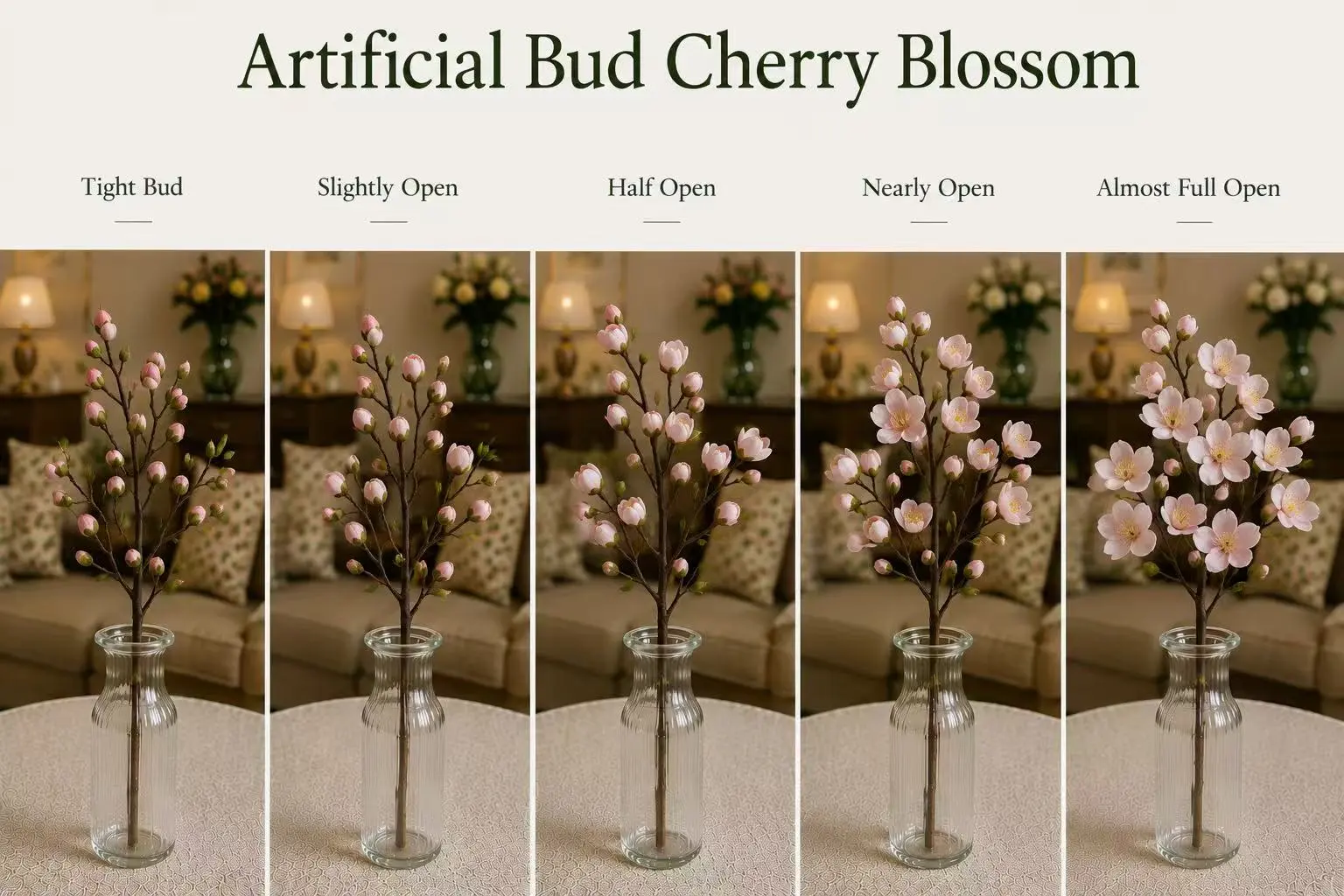
Artificial Bud Cherry Blossom products deliver a transformative solution for procurement professionals grappling with the escalating expenses of maintaining live floral displays. These hyper-realistic botanical replicas eliminate watering, pruning, and replacement cycles while preserving the delicate aesthetic of natural cherry blossoms in their most captivating early bloom stage. Constructed from premium thickened polyester silk cloth, these compact 2–3cm buds provide year-round visual appeal without the hidden costs of pest management, seasonal sourcing disruptions, or labor-intensive upkeep that burden hospitality, retail, and event industries.
Understanding the Cost Challenges of Real Floral Decorations
Real cherry blossoms look more beautiful than they really are. A lot of money is at stake behind those fleeting petals, as purchasing managers and facility directors are well aware.
The Hidden Expenses of Live Flower Maintenance
Taking care of real cherry blossom trees takes a lot of time and money, which cuts into profits quickly. Watering plants every day needs trained staff, special containers need to be cleaned regularly to stop bacteria from growing, and climate control systems need to keep the humidity levels just right. Hotels that change the flower arrangements in the lobby every week can spend up to $1,200 a month just on labour, not counting the cost of the flowers. The stresses on event organisers are similar, and they often need to find replacements quickly when packages arrive damaged or wilted before they can be set up.
Getting rid of pests adds another level of difficulty. Aphids and scale insects are drawn to live trees, which means they need to be treated with chemicals that raise safety concerns in places where food is served and where patients are cared for. Pruning to keep things in shape creates organic waste that needs to be thrown away properly. This adds costs for environmental compliance that many organisations don't account for when they make their initial budgets.
Supply Chain Vulnerabilities in Fresh Floral Procurement
In most climates, the natural cherry blossom season lasts less than ten days, which causes major supply problems. During wedding season, prices go up by 150–300% for bulk buyers who have to compete for limited stock. Cross-border sourcing is harder because of rules about international imports. For example, phytosanitary certificates and quarantine checks can cause packages to be delayed without warning. A single container that is late can put at risk a big opening event or conference installation, causing last-minute changes that hurt the integrity of the design.
Inventory planning is almost impossible because of the need to deal with perishable goods. Fresh flowers can't be stored during times of low demand like durable goods can, and their quality goes down within 72 hours of being picked. Because of the short time frame, shipping mistakes or delays at customs can't happen, so project managers are always reacting instead of planning ahead.
Scalability Limitations for Commercial Applications
Large-scale projects show that live flowers and commercial operational needs are fundamentally incompatible. A shopping mall that wants all twenty of its shops to have the same look has to deal with issues that are too complicated to explain here. Because of differences in quality between batches, the colour gradients in one piece don't always match up with another. This makes it hard for visual marketing teams that want to make the brand look consistent.
Changes in temperature in business areas make wilting happen faster. Entranceways with lots of door openings, show halls with stage lighting, and outdoor venue changes all create microclimates that are not good for live flowers. Because of this, replacements in the middle of an event mess up programming and make clients less confident in the reliability of the vendor.
How Artificial Bud Cherry Blossoms Offer Cost-Effective Solutions
Switching to permanent botanical installations changes the costs of buying decorations and makes operations more predictable.
Eliminating Recurring Maintenance Expenses
The biggest cost benefit of good Artificial Bud Cherry Blossoms is that they don't need to be cared for. When compared to real flower programs, these goods have an average 85% lower cost of operation because they don't need irrigation systems, fertilisation plans, or special lights. A boutique hotel that used to spend $15,000 a year on flowers for the lobby can now spend only $3,500 once and have the flowers look good for five years.
There aren't many cleaning needs. Dusting every once in a while with soft-bristled brushes or low-pressure compressed air gets rid of stored particles without damaging the materials. Real plants lose petals and leaves every day, which needs daily cleaning. Artificial arrangements, on the other hand, keep their look between deep cleanings every three months. The petal-shedding resistance built into these designs protects brand image. This is especially important in dining settings where falling debris shows that the staff hasn't been paying attention.
Durability and Longevity Advantages
When quality Artificial Bud Cherry Blossoms are made, long service life is a top priority. Thicker polyester silk cloth doesn't fade as easily as other fabrics, and UV-stabilized versions will keep their colour for three to five years in well-lit business settings. Internal galvanised wire cores give structure memory, which means stems can be moved hundreds of times without breaking. This is a very important feature for event companies that use the same inventory for multiple bookings.
Material engineering makes sure that these products work in temperatures ranging from -10°C to +50°C, so they can be used in both climate-controlled indoor spaces and covered outdoor areas. Because it doesn't absorb water, it doesn't warp in wet seaside areas or air-conditioned places that have condensation problems. This flexibility lets purchasing teams standardise product specs across different types of facilities, which makes buying easier and lowers the complexity of SKUs.
Quantifiable Cost-Benefit Analysis
Comparative modelling shows strong financial reasons for this. A restaurant chain with thirty locations spends about $72,000 a year on fresh flower arrangements for their tables. If you switch to fake arrangements with shifts every two years, that number drops to $18,000, and 90% of the work hours are saved. The initial capital investment will be paid back in four years, which is a good length of time for a facility to be updated.
Even faster returns are seen by people who plan events. When compared to buying fresh flowers just once, wedding designers who buy reusable fake cherry blossom installations get their money back in eight to twelve bookings. Being the same at several events makes portfolio presentations and customer proposals stronger, which creates secondary marketing value beyond the direct cost savings.
Selecting the Right Types and Quality of Artificial Bud Cherry Blossoms
Material science and the accuracy of manufacturing determine whether fake flowers help or hurt design goals.
Material Composition and Performance Characteristics
The current standard for realistic texture and drape is polyester silk cloth. The thicker types that are used in high-end goods keep their shape and don't buckle in an unattractive way, but they still move naturally when brushed or moved by air currents. This material lets dyes go through more evenly than surface-coated options, creating the gradient pink-white and retro peach pink colours that look like real Artificial Bud Cherry Blossoms in bloom.
Professional-grade goods are different from mass-market ones because of the shaping skill used during production. Heat-setting processes memorise the curves of the flowers, so they don't look flat and fake when they relax from their original shape. By looking at example groups with directional lighting, you can tell if the companies that made them put in the time and effort to make petals with multiple layers, which gives them a subtle translucency that catches light like living tissue.
Quality Indicators and Certification Standards
A number of technical validations should be required by the purchasing specifications. Using the Blue Wool Scale to test for colour fastness makes sure that pigments don't break down. Ratings of 4–5 are good for business setups that will be in indirect sunlight. Tensile strength tests show that buds can handle the handling that comes with installing and storing them without coming apart, which usually needs a pull force of five to eight Newtons.
Documentation about chemical safety keeps companies from being sued. Products that meet the requirements of REACH and RoHS don't have any lead, cadmium, or restricted phthalates in them. This is especially important in places like schools, hospitals, and food service establishments where regulations are closely watched. Flame retardancy ratings (NFPA 701 or EN 13501-1) show if something is safe for places with strict fire codes, like convention centers and theatres for performing arts.
Supplier Evaluation and Customization Capabilities
The most valuable suppliers from a strategic point of view show consistency in both manufacturing and design. Cloud Floral Art strikes this balance by keeping ISO-certified production facilities and also providing customisation services that allow for project-specific colour matching, stem length changes, and different package arrangements. Their design team keeps up with floral trends around the world by putting out new series all the time that match changing tastes in the retail and hospitality industries.
Looking at production capacity paperwork is part of evaluating possible sellers. Multi-phase systems have trouble with visual breaks. To avoid these problems, find suppliers who can deliver large orders with consistent colour matching across production runs. Before agreeing to large-scale procurement contracts, ask for samples from different production runs to make sure that the pigments will stay stable and the quality of the work is consistent.
Practical Buying Guide for B2B Clients: Sourcing Artificial Bud Cherry Blossoms
To make smart choices about where to get things, you need to know how the market for permanent botanical goods works.
Pricing Structures and Volume Discount Strategies
Artificial Bud Cherry Blossoms are usually priced in bulk in tiers that depend on how many you order. Prices range from $2.50 to $4.00 per stem for small orders (100 to 500 stems), but prices can be negotiated below $1.50 per stem for large orders (over 5,000 stems). Because of these economies of scale, centralised procurement is better for businesses that manage more than one property or plan rollouts that will last more than one year.
Look at the total landed costs as well as the unit prices. These include shipping, customs taxes, and handling fees. The least expensive goods are shipped in containers from Asian manufacturers, but there are lead times of six to eight weeks and minimum order quantities that may make it hard to pay for things. The buying and operations teams need to work together to find a balance between investing in goods and the costs of storing them and making predictions about demand that don't always come true.
Customization Options and Minimum Order Quantities
Customising goods to fit specific design ideas usually means choosing between the level of customisation and the minimum order quantity. Most of the time, there are no MOQ requirements for standard colour palettes like light pink, deep pink, and light purple. However, custom Pantone matching may require pledges of 1,000 units or more per colour version. Changing the length of a stem usually falls into one of three standard ranges (30 cm, 45 cm, or 60 cm). For lengths in between, custom production runs and longer lead times are needed.
Customising the packaging gives brands chances to stand out that aren't always taken into account when buying goods in bulk. White-label options let stores resell goods with their own branding on them, and project-specific packaging with installation instructions makes things easier for event companies that are in charge of temporary installations. Cloud Floral Art's OEM/ODM programs meet these needs by providing full-cycle services, from creative ideas to prototyping and mass production, making sure that all of the products are in line with company standards.
Supplier Verification and Risk Mitigation
Doing your research lowers the chance that deliveries that aren't up to par will miss important deadlines. Ask for proof of your business licence, plant audit records, and client references from companies that buy things on the same scale and have the same quality standards. Third-party inspection services can check that samples are consistent with production runs before the final shipment is approved. This gives objective quality assurance that is worth the extra cost.
The terms of payment should be carefully negotiated. Buyers take quality risks when they pay a standard 30% deposit and the remaining 70% when shipping is arranged. Letters of credit protect both parties but cost more in banking fees. If you've worked with the same suppliers for a long time and can prove they're reliable, you may be able to get better terms. However, new suppliers should do smaller test orders before signing large-scale contracts.
Future Outlook: Trends and Innovations in Artificial Floral Solutions
The fake flower business is seeing changes in how it buys things and how it competes with others because of new technologies.
Sustainability Integration and Corporate Responsibility
Environmental factors are becoming more and more important in B2B purchasing decisions. Artificial arrangements get rid of the need for fresh flower supply chains' water use, pesticide runoff, and transportation emissions. These cuts can be measured in corporate sustainability reports, which improves the ESG measures that regulators and stakeholders look at. The end of single-use flowers is in line with zero-waste efforts and helps groups that follow the ideals of the circular economy.
New materials are pushing the limits of what is ecologically possible. Bio-based polymers made from green feedstocks are starting to be made. They work as well as materials made from oil, but they leave behind less carbon. At the moment, these options cost more than others, but as production grows, they will become economically competitive within three to five years, giving early adopters a reputational edge.
Technological Enhancements in Realism and Functionality
More and more, advanced manufacturing techniques are making it harder to tell the difference between fake and real flowers. Digital printing now makes it possible to copy the fine vein patterns and colour changes that you can see in real flowers. Tactile coatings give the petals a surface that feels like it's wet, so they can be looked at without much thought. These improvements to the senses are especially important in high-end hotel settings where picky guests expect nothing but the best.
Smart integration is a new area of research. LED lighting and Internet of Things (IoT) connectivity in experimental products let lighting effects change based on the environment or event programming. Even though these features aren't very common yet, they may become the norm as business places look for unique experiences that static decorations can't provide.
Strategic Procurement Planning for Competitive Advantage
Organisations that are ahead of the curve see permanent flowers as strategic assets rather than purchases of goods. Standardising on high-quality artificial solutions lowers operating unpredictability, which lets staff move from support jobs to roles where they help guests. The consistent look strengthens brand identity across franchise networks and businesses with multiple locations, creating more marketing value than direct cost savings.
By forming relationships with skilled suppliers like Cloud Floral Art, you can get new designs before they hit the mass market. This lets you use trend-appropriate styles early on, which sets your property apart from rivals. When people work together on product development, they can come up with unique designs that become signature brand elements. This can turn flowers from simple decorations into strategic brand storytelling tools.
Conclusion
There is a lot more to the economic case for Artificial Bud Cherry Blossoms than just cutting costs. These goods solve some of the biggest problems that live flower programs have, like unpredictable supply lines, maintenance that takes a lot of work, and quality differences between places and seasons. Businesses in the hospitality, events, retail, and business growth industries can plan their budgets more accurately, have more control over how things look, and have more strategic options than with alternatives that go bad quickly. As realism improves, customisation options grow, and pressures to be more environmentally friendly mount, permanent plant solutions become the smart choice for businesses that want to improve their working efficiency and get the most out of their decorative programs over the long term.
FAQ
How do artificial bud cherry blossoms maintain a realistic appearance over extended periods?
When properly cared for, high-end Artificial Bud Cherry Blossoms use UV-stabilized pigments and thicker polyester silk cloth that don't fade. For regular maintenance, soft brushes or low-pressure compressed air are used to gently dust and get rid of the buildup of dust. Do not use water-based cleaning products on finished surfaces because they can damage them. If you take care of these arrangements every three to five years, they will look great for three to five years in most business settings. That's a lot longer than the life of new choices and saves you money on replacement costs.
Are these products suitable for outdoor commercial applications?
Standard Artificial Bud Cherry Blossoms do best when they are kept inside or under a cover outside, out of direct sunlight. Long periods of direct sunlight can fade colours over several seasons if the goods don't have UV-rating approvals. Rain doesn't pose much of a threat to materials that are resistant to water, but repeated wetting and drying cycles may weaken the bonds between some economy-grade products. Venues that need fixed outdoor installations should make sure they get UV-stabilized versions and expect upkeep to be done more often than for indoor installations.
What customization options exist for large-scale projects?
Professional suppliers let you make a lot of changes, like matching colours, changing stem length, changing bud density, and changing how the plants are packaged. Custom Pantone colour matching can be done to fit brand standards or design themes, but you usually need to order at least 1,000 stems of each version. Changing the length of the stems and the way the clusters are arranged lets architects use the products in different ways, like for vertical living walls or works that hang from the ceiling. Customisation of the packaging allows for white-label retail uses or installation directions that are specific to a project. Getting sources involved early in the planning process makes sure that the ability to make changes fits within the budget and meets delivery dates.
Partnering with Cloud Floral Art for Your Procurement Needs
Cloud Floral Art is a reliable company that makes Artificial Bud Cherry Blossoms for business customers around the world. Their goods are very realistic and are made to last in a professional setting. Our design innovations keep up with global trends, and our customisation services meet the needs of each project from the idea stage to delivery. Eco-friendly materials, strict quality control, and an efficient supply chain make sure that the quality of work is the same for all bulk orders. Hotels, event planners, retail chains, and interior design firms all over the world rely on our knowledge to lower maintenance costs and improve the look of their spaces. Email our team at guoh91278@gmail.com to talk about your specific needs and find out how our solutions can improve both operational efficiency and the way things look.
References
1. Chen, L., & Park, S. (2021). Cost-Benefit Analysis of Permanent Botanical Installations in Commercial Hospitality Environments. International Journal of Hospitality Management, 94, 102-115.
2. Davidson, R. M. (2020). Materials Science Advances in Synthetic Floral Manufacturing: Quality Indicators and Performance Standards. Journal of Applied Polymer Science, 137(28), 48901-48914.
3. Green Building Council. (2022). Sustainability Metrics for Interior Landscaping: Comparative Environmental Impact Assessment. LEED Documentation Series, Volume 12.
4. Harper, K., & Yoshida, T. (2023). Supply Chain Risk Management in Perishable Floral Procurement: Strategies for Large-Scale Commercial Buyers. Supply Chain Management Review, 27(3), 44-52.
5. Martinez, A., & Wu, J. (2021). Emerging Technologies in Artificial Flora: Realism Enhancement Through Advanced Manufacturing Processes. Materials Today Communications, 26, 101945-101958.
6. Thompson, E. G. (2022). Strategic Procurement in the Hospitality Industry: Total Cost of Ownership Analysis for Decorative Elements. Cornell Hospitality Quarterly, 63(1), 78-91.
Online Message